
You Can Make $50,000 To $100,000 Working In Restaurants And Bars
More people probably should follow this — yes — career path
In a recent conversation, a friend said:
My son is 18 and a freshman in college. He’s always had an instinct for working “just enough.” Not in a lazy, half-assed way, but in a work smarter not harder way.
When he got a job, he found one where he earns tips, so $18/hr becomes $50-$70/hr, and he only works the shifts and locations that make his commute worthwhile. He works 1–2 days a week, spends very little money, and has saved $10k in just a couple years. He’s definitely on a work less now so you can work less longer track.
I’ve wondered if this is mostly just him, or if his generation is generally more chill. I’ve seen internet memes about GenZ not checking their work emails on the weekend, so it makes me think his mindset is shared more broadly.
As somebody who — by choice — spent a few years working in the hospitality industry prior to the pandemic, this resonated with me. And, also because, I live by the motto of work less now so you can work less longer.
So I responded to her with this:
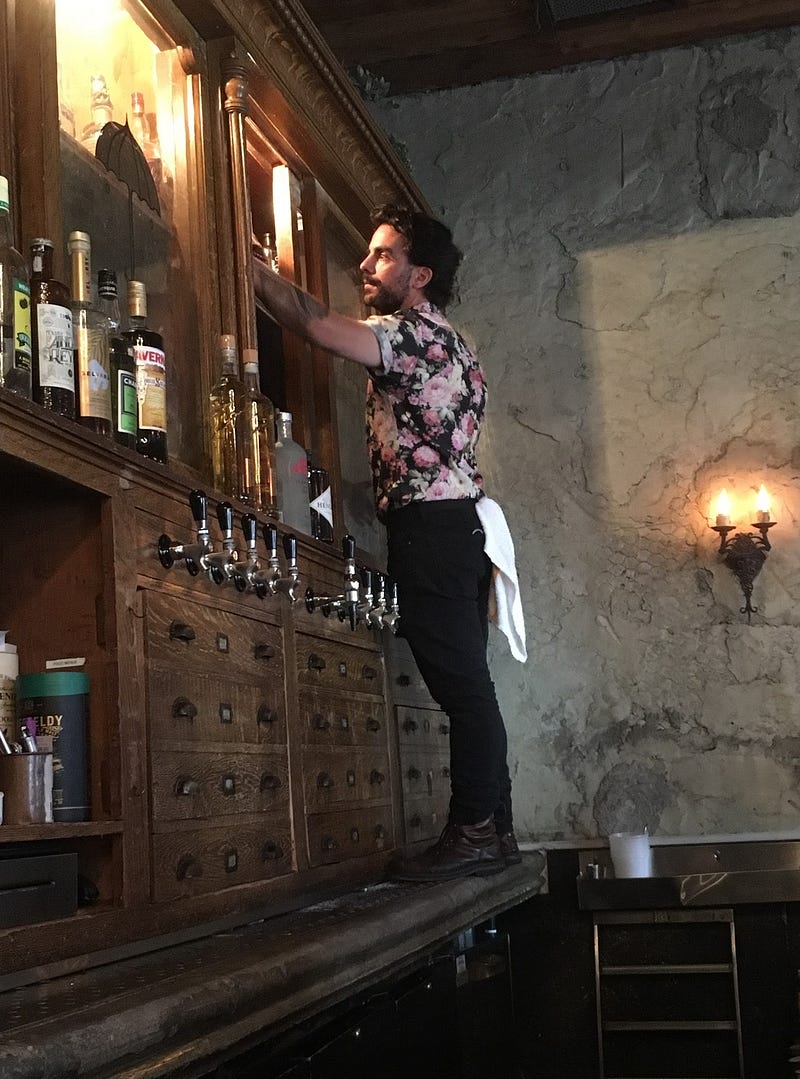
Find the right restaurant or bar and there’s no reason why you can’t work 3–5 shifts a week and earn upwards of $60,000 a year. To say you can get into the six figures working a handful of dinner or night shifts a week isn’t unrealistic. I managed a busy — but not the busiest — bar and saw it. People walking away with their hourly wage, credit card tips and cash totaling $300, $400, even $500 in one night …
If he wanted to continue working in hospitality — even for the rest of his life — would this be a problem?
In our society — yes, absolutely — this would be a problem.
The person who chooses to make a career in hospitality — and doesn’t rise to the status of accomplished chef or beverage industry equivalent — gets branded everything from loser to underachiever.
This fucked up, outdated way of thinking needs to change.
In this article, I explain why.
But first, if you find the right job, you can make a good living behind the bar or as a server at an expensive, well-established and/or high-volume establishment. Especially in California.
Take your hourly wage, add in tips and, yes, you can regularly make between $100–$150 on the low end and $300-$500 on the high end, per shift. There’s a reason why you run into the same bartenders and servers at the same bars and restaurants you frequent. From small diners to fine dining restaurants to dive and craft cocktail bars, there are people making relative bank in the hospitality industry.
At $300 per shift, just four shifts a week earns you $1,200 a week, $4,800 a month or $57,600 a year. Not bad. Get yourself into a gig where you have a loyal core of regulars and/or high prices and high volume and I just made a conservative calculation.
I know what you’re thinking.
- Doesn’t the person who does this have larger aspirations? Do they really enjoy getting shit on by demanding or otherwise rude customers? We’ll get to those two questions in a second.
- Good luck finding that type of sweet gig.
Well, yeah, I’m not saying you’re going to walk into any restaurant or bar and instantly pull in $60,000 or more. In fact, you’ll probably make much less.
But it’s sort of like writing. In this racket, a relatively small number of people make actual, if any money, let alone enough money to live and live well on. It takes time, but more than that, it requires savvy, strategy, a willingness to learn and be flexible, and a love for what you’re doing.
In other words, you need a good attitude.
If you have a good attitude and either come with or develop a love for providing superior hospitality (not service), the bars and restaurants where you can make the most money will want you. If you can show up on time and convince them that you won’t get (too) drunk on the job — as in, you’re reliable — the sky’s the limit at these establishments. They want professionals in a profession full of — admittedly — unreliable people who don’t consider bartending or serving a profession.
With the right attitude, you won’t get shit on — as much — by customers.
Call them guests, by the way.
Treat “customers” like guests. Like someone you want to make happy. Someone you want to show a good time. More often than not, you will get what you give.
When you take on this attitude behind the bar or on the floor, you immediately start making more money. Even in a not-so-busy bar or restaurant, you can do well because your above-average — or hopefully — above-and-beyond hospitality results in far better-than-average tips.
Establish yourself with a few regulars and you’ll regularly get tipped 50% to 100% of their tab. Add in some volume and that $300 number becomes easier to attain than you might think.
But why would anybody want to do this?
Because working in hospitality — in this type of situation — means you can work very little and make the same or more money as you might in a job where you have to put in a comparatively miserable 40-plus hours a week.
And even if you make less … that’s sort of the point. The days of lusting over money and material things are long gone. And this is a good thing. It’s high time to find a way to buck this trend and — somewhat ironically — make a living off of the majority who will continue to grind and over-consume.
As I told my friend:
Because — as I have lived, learned and settled on my presently evolving iteration of a semi-retired life — I argue there would be nothing wrong with an 18-year old today saying:
- I’m going to work as little as possible at a job where I can optimize my earnings in a short period of time over each week, month and year.
- While I actually can have more money saved than most people and even get rich over the long haul doing this, I’m wise to keep a low cost of living.
- I’m going to spend my ample, way above-average free time doing the things I like to do — now and for the duration.
- And, fuck you Mom and Dad (definitely not speaking specifically about Jen’s kid here!), this makes me no less of an adult.
It’s just society’s stigma around work that makes us logically and emotionally uncomfortable with that scenario.
Because it takes a smart, savvy, super capable and emotionally intelligent person to be able to create this type of situation for themselves.
To be able to buck the trend of overachieving and chasing the American dream and look people in the eye and say — yeah, I’m a mother fucking career bartender or server.
And I make good money.
Between what I make and my cost of living, I’m actually better off than the person who works more, earns more and keeps more overhead. It’s this person who effectively feeds me by paying $16 for a cocktail and tipping handsomely on top of it. It’s their right to want this and pay for it. And I’m more than happy — actually excited — to deliver an experience alongside their expensive consumption.
Plus I went fishing today. And the day before. And I’m going again tomorrow. And I’m going to do that — or whatever else the hell I want to do — for the rest of my life while you tend to your yard, busted water heater and piece of crap Tesla that won’t charge and work at a job and with people you hate.
Or whatever.
The bottom line — there’s a need for young people in this country to adopt simpler ways of life. They see the housing and retirement crises happening to the people who came before them. They see the downsides of the dying American dream.
And many of them don’t want any part of this tripe.
Not all will — or even should — craft cocktails or woo guests for a living. They’ll do other smart and refreshing things their parents will think are just as crazy. But large numbers should consider using a career — a career — in hospitality as a key element in carving out a soft and easy life.
To receive a notification each time I publish a Medium article, go here. You’ll get to see more of what I normally write about — personal finance for those of us who might never retire.
You can also subscribe to my Never Retire: Living The Semi-Retired Life newsletter where I chronicle my big decisions on lifestyle, housing and cost of living, which includes moving to Spain sooner rather than later.


