
How To Fix Your Housing Crisis, Even If You Don’t Think You’re In One
Because you can’t keep blaming it on government or the universe, focus on solutions

We have a tendency to play the waiting game on housing prices. We say we’ll wait to do this or that until rents or the cost of property comes down or interest rates decline.
But what if what we expect and anticipate never happens?
And, even if there’s some cooling off of this or that, will it really translate to significant change in your life or have a meaningful impact on your money?
Here’s the reality — large numbers of us face a housing crisis. Subsequently, we have big decisions to make.
We can:
- Ignore the reality.
- Take a risk by playing the waiting game.
- Externalize the problem, becoming keyboard activists who riff on injustice and blame everything from government to the universe.
- Brainstorm solutions.
Because the first three bullet points — especially the third one — annoy the hell out of me. And because I’m living this right mother freaking now, let’s make the choice to run with bullet point number four.
That said, it’s important to set the stage in addition to what we already know —
The median price of a house nationally is $440,000, as of July 2023. This is only $9,000 lower than the all-time high set in June 2022.
Let’s say you can put 10% down. That’s $44,000 up front, just for the down payment. At a 7% interest rate on a 30-year mortgage, you’re looking at a monthly payment of about $3,400, including property taxes and insurance. To afford this payment — using the don’t spend more than 30% of your income on housing standard — you need to earn roughly $11,333 a month, or approximately $136,000 a year.
Mind you, not even two weeks after I wrote that, things got worse. At last check, the going interest rate on a 30-year mortgage was 7.37%.
According to Black Night’s excellent Mortgage Monitor, home prices are at record highs in 60% of the nation’s biggest markets.
It’s another case of — as Bruce Springsteen wrote — winners and losers and don’t get caught on the wrong side of that line. Because this means increases in home equity for people in more favorable or all set housing situations and near, if not record low affordability for just about everybody else.
On the road to solutions — or why you might need to start thinking about solutions even if you don’t think you’re in a housing crisis — run the math on how much a few percentage points of a decline in rents or property prices would actually impact your life.
For most of us, even a real decline (that we’re just not seeing, by the way) would not magically make housing more affordable — on the ground. We’re talking about rounding errors. And not the good kind of rounding errors in personal finance. (I ask for your technical leeway on my use of the term rounding error. I have a newsletter post and Medium article in the hopper to clarify!).
However, you can create meaningful rounding errors in your own life, even if you don’t want to move.
Because part of the problem here is that people either —
- Don’t feel like they should have to move.
- Or they don’t want to move because of family, friends, attachment to a house or apartment, work, quality of life perception or reality.
I get all of this. Plus, moving, in and of itself, can be expensive.
Even at this juncture, you need solutions.
Solutions require sacrifices. Or, put in a way I prefer, a healthy change in mindset and expectations.
If I got rid of my car tomorrow, I’d save roughly $450 a month. Because I’m not in a dire situation and not having a car in Los Angeles would be inconvenient, I’m waiting to sell the piece of junk until right before my partner and I move to Spain. Hopefully, this will tack several thousand dollars onto our savings.
However, if I didn’t want to move across the world, I’d most likely go without a car (which is what I did between 1999 and 2012 or so) or buy a true beater with no payment and drive it as little as possible. I’d change my lifestyle — and become reaccustomed to being car-free — to lower my overall cost of living and offset my housing expense.
There are so many areas where we can save and not suffer, if we’re unwilling or unable to budge on housing.
However, if you are willing and able, you don’t have to move to a different country.
I’m always mind blown when watching House Hunters and House Hunters International. A majority of people on these shows — whether they’re looking to rent or buy — absolutely say they must have an extra bedroom for a home office. Sometimes two extra rooms if both ends of a couple work from home.
This is partially a pandemic thing, right?
I don’t get it. I work at the kitchen table and in my bed just fine. If I really wanted a dedicated office space, I could create one in an existing room of our one-bedroom apartment. Bu there’s no need.
People on these shows do likewise with parking. Everyone needs a freaking parking space.
The amount of money you save by simply getting the number of bedrooms you actually need and parking on the street is meaningful. Like hundreds and hundreds of dollars a month.
To this end, many of us need to lower our expectations. Watching people move to classic European cities in places like the Netherlands and France, asking for and expecting American amenities, size and space underscores our warped sense of what housing should be in this country. Now, it’s starting to catch up with us, given that the most basic dwellings have become unaffordable, even for people making decent or better money.
Embrace small spaces. Because they’re cheaper and less expensive to furnish and maintain.
I’m at an advantage because I am willing, able and actually want to move.
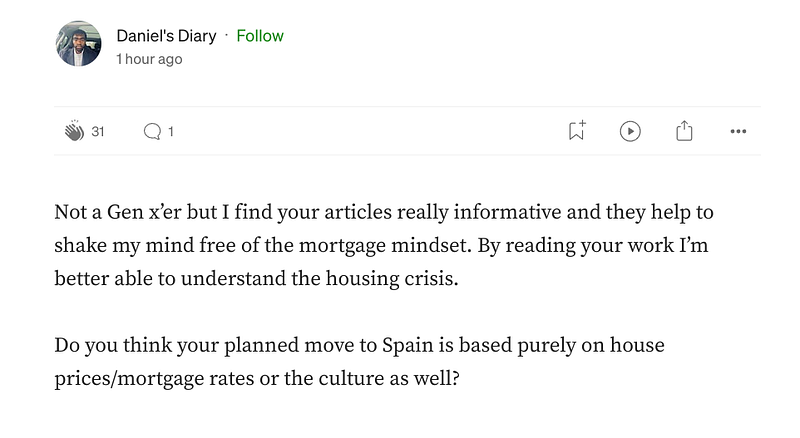
A reader asked the other day —
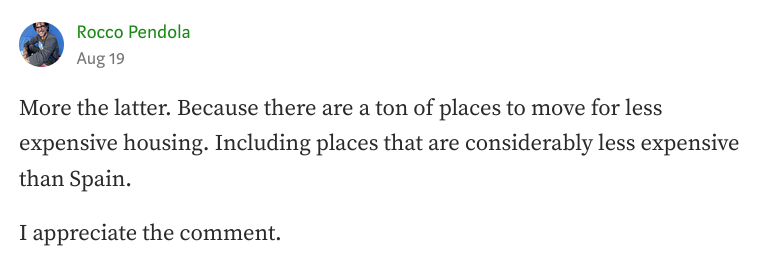
My reply —
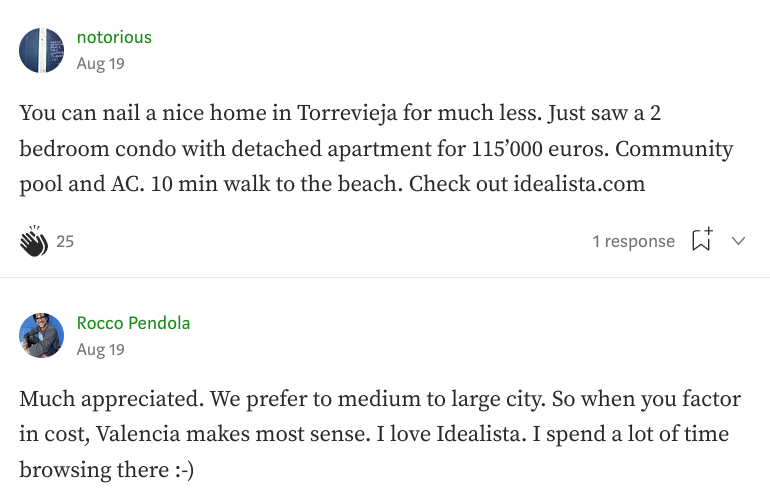
Then there was this exchange —
Taken together, the lesson — or solution to my housing crisis — is:
- Determine your preferred lifestyle.
- Think about this in terms of specifics of the built environment. Life on the ground. The day-to-day. Because place matters more than people give it credit for. If you hate the suburbs, you’re not going to be happy there just because you have a backyard. If you hate the city, you’re not going to be happy there just because you have a luxury apartment downtown.
- Think about places where you can afford to live your preferred lifestyle. For some of us, it’s right here in America. Maybe it’s suburbia. Maybe it’s a small city. Maybe it’s rural America. Maybe it’s in a tiny house behind your cousin’s house. For others, it’s another, less expensive country.
- Then, focus on culture and quality of life first, small changes in cost of living second. Sure, we could spend less in Torrevieja than we will in Valencia. But would we be happy living in a city of 84,000 people versus Valencia’s 900,000 or so in the city and roughly 1.6 million in the larger metro area? No, we wouldn’t. On the flip side, we love Barcelona, but it’s more expensive and has less of a neighborhood feel than Valencia.
Ultimately, you have to have a personal financial choice in the matter. In that you either have or can save the money to move. From there, moving to Thailand simply because it’s less expensive than Spain makes zero sense if you prefer Spain over Thailand.
Whatever specifics govern your situation and preferences, do something!
Because the overall housing crisis isn’t going anywhere any time soon, if ever. And your personal housing crisis might only get worse if you wait, particularly if, like me, you’re fast approaching relative old age.
I love having this conversation. Taking it and, hopefully, developing, if not elevating it. I love it because the subject matter has always interested me, but also because it is my life as I’m living it right now. And, based on the response I receive, I’m hardly alone.
So please find a way — like in response to this article — to share your thoughts and experiences and help advance the discussion.
If you’d like to know more about the journey I’m on, follow me on Medium.
You can also subscribe to my Never Retire: Living The Semi-Retired Life newsletter where I chronicle my big decisions on lifestyle, housing and cost of living, which includes moving to Spain sooner rather than later.
This article is for informational purposes only. It should not be considered Financial or Legal Advice. Not all information will be accurate. Consult a financial professional before making any major financial decisions.


