
%22%3E)
7 Leadership Secrets of Nick Saban
He makes $11 million a year, coaches the №1 ranked college football team, and at 70, isn’t slowing down.
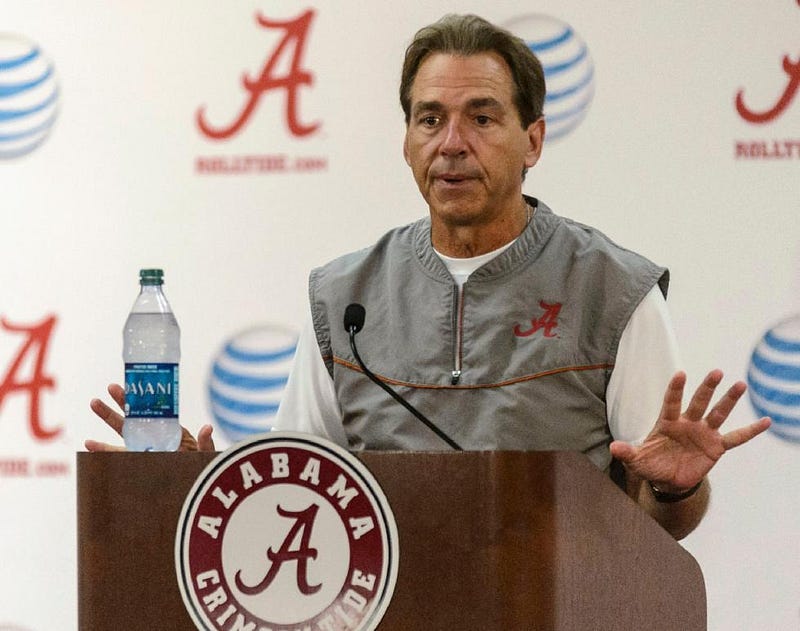
Nick Saban was furious when he saw that two grab bars had been attached his office toilet while he was away having a hip replaced. Someone thought he might need help getting up.
The handicap rails could have made Saban look fallible and hurt his ability to recruit players, John Talty says in his new book about the University of Alabama football coach, The Leadership Secrets of Nick Saban: How Alabama’s Coach Became the Greatest Ever (BenBella Books).
“That was unacceptable to a man who over the years dyed his hair, among other age-defying tactics, not out of vanity but for recruiting purposes,” writes Talty, a sports editor for the Alabama Media Group. Saban had a facilities handyman remove the rails immediately.
Anecdotes like that abound in Talty’s unauthorized but smart and well-written analysis of the coaching and management strategies of a man who earns $11 million a year and has won six national championships with the Crimson Tide, a team ranked №1 as of Oct. 3, 2022. His book draws on research that includes original and previously published interviews with coaches, players, and others in Saban’s orbit.
Talty’s sympathetic portrait of Saban sidesteps the twin perils that await reporters who write books about coaches and players they cover: If they’re too critical, they’ll lose access to a vital source and if too flattering, they’ll lose credibility.
At times you hear punches being pulled — most notably, when Talty says the 70-year-old Saban is 5’8” although football programs from youthful playing days have put his height 5’6” and people tend to lose a half inch every 10 years after the age of 40. The book doesn’t mention the lifts the coach is reported to wear.
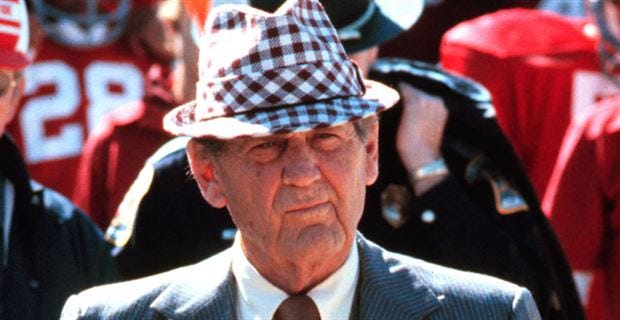
Talty also doesn’t deal with the recent landmark change that will allow college players to earn money from the use of their names and images, which could affect coaching strategies at sports Goliaths like Alabama. And he says perhaps too little about the challenges Saban faced in stepping into the Alabama slot once filled by the legendary Paul “Bear” Bryant.
But there’s plenty in Talty’s book to interest football fans, whether they want to know how Alabama has benefited from the no-huddle offense or what Saban eats for breakfast (two Little Debbie oatmeal cream pies).
Here are seven of the coach’s winning strategies.
1. Instill ‘a sense of urgency’ about change
Harvard Business School professor John Kotter has identified eight ways to “lead change” in an organization, and Saban was using some before a book about them became a bestseller, Talty says. One is to “create a sense of urgency” about what must happen.
In his first head coaching job, at the University of Toledo, Saban made clear that “everything players and coaches did was to be done to a certain standard from the very first day,” and his approach has changed little. Saban likes to say, “Mediocre people don’t like high achievers, and high achievers don’t like mediocre people.”
Talty doesn’t say Saban is a “my way or the highway” coach, but he allows:
“Saban believes it is of critical importance that everyone holds the same high standards if the organization has any chance of being successful, and those who are unwilling to do so need to look for opportunities elsewhere.”

2. Recruit continually
Saban realized early on that the best game plan will fail if you lack the right people to execute it, or if they haven’t bought into it fully.
At Alabama, his first meeting involved not just fellow coaches but janitors, secretaries, and others who worked with the team. Saban said unswept floors or dirty bathrooms would make the program look bad.
“This place has to be show-ready 100 percent of the time,” he said.
Saban set a pattern when, in his first head coaching job at the University of Toledo, he called his running backs coach, L.C. Cole, on Christmas.
“You want to go watch some film?” Saban asked.
The newly married Cole said, “I don’t think so, Coach — you’re going to make me get divorced.”
Saban watched 10 or 15 videos every night when he first arrived at Alabama in 2007, and six championships later, he still doing it.
3. ‘Only promise opportunity’
Some coaches offer recruits the moon to close the deal. “They’ll give them their preferred jersey number, they’ll promise them early playing time, they’ll say they will build their offense around them,” Talty writes.
Saban promises only the opportunity to play for his storied team or to compete for the position they want. As the new Alabama coach, he badly wanted to sign the star high school receiver Quintorris “Julio” Jones. But he wouldn’t sell out for him. He instead made what has become a signature pitch: “I would love to win with you, but I will win without you.”
Jones signed with Alabama, played on its 2009 national championship team, and became the sixth overall pick in the 2011 NFL Draft.
4. Practice strategically
At practices led by Saban, everyone — starters, backups, walk-ons unlikely to play — must meet physically and emotionally withering standards.
“Don’t practice until you can get it right,” Saban says. “Practice until you can’t get it wrong.’ ”
Saban believes his approach builds players’ confidence and results in fewer injuries. It also makes it easier to call “high risk, high reward” plays, such as Tua Tagovailoa’s walk-off touchdown in the 2018 national championship.
Tagovailoa was a freshman who had never started in a college game when, with Alabama trailing Georgia 13–0 at the half, Saban made the controversial decision bench quarterback Jalen Hurts and send in the rookie. He threw a 41-yard game-winning touchdown pass that became one of the most famous plays in the history of the Crimson Tide.
5. ‘Don’t look at the scoreboard’ during games
Saban has developed a style of coaching known as “the Process,” which focuses not results but on processes that can lead to perfection. He discourages talk about individual goals, such as how many touchdowns a player might score, and emphasizes team values.
“Our goal is to be better today than we were yesterday,” he told Ron Medved, a former player for the Philadelphia Eagles.
That goal involves taking one play at a time. Don’t look at the scoreboard during games, he tells players. He’s not joking, says the Michigan State secondary coach Harlon Barnett.
“They are up 45–3, they’ve got the backups in, and he goes off for a blown coverage; he’s dead serious,” Barnett says.
If you blew the coverage, watch out: “there is a graveyard of broken headsets somewhere from when Saban lost his cool during a game.”
6. ‘Pick where you can win’
Saban left his job as head coach at Michigan State for the same position at LSU because he told a friend, the university would “always be second fiddle” to the University of Michigan.
“No matter what he did in East Lansing, Michigan State would never have the large fan base and dominate the conversation the way the school in Ann Arbor did,” Talty says.
Saban’s detractors have accused him of opportunistic job hopping, but the move to LSU paid off for the Louisiana school: He won his first national championship there and went on to win six more at Alabama.
7. Show your team motivational movies on the night before games
An emphasis on perfection in practice doesn’t banish pre-game jitters. But one of Saban’s strategies may help to distract the team from them: He shows players motivational movies like The Gladiator, a tactic that also keeps them away from bars and parties. Read about three of them here:
You might also like this story about heroic female leadership:
Jan Harayda is an award-winning journalist on the Alabama Gulf Coast.