avatarJanice Harayda

Free AI web copilot to create summaries, insights and extended knowledge, download it at here

3461

Abstract

time photo shoot: bad idea.”</p><p id="d233">Never mind that Michelle Obama posed for a Vogue cover <a href="https://www.cnn.com/2016/11/11/politics/michelle-obama-vogue">three times</a> as war raged in Afghanistan. Or that the wartime first lady Eleanor Roosevelt <a href="https://en.wikipedia.org/wiki/My_Day">wrote articles</a> for the magazine and turned up on its pages in a gown far more glamorous than any outfit Zelenska wore. Would Bremmer and his fellow scolds have faulted those women?</p><figure id="b050"><img src="https://cdn-images-1.readmedium.com/v2/resize:fit:800/1*OWksRVxpsbenzbxnC5oSoQ.jpeg"><figcaption>Detail from the March 2009 Vogue cover of Michelle Obama / Annie Leibovitz for Vogue</figcaption></figure><p id="d4ac">I worked as a writer and editor for Vogue’s sister magazine, Glamour, an independent entity with offices two flights down in a former Condé Nast building. Any of my co-workers might have cringed at how misleading the responses to the Zelenska story have been.</p><p id="3c2f">Contrary to the implications of some comments, that article wasn’t just a “photo shoot.” A photo shoot may involve nothing more than pictures of a model or celebrity with captions identifying the clothes worn in them.</p><p id="0aea">What <i>Vogue</i> ran was a 12-page profile, written by Rachel Donadio, a former European cultural correspondent for the New York Times<i>, </i>accompanied by<i> </i>five large photos by Leibovitz. A good profile is a well-researched, multisourced article — ideally, one that results from face-to-face conversations with its subject, supplemented by interviews with others.</p><p id="58d9">The outfits Zelenska wore also came from Ukrainian designers, and they were not the point of the story. Zelenska’s life in wartime was the point. And it’s not as though she gave an interview only to Vogue: She’s also spoken to Congress, to “Sixty Minutes,” and to global leaders about her country’s need for weapons and other aid.</p><figure id="335a"><img src="https://cdn-images-1.readmedium.com/v2/resize:fit:800/1*Eq5lgfaCzGAyuTQ_yAz4AA.jpeg"><figcaption>Edward Steichen photo of Eleanor Roosevelt in Vogue / Credit: <a href="https://condenaststore.com/featured/eleanor-roosevelt-in-a-rosy-white-gown-edward-steichen.html?product=wood-print">Conde Nast Store</a></figcaption></figure><p id="768b">Zelenska’s heroism has consisted, in part, in staying on message, whether she’s speaking to a reporter or an international conference. She doesn’t dilute her point — as so many American first ladies have — by talking about her hair, clothes, or recipes. She has used her speeches and social media much as Eleanor Roosevelt used her public appearances and her “My Day” newspaper column: to rally and uplift the spirits of a country in crisis. If Ukraine prevails, Zelenska may go down in history as the greatest wartime first lady since Roosevelt.</p><h2 id="6dd7">Criticisms of Zelenska play into Putin’s hands</h2><p id="46d4">Amid all of that, there’s something more troubling about the denunciations of Zelenska than whether or not they fairly reflect her actions: The criticisms of her play into Putin’s hands. To the degree that they foment division among supporters of Ukraine, they are giving him what he wants.</p><p id="ae5b">Putin’s divide-and-conquer strategy has been clear since he took Crimea from Ukraine in 2014. He pursued it with his invasion of Ukraine on Feb. 24, 2022, and with his recent attemp

Options

t to annex four additional regions — Donetsk, Kherson, Luhansk, and Zaporizhzhia. He has also used that strategy to try to undermine the West’s unity on Ukraine.</p><p id="6c23">The author Melik Kaylan made <a href="https://www.wsj.com/articles/the-zelenskys-defiant-vogue-cover-olena-leibovitz-culture-ukraine-beauty-art-identity-institutions-west-putin-russia-11659377020">an apt point</a> in the Wall Street Journal about the flap over Zelenska:</p><blockquote id="560a"><p>“Lacking any substantive cause, the clamor seems to have been largely provoked by the quietly confident elegance on display.</p></blockquote><blockquote id="40f9"><p>“Vladimir Putin is also intent on erasing this sort of image of Ukraine, contending that the country is merely a wayward part of Russia….</p></blockquote><blockquote id="f9e8"><p>“The Kremlin believed that Ukrainians were irredeemably soft exactly because of their penchant for the good life, what the old leftist ideologues would have deemed a colonialist’s ‘feminized’ view of subject cultures.”</p></blockquote><p id="2383">Kaylan added:</p><blockquote id="cb9e"><p>“It turned out that Ukrainians of both sexes were willing to fight and die to uphold their culture. They refused to let Mr. Putin erase them, and not simply in terms of buildings or institutions but in the enduring celebration of joy and panache and good taste, a provocative defiance to Russia, which considers itself the height of culture. You can be sure that the psychological lesson isn’t lost on Moscow’s nihilistic bullies.</p></blockquote><blockquote id="2185"><p>“Yet it seems to have been entirely missed by the Western killjoys who see the Zelenskys as violating a wartime moral imperative to drape everything in a relentless gray. They shouldn’t be helping Mr. Putin wipe away Ukrainian cultural traits simply because they don’t conform to their own.”</p></blockquote><p id="048a">In the U.S., the fomenting of divisions about the Zelenska story distracts from the larger issues at stake. The war in Ukraine is not about fashion or photography or how you sit. It is about, as Donadio wrote in Vogue, “who will uphold the values of the West and the post-war rules-based order.”</p><p id="b838">Americans may not fully grasp this, but Zelenska does. What inspires her, she told Vogue, is her fellow Ukrainians.</p><p id="fe36">“We have no doubt that we will prevail,” she said. “And this is what keeps us going.”</p><p id="44ce"><i>Jan Harayda is an award-winning journalist who has written for many major media. She was a writer and editor for </i>Glamour<i> before she became the book critic for </i>The Plain Dealer<i> in Cleveland.</i></p><p id="3638"><b><i>You might also like my story on the Ukrainian national anthem at the Met:</i></b></p><div id="35f6" class="link-block"> <a href="https://readmedium.com/the-version-of-the-ukrainian-anthem-used-by-the-metropolitan-opera-f86f615bf261"> <div> <div> <h2>The Version of the Ukrainian Anthem Used by the Metropolitan Opera</h2> <div><h3>You get an A+ if you said, ‘Obviously! It’s in B-flat major’</h3></div> <div><p>medium.com</p></div> </div> <div> <div style="background-image: url(https://miro.readmedium.com/v2/resize:fit:320/1*K_lt0pdRy8eYACiN1eYXZg.jpeg)"></div> </div> </div> </a> </div></article></body>

THE RUSSIA-UKRAINE WAR

The Heroism of Olena Zelenska

Ukraine’s first lady deserves praise — not criticism — for speaking to Vogue. Here’s why people should put away their dart guns.
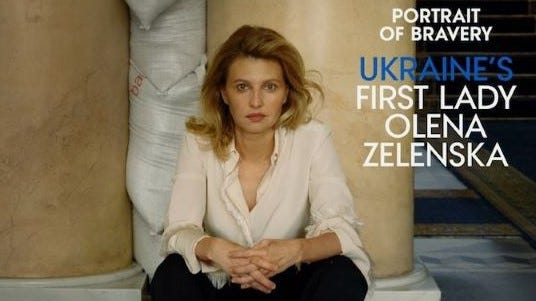
Detail from the July 2022 Vogue digital cover / Annie Leibovitz via President of Ukraine

You might think Americans would feel only sympathy for Olena Zelenska given the savagery Vladimir Putin has inflicted on her country. Or you might expect them to cut her some slack for doing what 11 of the past 12 U.S. first ladies have done: appear in Vogue magazine.

If you think either of those things, you underestimate how quick Americans are to condemn a first lady who dares to speak her mind — in this case, the wife of Ukrainian President Volodymyr Zelenskyy.

A volley of sexist carping has followed Zelenska’s appearance in a digital cover story in Vogue in July 2022 and in its print edition in October, both with photographs by the celebrated portraitist Annie Leibovitz.

Nothing about the article was frivolous or lacking in news value: One Vogue photo showed Zelenska with female Ukrainian soldiers in battle gear. And the story made clear why she was speaking to the magazine.

“I’m asking for something I would never want to ask for: I am asking for weapons — weapons that would not be used to wage war on someone else’s land but to protect one’s home and the right to wake up alive in one’s home,” Zelenska said.

Yet the first lady has faced personal attacks of a kind men seldom do for similar actions. Some involved a photo in which she sat with her forearms across her thighs, a posture popular with baseball players in dugouts. Its detractors found her position unfeminine, which inspired a backlash in the form of a wave of selfies with the hashtag #SitLikeAGirl.
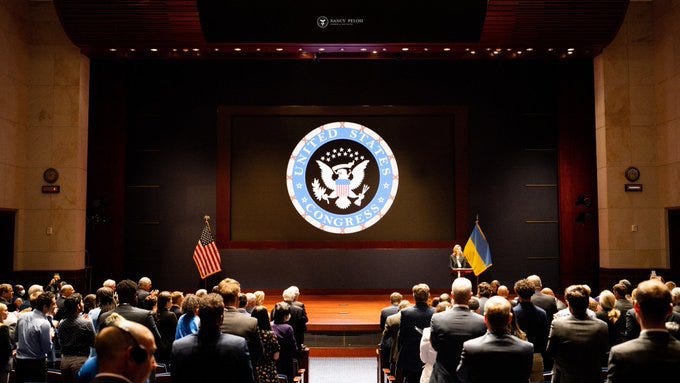
Olena Zelenska speaks to Congress / Wikimedia Commons public domain photo

Much of the fault-finding has come from predictable quarters, such as the far-right Republican Rep. Lauren Boebert of Colorado, who tweeted:

“While we send Ukraine $60 billion in aid Zelenskyy is doing photoshoots for Vogue Magazine. These people think we are nothing but a bunch of suckers.”

But more moderate voices have thrown shade, too, including Ian Bremmer, an editor-at-large of Time magazine. Bremmer sanctimoniously tweeted from his personal Twitter account: “vogue wartime photo shoot: bad idea.”

Never mind that Michelle Obama posed for a Vogue cover three times as war raged in Afghanistan. Or that the wartime first lady Eleanor Roosevelt wrote articles for the magazine and turned up on its pages in a gown far more glamorous than any outfit Zelenska wore. Would Bremmer and his fellow scolds have faulted those women?
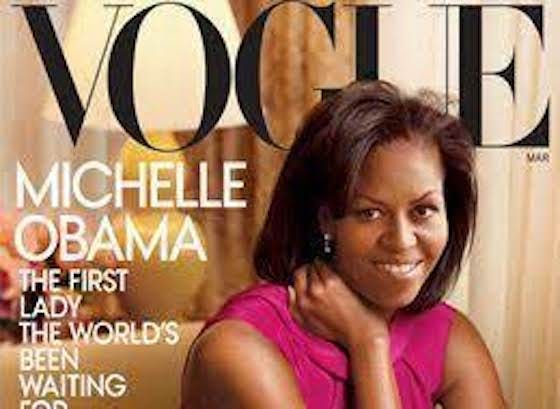
Detail from the March 2009 Vogue cover of Michelle Obama / Annie Leibovitz for Vogue

I worked as a writer and editor for Vogue’s sister magazine, Glamour, an independent entity with offices two flights down in a former Condé Nast building. Any of my co-workers might have cringed at how misleading the responses to the Zelenska story have been.

Contrary to the implications of some comments, that article wasn’t just a “photo shoot.” A photo shoot may involve nothing more than pictures of a model or celebrity with captions identifying the clothes worn in them.

What Vogue ran was a 12-page profile, written by Rachel Donadio, a former European cultural correspondent for the New York Times, accompanied by five large photos by Leibovitz. A good profile is a well-researched, multisourced article — ideally, one that results from face-to-face conversations with its subject, supplemented by interviews with others.

The outfits Zelenska wore also came from Ukrainian designers, and they were not the point of the story. Zelenska’s life in wartime was the point. And it’s not as though she gave an interview only to Vogue: She’s also spoken to Congress, to “Sixty Minutes,” and to global leaders about her country’s need for weapons and other aid.
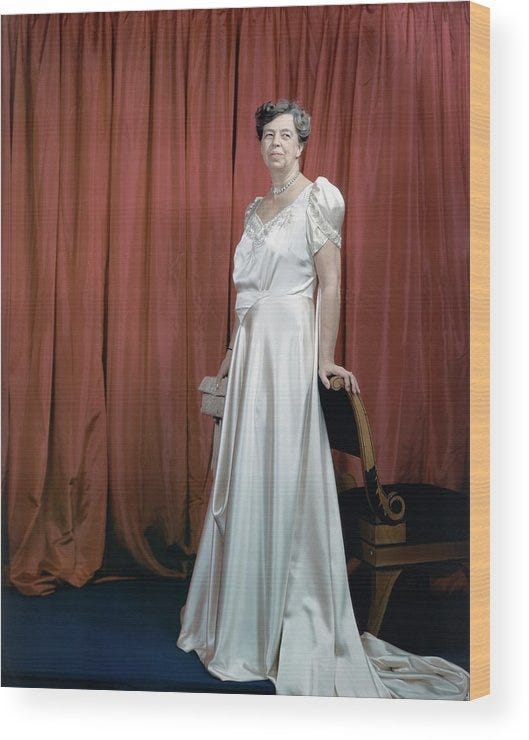
Edward Steichen photo of Eleanor Roosevelt in Vogue / Credit: Conde Nast Store

Zelenska’s heroism has consisted, in part, in staying on message, whether she’s speaking to a reporter or an international conference. She doesn’t dilute her point — as so many American first ladies have — by talking about her hair, clothes, or recipes. She has used her speeches and social media much as Eleanor Roosevelt used her public appearances and her “My Day” newspaper column: to rally and uplift the spirits of a country in crisis. If Ukraine prevails, Zelenska may go down in history as the greatest wartime first lady since Roosevelt.

Criticisms of Zelenska play into Putin’s hands

Amid all of that, there’s something more troubling about the denunciations of Zelenska than whether or not they fairly reflect her actions: The criticisms of her play into Putin’s hands. To the degree that they foment division among supporters of Ukraine, they are giving him what he wants.

Putin’s divide-and-conquer strategy has been clear since he took Crimea from Ukraine in 2014. He pursued it with his invasion of Ukraine on Feb. 24, 2022, and with his recent attempt to annex four additional regions — Donetsk, Kherson, Luhansk, and Zaporizhzhia. He has also used that strategy to try to undermine the West’s unity on Ukraine.

The author Melik Kaylan made an apt point in the Wall Street Journal about the flap over Zelenska:

“Lacking any substantive cause, the clamor seems to have been largely provoked by the quietly confident elegance on display.

“Vladimir Putin is also intent on erasing this sort of image of Ukraine, contending that the country is merely a wayward part of Russia….

“The Kremlin believed that Ukrainians were irredeemably soft exactly because of their penchant for the good life, what the old leftist ideologues would have deemed a colonialist’s ‘feminized’ view of subject cultures.”

Kaylan added:

“It turned out that Ukrainians of both sexes were willing to fight and die to uphold their culture. They refused to let Mr. Putin erase them, and not simply in terms of buildings or institutions but in the enduring celebration of joy and panache and good taste, a provocative defiance to Russia, which considers itself the height of culture. You can be sure that the psychological lesson isn’t lost on Moscow’s nihilistic bullies.

“Yet it seems to have been entirely missed by the Western killjoys who see the Zelenskys as violating a wartime moral imperative to drape everything in a relentless gray. They shouldn’t be helping Mr. Putin wipe away Ukrainian cultural traits simply because they don’t conform to their own.”

In the U.S., the fomenting of divisions about the Zelenska story distracts from the larger issues at stake. The war in Ukraine is not about fashion or photography or how you sit. It is about, as Donadio wrote in Vogue, “who will uphold the values of the West and the post-war rules-based order.”

Americans may not fully grasp this, but Zelenska does. What inspires her, she told Vogue, is her fellow Ukrainians.

“We have no doubt that we will prevail,” she said. “And this is what keeps us going.”

Jan Harayda is an award-winning journalist who has written for many major media. She was a writer and editor for Glamour before she became the book critic for The Plain Dealer in Cleveland.

You might also like my story on the Ukrainian national anthem at the Met:

Politics
Journalism
Russia Ukraine War
Feminism
Culture
Recommended from ReadMedium