
7 Insights to Outsmart Your Brain and Save Hours of Study Time
Embrace these scientifically-backed strategies to enhance your learning efficiency and retention.

Have you ever wondered how you can enhance your learning journey without putting more hours into studying?
Many people focus on the easy practices — such as highlighting and rereading — that give us an illusion of mastery but are rather useless in reality.
As a learning science nerd, I’ve explored countless articles and books on how to learn better and faster. Over the holidays (at the beaches of Koh Phangan), I binge-read “Outsmart Your Brain: Why Learning is Hard and How You Can Make It Easy” by Daniel T. Willingham, Ph.D.
Whether you’re my long-time reader or new to the science of learning, this book is a gem. It summarizes key learning principles, offering valuable insights for your personal learning journey.
Below is my distilled summary of the key concepts, focusing on the most impactful ideas and their implications for you, so you can maximize your learning.
#1 Understanding 3 Key Cognitive Processes
Willingham explores cognitive processes like attention, memory, and problem-solving. By understanding these processes, you can deploy strategies to enhance your learning efficiency.
Attention is the skill of concentrating on certain information or stimuli while tuning out distractions. It’s about how we direct our mental resources. There are various forms of attention, such as selective attention, which is the ability to focus on specific things while disregarding irrelevant ones, and sustained attention, which is the capacity to maintain focus over extended periods. For example, when you’re engrossed in a book, your attention helps you focus on the words and grasp the story, all while tuning out external distractions like background noise or other visual interruptions.
Memory is your personal tool for encoding, storing, and retrieving information. It operates in three essential stages: encoding, where you register new information; storage, where you retain this information over time; and retrieval, where you recall this stored information when needed. For example, as you prepare for an exam, your memory enables you to encode and store key details, such as concepts and facts. Later, during the test, you can retrieve this information, helping you answer questions effectively.
Problem-solving involves the mental processes you use to identify, analyze, and solve problems or challenges. It includes recognizing a problem, generating potential solutions, evaluating them, and choosing the best course of action. For instance, when you encounter a complex math problem, your problem-solving skills help you to analyze the problem statement, consider various strategies or formulas, apply logical reasoning, and systematically work through the problem to find a solution.
Understanding the interplay of cognitive processes like attention, memory, and problem-solving is key to optimizing your learning. By improving in each area, you can retain and recall information better and solve problems more efficiently.
#2 The Importance of Prior Knowledge
In his book, Daniel T. Willingham underlines the critical role of prior knowledge. The exponential nature of knowledge has a strong impact on learning, illustrating how each new fact or skill builds upon existing knowledge, leading to rapid growth like branches on a tree.
For instance, a solid grammar foundation in your native language makes learning a new language smoother. This prior knowledge acts as a springboard for new learning, enabling easier understanding and connections between new information and what is already known.
#3 Prioritizing Active Learning Over Passive Learning
Willingham promotes active learning as an effective approach. He argues that passive learning, such as re-reading or highlighting, is less effective than engaging with the material actively. Techniques like summarizing, questioning, and teaching others enhance understanding and retention. Instead of passively reading a textbook chapter, actively engage with the material by summarizing each section in your own words, asking yourself questions about the content, and discussing it with a study group.
If you want to learn more about active learning, dive into my article “Three Active Learning Strategies to Save Hours of Study Time,” which delves into the misconceptions and neuroscience behind active learning, contrasting the common belief in hands-on projects with its true nature as a process involving thoughtful activities and discussions for deeper understanding. The article provides practical insights on enhancing learning and teaching through active learning techniques like collaboration and retrieval practice, based on research and resources like Barbara Oakley’s book “UnCommon Sense Teaching.”
#4 Spaced Repetition: The Long Game
I love it when people explore the benefits of spaced repetition because I experience again and again that it simply works. It’s one of the things I would have loved to have known while I was in school.
“Outsmart Your Brain” highlights the effectiveness of spaced repetition in learning. Willingham explains that instead of cramming information, spacing out learning sessions over time aids long-term retention. Encoding knowledge into your memory works best when you reproduce the same piece of information from your mind over increasing time intervals.
If you want to dive deeper, check out this guide I wrote on how to build a personal memory system that makes remembering a choice (I still use it daily).
#5 Practice and Feedback for Mastery
The book stresses deliberate practice, which means actively practicing a skill while intending to improve your performance. Engaging in purposeful practice, focusing on specific skills or concepts, helps improve mastery.
Additionally, receiving timely feedback allows learners to correct mistakes, reinforce learning, and make necessary adjustments.
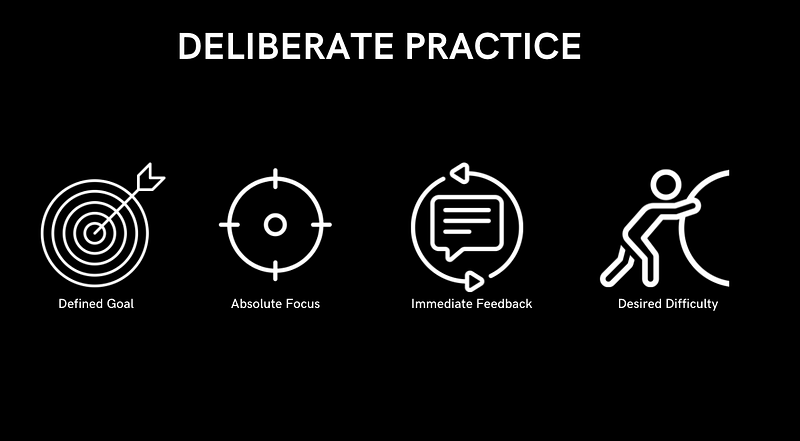
How can you apply deliberate practice? Here’s how I would summarize the four key points to deliberate practice:
1. Define a specific learning goal: Before you dive into practicing, consider which goal you want to achieve. Break down your ultimate goal into sub-steps, similar to skill trees. If you want to become a better guitar player, decide what to focus on. The rhythm? Ear training? Barre chords? Riffs?
2. Commit to absolute focus: Whenever you practice, flight mode your phone and put it in a different room. Turn your computer off. Set a timer for your desired practice time and focus on nothing else.
3. Get immediate feedback: Practice doesn’t make perfect. Practice makes permanent. You can repeat a specific behavior indefinitely without getting better at it. All you do is manifest the existing technique. There are a couple of ways you can use to get immediate feedback:
- Self-record a video of you practicing a specific skill (e.g., playing an instrument or doing a sports technique) and compare it to an expert’s video.
- Hire a coach or trainer who has mastered the practice you’re aiming to achieve.
- Use learning software that provides you with immediate feedback. For example, language learning tools such as Lingvist or Memrise, or programming learning software such as Codecademy, have in-built feedback mechanisms.
4. Aim for desired difficulty: “In the short term, conditions that make learning more challenging — such as generating words instead of passively reading them, varying conditions of practice, transferring knowledge to new situations, or learning to solve multiple types of math problems at once — might slow down performance. However, there is a yield in long-term retention,” a Stanford article says.
To steepen your learning curve, practice a bit outside your comfort zone. While additional challenges make your practice less enjoyable, it will become more effective.
#6 Making Real-Life Connections to the Material
Willingham emphasizes the need to make real-life connections to the material being learned. Relating new information to pre-existing knowledge or experiences facilitates understanding. By establishing meaningful associations, learners can better retain and apply what they learn (something called “elaboration”).
The more details and the stronger you connect new knowledge to what you already know, the better. By doing so, you’re generating more cues. Elaborative rehearsal is a method to encode information into your long-term memory more effectively. It can be advantageous to relate the material to a personal experience or to something you already know, explaining the idea to someone else and explaining how it relates to your life.
#7 Metacognition: Thinking About Thinking
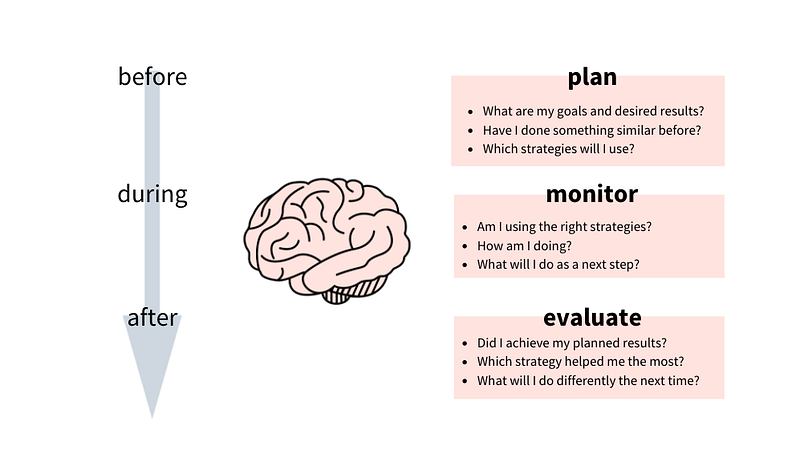
Finally, Willingham explores one of my favorite topics — metacognition, which refers to thinking about one’s own thinking. Being aware of how we learn and process information allows us to develop effective learning strategies, set goals, and monitor our progress.
How can you integrate metacognition into your learning routine? Before your next task or learning endeavor, make sure to:
- Plan. Say it out loud. Be explicit about the way you approach a task.
- Monitor. Stay aware of whether you’re doing it right.
- Evaluate. Reflect on how well you’ve done.
Conclusion
To maximize your learning outcomes, you need to learn smarter. Here are the seven concepts that Daniel Willingham describes in his book that are essential for your learning journey:
- Understanding cognitive processes (attention, memory, problem-solving)
- Recognizing the importance of prior knowledge
- Prioritizing active learning over passive learning
- Implementing spaced repetition in your learning sessions
- Engaging in purposeful practice and receiving timely feedback
- Making real-life connections to the material being learned
- Thinking about thinking (metacognition)
By understanding the principles outlined in “Outsmart Your Brain: Why Learning is Hard and How You Can Make It Easy,” you can enhance your learning approach.
Want to feel inspired and become smarter about how you learn?
Subscribe free to my Learn Letter. Each Wednesday, you’ll get evidence-based tools and resources that elevate your love for learning.


