
How to Augment Your Long-Term Memory in 15 Minutes a Day
Your personal memory system makes remembering a choice.

What would change if you could remember any information you want forever?
Imagine all things that are useful for you would be stored in your long-term memory, giving you an edge in every conversation, brainstorming or deep work session.
Since 2012 I’ve been on a mission to uncover how and when we learn best. I’ve read everything I could find on the science of learning — a new domain that builds on cognitive psychology, neuroscience, brain research and social psychology.
One thing that’s become clear is the strong evidence for the efficiency of spaced repetition and active retrieval.
Encoding knowledge into your memory works best when you reproduce the same piece of information from your mind over increasing time intervals.
But even if you know what to do, it can be challenging to apply it in your daily life.
A month ago, I discovered an applicable method that can change everything. I haven’t felt so excited about something since RoamResearch.
In essence, the following strategy makes remembering a choice rather than coincidence.
It builds on the insight that your brain’s long-term memory capacity is unlimited. Knowledge begets knowledge. The more you learn, the more you can remember.
Here’s how you can expand your long-term memory and remember everything you want within a couple of minutes each day.
What You Need to Do to Remember Things Forever
It’s not your fault that you forget any facts, names, or ideas after some time.
Most people view forgetting as an error in an otherwise functional memory system.
But the opposite is true.
Forgetting isn’t your enemy; it’s essential for learning.
The forgetting curve visualizes how much you forget over time. It shows how your ability to recall things from memory naturally decreases over time.
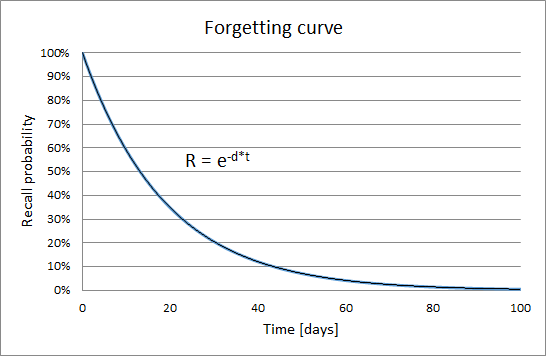
Here’s an important implication many people never realize: If you see information only once, you will very likely completely forget them after three months. However great a lecture, book, corporate training, or online course; you will forget most of the content unless you interrupt your forgetting curve.
To remember information forever, you need to interrupt your forgetting curve strategically.
Spaced repetition is the best way to do so. In essence, you test yourself on the same information across increasing intervals.
Notice how the forgetting curve flattens after each review. You can retain more, and you forget slower.
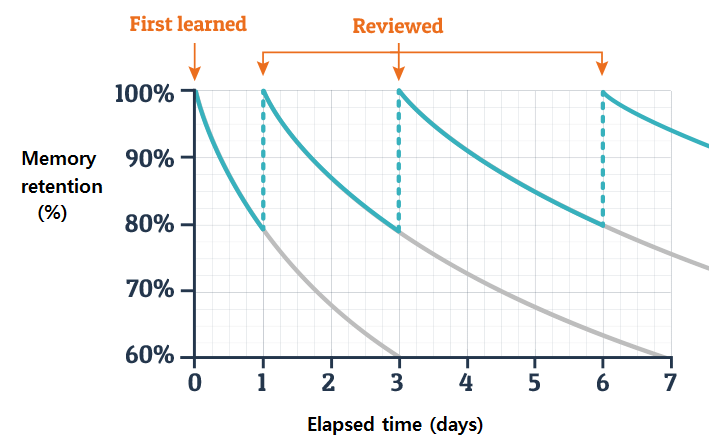
So to remember information forever, you want to have a process that makes your recall a piece of information at the right time for optimizing retention.
But how can you do this? Handwriting flashcards and starting a manual review system?
Luckily, there are more efficient ways.
How to Augment Your Long-Term Memory in 15 Minutes a Day
Simple tools can make remembering a choice rather than a coincidence.
Anki and Neuracache resurface information at the optimal moment and interrupt your forgetting. (To understand the algorithm behind it, read this article by SuperMemo, this iteration from Anki or watch this 5-minute explainer.)
Unlocking the power of these tools works in three steps:
- Create digital flashcards. You enter a question and a corresponding answer.
- Retrieve information from your memory. When the program shows you a card, you actively recall the answer from your memory. Look at the answer afterwards.
- Self-assess. The software asks whether you knew the answer or not. Based on your self-assessment, the software manages the review schedule for you.
If you got the answer right, more time would pass until you see the card again. A one-day gap between reviews become a week, a month, and so on.
This seems trivial, but showing you flashcards based on your forgetting curve is incredibly efficient.
What Will Happen When You Apply This
Within a few minutes of learning a day, you can memorize thousands of facts, ideas, rules, or words.
Michael Nielsen, a scientist who has used this system for four years, explains in his essay how much time it can save you:
“On average, it takes me about 8 seconds to review a card. Suppose I was using conventional flashcards, and reviewing them (say) once a week. If I wanted to remember something for the next 20 years, I’d need 20 years times 52 weeks per year times 8 seconds per card. That works out to a total review time of just over 2 hours for each card.
By contrast, Anki’s ever-expanding review intervals quickly rise past a month and then out past a year. Indeed, for my personal set of Anki cards the average interval between reviews is currently 1.2 years, and rising. In an appendix below I estimate that for an average card, I’ll only need 4 to 7 minutes of total review time over the entire 20 years. Those estimates allow for occasional failed reviews, resetting the time interval. That’s a factor of more than 20 in savings over the more than 2 hours required with conventional flashcards.”
Let me rephrase this because it’s revolutionary: within 4 to 7 minutes of total review spread over 20 years, you can remember anything you want.
Based on the spaced repetition algorithms, you can decrease your time spent studying while increasing the amount you learn and remember.
Michael Nielson started in 2018. I asked him this week whether he still sticks to the process. Here’s his reply:
Imagine how your life would change if you encoded 20,000 useful bits of information. Yes, you can google almost anything but processing fluency matters.
You can only hold a handful of items in your short-term memory. When you encode information into your long-term memory, you will have the edge over many other people because you atomize and retain valuable insights directly from your brain.
The benefit of memorizing information is not in the knowledge itself, but in the way you can deploy it. Through memorization you build a mental structure that helps you develop new thoughts and knowledge.
“Long-term memory is capable of storing thousands of facts, and when we have memorised thousands of facts on a specific topic, these facts together form what is known as a schema. When we think about that topic, we use that schema. When we meet new facts about that topic, we assimilate them into that schema — and if we already have a lot of facts in that particular schema, it is much easier for us to learn new facts about that topic.”
— Daisy Christodoulou
What do You Want to Remember forever?
Michael Nielsen’s rule of thumb is as follows:
“If memorizing something will likely save you five minutes in the future, write a flashcard. Because the expected lifetime review time is less than five minutes, i.e., it takes < 5 minutes to learn something… forever.”
There’s a ton of things you can remember forever with Anki or Neuracache, such as:
- Findings of books and papers important in your area of expertise
- A line of commands for a programming language
- Vocabulary from a foreign language
- Birthdays and wedding days from your close friends and family
- Academic material such as periodic tables and geography
- Quotes or poems you want to be able to recite
- Names and faces
- Reflections or life lessons from your work or hobbies
- Favourite places from a holiday or best dishes in a restaurant
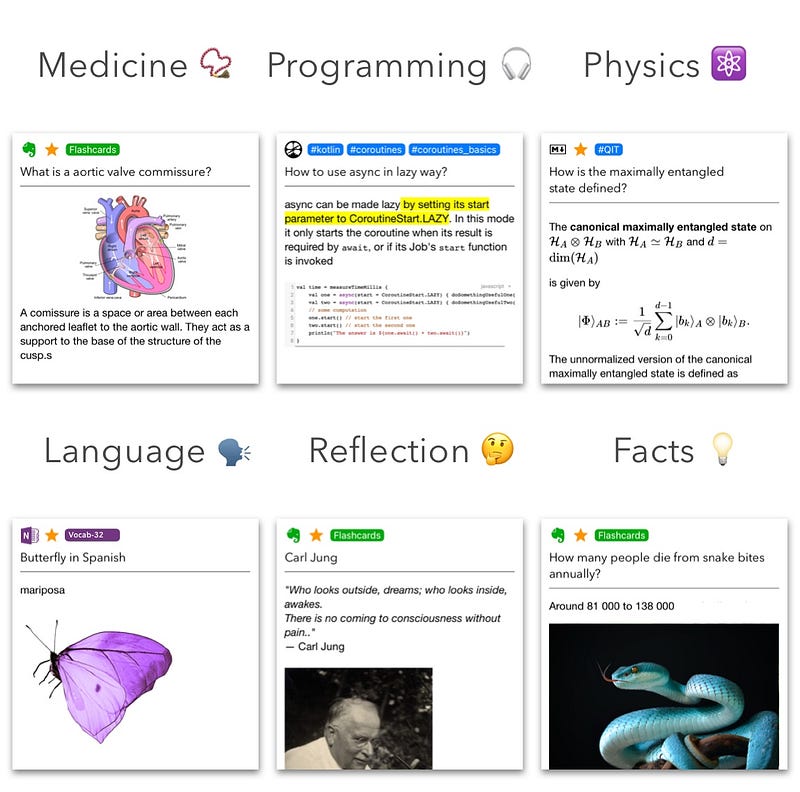
While there are many pre-written decks, writing cards yourself is even more meaningful.
Creating flashcards is a learning process in itself. Learning scientists call this elaborative encoding — you explain and describe an idea in your own words.
Final Thoughts
Knowing that many valuable facts and ideas will vanish from our memories has made me feel frustrated for a long time.
My digital note-taking system keeps growing, and it’s been very beneficial. But working memory capacity is limited and even with my second digital brain, I can only hold a specific number of things in my head.
The above method changes everything.
Applying spaced repetition and active recall for 15-minutes a day is a bullet-proof way to embed new knowledge in your long-term memory.


