
Steepen Your Learning Curve with Deliberate Practice
The four pillars for achieving mastery.

The 10,000-hour rule is a harmful myth.
Malcolm Gladwell argued in ‘Outliers,’ if a person practices a skill for 10,000 hours, they will become a world-class master in that field.
While this simple rule sounds appealing, it’s wrong in several ways.
Ericsson, a scientist among the study’s authors that Gladwell popularized, debunks this learning myth:
- Ten thousand hours was an average. Most world-class performers practiced less or more before they achieved mastery.
- Nothing in the study implied almost anyone could become an expert in a given field by practicing ten thousand hours.
- Gladwell didn’t distinguish how the hours were used. If your practice is ineffective or flawed, even 10,000 hours won’t help you become a master.
Luckily, there’s a better model you can use to replace the misleading 10,000-hour rule — deliberate practice. Here’s how it works and how you can use the method to steepen your learning curve.
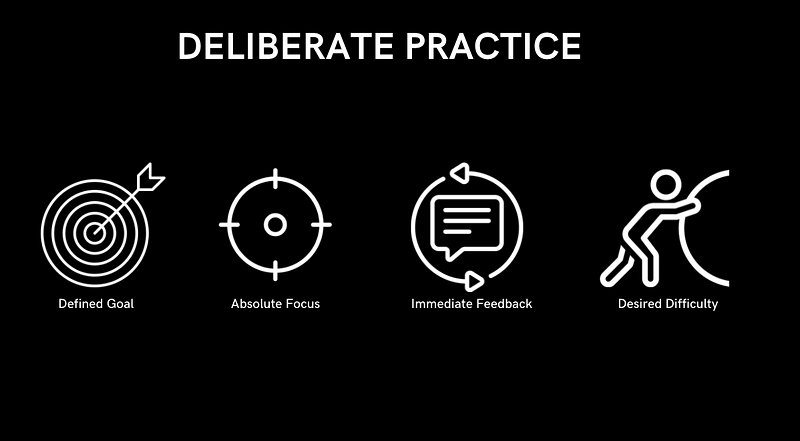
In essence, deliberate practice means actively practicing a skill while intending to improve your performance. “This distinction between deliberate practice aimed at a particular goal and generic practice is crucial because not every type of practice leads to the improved ability,” Ericsson writes.
The authors of ‘Make it Stick’ further specify: “If doing something repeatedly might be considered practice, deliberate practice is a different animal: it’s goal-directed, often solitary, and consists of repeated striving to reach beyond your current level of performance.”
So here’s how you can make your practice deliberate.
1) Define a Specific Learning Goal
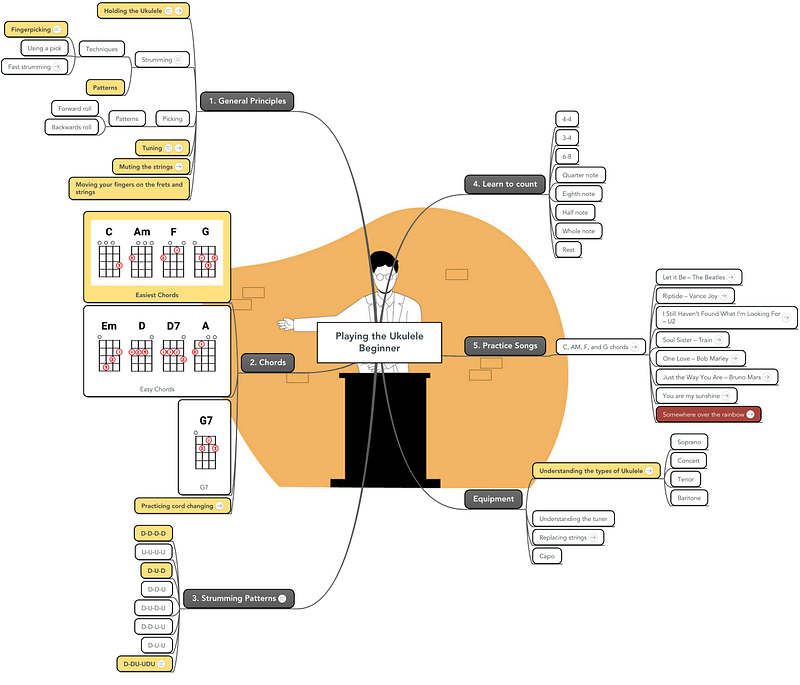
Before you dive into practicing, consider which goal you want to achieve. Break down your ultimate goal into sub-steps, similar to skill trees.
If you want to become a better guitar player, decide what to focus on. The rhythm? Ear training? Barre chords? Riffs?
By breaking down your desired activity to one specific goal, you’re setting the groundwork for deliberate practice. One clear outcome is a thousand times better than overarching terms such as “succeed” or “get better.”
If you’re unsure where to start, get inspired by Danny Forest’s excellent exploration of Skill Trees. Here’s a beautiful visualization he created for playing the Ukulele for Beginners.
2) Commit to Absolute Focus
“Where your attention goes, your energy flows,” somebody wise once said. Absolute focus is the most valuable skill of our century. But it requires training.
In Cal Newport’s words, absolute focus means: “professional activities performed in a state of distraction-free concentration that pushes your cognitive capabilities to their limit.”
The key term here is ‘distraction-free.’
Whenever you practice, flight mode your phone and put it in a different room. Turn your computer off. Set a timer for your desired practice time and focus on nothing else.
Distraction-free environments are the crucial factor to unlock deliberate practice. “In tranquil silence, you can do deep work — the real work,” a fellow Medium writer rhymed.
“‘Just keep working at it, and you’ll get there,’ is wrong. The right sort of practice carried out over a sufficient period of time leads to improvement. Nothing else.”
— Karl Anders Ericsson
3) Get Immediate Feedback
Practice doesn’t make perfect. Practice makes permanent. You can repeat a specific behavior indefinitely without getting better at it. All you do is manifest the existing technique.
If you practice soccer with the same ineffective dribbling technique, you’ll never improve. To get better, you need to know what exactly you’re striving for and become aware of your shortcomings.
Feedback is the cornerstone element for deliberate practice.
You’ll understand how the desired skill works and what you need to do to get there. Feedback helps you manifest the correct revisions rather than repeating ineffective behavior.
There are a couple of ways you can use to get immediate feedback:
- Self-record a video of you practicing a specific skill (e.g., playing an instrument, doing a sports technique) and compare it to an expert’s video.
- Hire a coach or trainer who has mastered the practice you’re aiming to achieve.
- Use learning software that provides you with immediate feedback. For example, language learning tools such as Lingvist or Memrise, or programming learning software such as Codecademy, have in-built feedback mechanisms.
4) Aim for Desired Difficulty
Whenever you practice, you want to challenge yourself a bit further than the last time. Desirable difficulty means putting in a considerable but desirable amount of effort into your practice.
“In the short term, conditions that make learning more challenging — such as generating words instead of passively reading them, varying conditions of practice, transferring knowledge to new situations, or learning to solve multiple types of math problems at once — might slow down performance. However, there is a yield in long-term retention,” a Stanford article says.
To steepen your learning curve, practice a bit outside your comfort zone. While additional challenge makes your practice less enjoyable, it will become more effective.
“There is a place, right on the edge of your ability, where you learn best and fastest. It’s called the sweet spot.…The underlying pattern is the same: Seek out ways to stretch yourself. Play on the edges of your competence. As Albert Einstein said, “One must develop an instinct for what one can just barely achieve through one’s greatest efforts.”
The key word is ‘barely.’”
— Daniel Coyle in ‘ The Little Book of Talent’
In Conclusion
Not every practice needs to be deliberate. You can learn a new skill just for fun and doodle around. Hobbies without clear goals or a coach inside your comfort zone can be a source of joy and fulfillment.
But if you’re looking for a way on how to learn a new skill faster, keep the four pillars of deliberate practice in mind:
- Specify your goal into a sub-goa.
- Schedule distraction-free focused practice.
- Find a way to get immediate feedback.
- Push yourself outside your comfort and inside your learning zone.
Want to feel inspired and improve your learning?
Subscribe free to The Learn Letter. I read a book and 50 articles a week, and each Wednesday, you’ll receive the best in your inbox. This newsletter will make you find tools and resources that help you on your path to health, wealth, and wisdom.


