
7 Honest And Useful Tips For First-Time Digital Nomads
How to make the lifestyle work

A mere decade ago, digital nomads were a tiny group of adventure chasers on the fringes of society.
Most of them were bloggers, and the vast majority lived in a few Southeast Asian hotspots.
Times have changed. Remote working arrangements are more popular than ever, and the trend is here to stay.
A few years ago, digital nomadism was out of reach for most employees. The idea resembled a fantasy only successful entrepreneurs could achieve.
Today, most companies have remote working policies, and employers are warming up to the idea.
But how can aspiring digital nomads make the lifestyle work without falling into the holiday trap?
How can full-time planet roamers stay productive and motivated?
And most importantly, what’s the secret to finding a balance between work and play on the road?
After more than two years of full-time traveling, the following are some of my most honest and useful tips for first-time digital nomads.
1. Choose places according to your self-defined criteria, not Instagram
First and foremost, choosing the right places is paramount for first-time digital nomads.
So, what are the right places? Well, there is no clear-cut answer.
People have varying preferences, and businesses have contrasting priorities. As such, some places are better suited to some digital nomads than others.
The main point is to identify your criteria.
Always remember: you’re choosing a base, not a holiday destination. You base yourself in a certain location to work remotely from there.
You’ll naturally want some tourism-related strong points, but the mere travel factor should not determine your choice. It should be one of various elements.
In this context, my criteria for choosing a nomad base are the following:
- it needs to be a city, preferably with more than one million inhabitants;
- it needs to have good infrastructure, preferably a strong public transit network;
- it needs to have a coffee shop culture with cozy places to work from;
- it should have a passable price/quality relation;
- it should have good connections, preferably a large airport;
- it needs to be in a region that I like;
- it should have exciting cultural and culinary offers; and
- it should have day-trip options.
These are the criteria I consider when choosing a nomad base. They cover all the basics but also leave space for novelty.
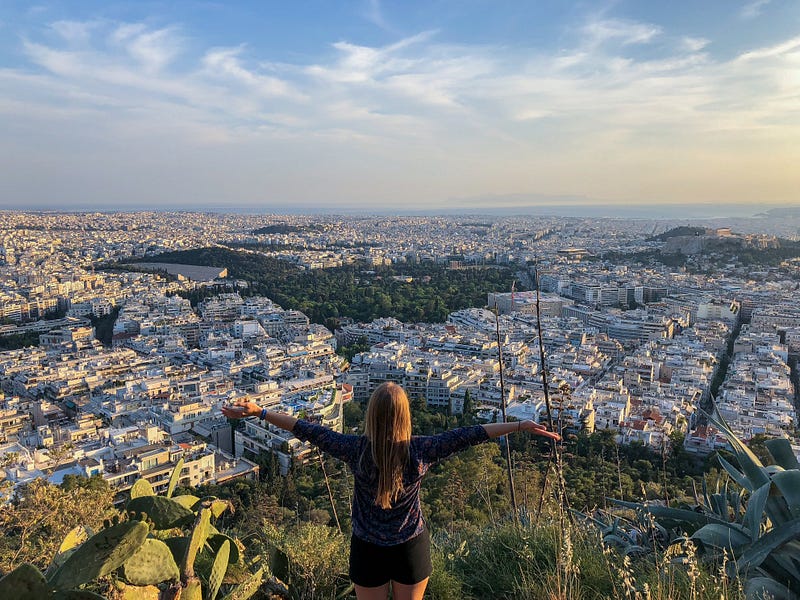
As an example, I am writing this article in Athens, Greece, a city that perfectly fulfills all of my criteria.
Now, if I only considered the travel aspect, the Greek islands would be better. But they don’t work well as nomad bases.
2. Focus on building a routine before celebrating the lifestyle
The biggest mistake most first-time digital nomads make is to fall into the holiday trap.
They arrive in an exotic location with high-minded ambitions, business ideas, and courage, but ultimately spend the bulk of their days surfing, partying, and chilling.
Six months later, they rejoin the corporate world in their home countries with a hole in their wallet and no real-world digital nomad experience.
They might have collected memories along the way, but they weren’t able to build their preferred lifestyle.
If you’re serious about remote work, you first need to establish a routine.
In this context, it’s best to design this routine at home and mirror it on the road.
If you want to become a freelance content creator and travel the world at the same time, try to build a sustainable network of clients and a productive creator’s routine before setting off.
If your goal is to work remotely for a company, test the waters in a neighboring city before committing to a different continent, time zone, and culture.
And if you’re building a business, put all relevant systems in place before moving to Bali.
The lesson here is the following: no matter the sector, establish a core set of systems and habits that will secure your professional success in any location.
Digital nomads naturally have flexible schedules, but the basic aspects of their routines — like getting up early and following a certain workflow — don’t change when they travel.
3. Don’t beat yourself up for classic digital nomad mistakes
During my first two months as a digital nomad in Asia, I incessantly beat myself up for not seeing enough of the places I was staying in.
During that period, I spent time in 20 cities but barely scratched their surface. I was traveling, but not exploring.
Most of my work was freelance at the time, and my income streams were irregular.
In short, I was terrified to lose my newly-adopted lifestyle and worked harder as a result.
My inner entrepreneur constantly wrestled my inner adventurer. The former wanted my business to grow quickly while the latter lamented every lost travel opportunity.
I made the classic digital nomad mistake of jumping from city to city without properly managing my time and professional routine.
I was working in Airbnbs in Asia, but they could have been in Europe, Africa, or Australia. It wouldn’t have mattered.
The lack of proper exploration made me furious.
Nevertheless, it took me another six months to find my best schedule. I realized that all this self-criticism was a road to nowhere. I had to accept my mistakes.
That’s why you shouldn’t be too hard on yourself during your first stint as a digital nomad.
Everybody makes mistakes and loses time, energy, and money. You’re allowed to make those mistakes as long as you implement their lessons in the future.
4. Spend enough time in each location
The solution to my initial travel vs business dilemma was simple: I needed to spend more time in each location.
My first year as a remote worker was a steep learning curve with lots of lessons. The most crucial might have been the importance of setting up a base and spending a few months there.
How long should I stay in a particular location?
Here’s my method: calculate your time in each location by taking the number of days you’d spend there as a tourist, and turn them into weeks.
For example, if you’d spend four days in Bangkok as a tourist, spend one month there as a digital nomad.
That way, you’ll have six working days for every off-day.
Of course, some nomads have more free time than others, but planning this way will guarantee enough time to secure the wellbeing of your business while also providing some well-deserved tourist experiences.
5. Don’t get sucked into the nomad bubble
Another essential tip for first-time digital nomads is not to remain trapped inside a nomad bubble.
In simple terms, don’t be scared to immerse yourself in the local culture.
You don’t need to be a perennial nomad who spends all of his time in ex-pat hotspots with other nomads.
I know the drill. Digital nomadism is still an unconventional lifestyle. Many people don’t understand, let alone admire this choice.
In our hometowns, admiration and social confirmation are rare. Our friends and family support us, but they don’t celebrate our path.
In our nomad bases, on the other hand, we don’t know a lot of people, and we don’t feel like locals. The natives see us as economy boosters, but not much more.
Consequently, the only people who truly understand and value our lifestyles are fellow nomads. This makes them natural allies and creates an ample foundation for friendship.
Nevertheless, we shouldn’t always take the comfortable route.
When you’re living in a digital nomad hotspot like Chiang Mai or Budapest, you run the risk of staying in a nomad bubble without any ties to the local community.
I believe that exiting your comfort zone will make you a better nomad, a more astute entrepreneur, and a more rounded human being.
Talk to strangers on the bus. Tell the locals about your lifestyle. Work in university libraries and try to meet local students. Go on dating apps if you have to.
And finally, always seek a balance between connecting with fellow nomads and experiencing the local culture.
6. Be prepared to lose your feeling of “being home”
When you commit to the digital nomad lifestyle, there are certain things you have to give up. One of those is the feeling of “home.”
As a full-time planet roamer, you won’t feel home anywhere.
But I can always return to my hometown.
You can, but it won’t be the same. Your friends will move on with their lives. Their priorities will change. And yours will too.
You’ll always have a different outlook on life, and not many people will share your vision.
You’ll struggle to blend in because you’ve made unorthodox decisions. As such, you won’t feel at home because you’ve become a full-time traveler.
Your hometown will be one part of your life, but it won’t be your natural retreat anymore.
What about finding a new home?
Of course, if you’re moving to a new place permanently, fully integrate into the local society, and feel part of the community, you can find a new home.
This, however, doesn’t work if you want to retain your digital nomad flexibility.
Unfortunately, feeling home and traveling full-time are often mutually exclusive.
Once you commit to the digital nomad lifestyle, you give up your feeling of being home, but you get something else in return: adventure.
7. Enjoy the lifestyle, you’ve earned it
The digital nomad lifestyle is not perfect, but it has a lot going for it.
That’s why my final tip for first-time digital nomads is the following: stay productive, focused, and serious, but don’t forget to enjoy yourself.
I’m sure you’ve heard the common backpacker phrase: “I wish I could stay here.”
As a digital nomad, you can.
Take full advantage of your flexibility and experience as many places as possible.
Once you’ve established your most suitable routine, you can make the lifestyle work without losing money, career opportunities, or time.
And when that time comes, you can be proud of yourself.
Even if your digital nomad odyssey only lasts a year, you still made a courageous choice most people could only dream of.


