
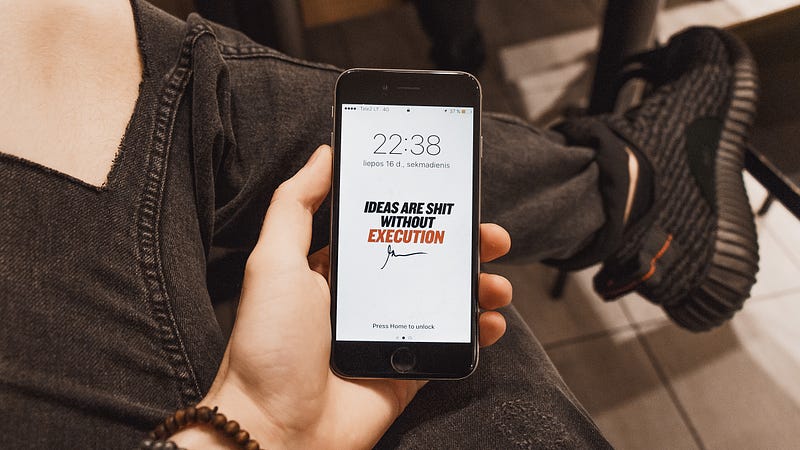
The True Meaning Behind Always Hustling
Hustle bros want you to keep hustling when in reality you’re running in place.
Everyone is doing a lot of grinding and it’s all been by design. Whether you call it hustling or grinding, the whole “rise and grind” mantra is posted everywhere and the vast majority of us take it up as some kind of mantra.
It is to the point that I can say grinding or grind and people can immediately register that I’m talking about work, and not something lewd or sensual.
It has become central to our culture and it fuels various actions or decisions. Many turn to productivity hacks or learning new systems to help them inch out a few extra minutes of work. People take up fasting because some executives tout it for its “heightened focus” ability.
Hustle bros live by that and spin it in such a convincing way in their rented Lamborghinis.
For decades this idea of working to the point you’re “grinding” has been pushed as the penultimate form of productivity. If everything in your work life is optimized, you’re able to achieve so many great things. And if you work exceedingly long hours, you’re able to get even more out of it.
But is that all really true?
Because despite hustle bros getting that title, they’re not exactly productive people. When you look at their output objectively, there’s nothing really unique about the courses they sell. A lot of it is the same recycled content that you would’ve found someplace else.
The only appeal to hustle bro courses is that it’s a reference point you can easily turn to.
Then there are people like Elon Musk who brags he works 80 hours a week. Well last I heard, his dick-shaped rocket blew up on 4/20 and he’s burning Twitter to the ground so badly that even its former CEO has caught on that it was a terrible mistake.
This must certainly be peak productivity, overspending on a social media site and grinding so much that the site is getting progressively worse.
The reality is that “always be hustling” or “grinding” are buzzwords that we’ve built our work identities around and they serve little to no value for us. Even though these kinds of mantras have been around for the past few decades, it harkens back to old forms of work that are no longer relevant to how we work today.
And it keeps us locked into older or regressive ways of thinking, like how those at the top create jobs that serve little purpose beyond keeping the status quo. Here is why.
It Keeps Us Distracted From Our Main Goals
As this article from Mel Magazine points out one issue the author theorizes is that the terms are masked to hide away the fact that we’re all truly disorganized people.
They go into how digital clutter can really mess up our focus and prevent us from getting into our flow state and putting out our mediocre work. The same can be said about an unkempt desk or other visual distractions.
I believe the author is on the right track as technology has made it an incredible tool to boost productivity, but also an addictive tool that can sap away at our time. Based on the fact our attention spans have dropped so much, it’s not too surprising that our computers force us to do a mixture of both these days.
But the article failed to tie this back into the whole hustle and grind culture that some extreme productivity gurus and hustle bros push. For sure, technology has made us all procrastinate more often and distract us more often than we would like. But the culture of always grinding or always hustling serves as a way to gaslight us into finding a new way to get more out of our work.
In this case, the author went into how we need to prioritize better. That’s fair, and a good strategy, but it misses the point.
It goes back to the irony of reading an article on how to overcome procrastination while you’re in the middle of work. All because you got a notification from your phone that that article might be worth reading.
It ultimately serves as a decoy and sure enough hustle bros or productivity gurus easily fill that gap in with a strategy that they wish to offer you — much like the author did. That could be buying an expensive course, reading more of their articles, or buying coaching services from them directly.
It creates an artificial problem that we’ve all been struggling with but the solution isn’t exactly one that you’re getting the most out of. Chances are high that the course won’t do much in making you more productive beyond giving you more ideas and avenues to pursue.
In other words more work.
Or the coaching might transition away from productivity tactics and guidance to other issues that you never really thought of lately or haven’t been focusing on.
And when it comes to advice, it could be helpful, but sometimes the advice is vague. Going back to the Mel article, they emphasized making better priorities and organizing. Sure, but it helps to have some clear examples or templates to work with.
It Covers Up Other Systemic Problems That Work Against Us
The problem with the capitalism that we have right now is that it’s incredibly exploitative and no amount of grinding is going to change that. Jeff Bezos makes over $200,000 in a minute while his employees have to pee in bottles.
No amount of extra time working in an Amazon warehouse is going to make you get even remotely close to what Bezos makes in the first minute of the day. This is especially true if you’re a woman as the World Economic Forum predicts it’ll take over 200 years before the gender pay gap is dealt with.
Not to mention the on-the-job sexual harassments that women have to deal with.
This is just the tip of the iceberg as others point out increased odds of developing cancer or that work-related stress has killed people.
Ultimately, the whole grinding or idea that suffering through your work is a noble thing is nonsense. But it effectively hides the problems that we’re currently dealing with.
The dangers of having too many billionaires. Being unable to form unions and demand better compensation. Being able to go to work without being worried about being hit on or sexually harassed.
There are deep systemic issues that prevent us from truly getting ahead. The only people that truly benefit from this are the grifters and those already at the top who really don’t need your money or support. But the only reason they continue to win and get richer is because they are very convincing at making us work and continue to work.
It Covers Up The Fact We May Be Running In Place
Beyond our distractions and neglect of other social issues that keep the status quo, the dangerous part of this culture is the idea of quitting something.
And I don’t mean the failure type.
I remember at the start of my self-improvement journey listening to Jay Shetty and Gary Vaynerchuk with awe and wonder. I remember how they talked about failure as just another stepping stone and you’ve never truly failed unless you didn’t gain anything from the experience.
It’s inspiring because it instills the idea to keep pursuing something and not deviate or change course. They never encourage you to stop and think whether this idea of yours is something to go all in.
Instead, they tell you to jump in with both feet and learn as you go along and if you fail, you try something else but still generally are doing the same thing.
You never truly quit the overarching thing that you do.
What the always hustling mindset instills is that struggle and failure are just part of the process. It’s still progress as success is just around the corner if you keep working more.
It’s a carrot on the stick analogy where it’s tantalizing and dangling right before you, but you can never reach it.
In some cases, it’s truly those systemic issues that get in the way, but in other cases, it could be yourself and the mindset you’ve wedged yourself into.
Hustle bros and productivity gurus have instilled in us this hatred or fear around the idea of quitting. Even if they don’t say that out loud, it’s certainly implied in those inspiring speeches they love to deliver. If you fail, they’re quick to provide you with a pick-me-up or a tool or a course to help you realign and focus back on your work.
All the while hiding the fact you may be spending years of your life chasing after something that you weren’t that great at. It’s the disappearing act all over again.
This isn’t to say that work shouldn’t be a struggle. Work is definitely hard. However, the definition of what hard is depends on who you are talking to.
I consider writing these articles as hard work. They’re taking longer hours than usual. I spend a lot of time rereading and saying paragraphs out loud.
But to a hustle bro, or other hustle porn out there, hard work is more hardcore than that. It’s kinda like this…
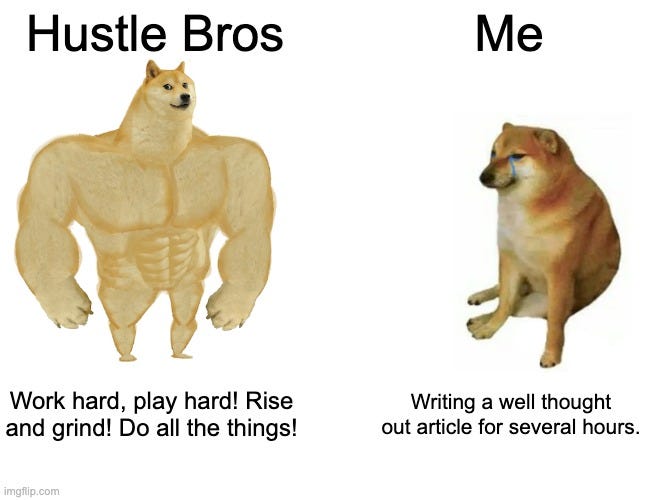
We wish to be like hustle bros to some extent. The idea of being rich and successful by grinding out those long hours seems nice on paper. But it disguises the fact that so much of it is a lie and that the deck is stacked against us in various ways.
And whatever they have to offer really doesn’t solve the true problems that we’re dealing with.
Bigger changes need to happen and chances are likely those changes aren’t going to be coming any time soon, unfortunately. But the biggest thing that we can all do right now is to change how we see hard work and what it means to be productive in this day and age.
We need to be setting better boundaries for ourselves and figure out what exactly helps us get into a better workflow and keeps us focused.
We need to figure out what specific actions that we take will make the biggest differences.
And we need to be working together with other people to truly grow and make bigger changes happen.
Enjoyed the article? Please consider offering your support!
👉 Subscribe to my email list here and receive emails whenever I publish on Medium!


