

You Don’t Need To Disappear For 6 Months
You need a strategy that you can build up day after day.
It’s no surprise that a lot of self-improvement advice out there is questionable or misleading. But probably the most unusual piece of advice that I’ve seen is one that has been memed on for years now.
The disappear for 6 months act.
At some point in time, practically every guru worth their salt out there has said something like this. Many talk about the whole transformational process, where if you just spend 6 months not interacting with anyone, you’ll be so different and live a more upscale life.
It is the pinnacle of productivity to vanish for that allotted time and you’ll get so many things accomplished that would’ve taken you 5 years to get done.
But the reality isn’t so simple. It’s yet another hustle bro tactic that the more you look at it, the weirder and convoluted it gets. It’s more inspirational porn nonsense than it is as actual practical advice on growing and having a fulfilling life.
In fact, disappearing for 6 months will transform your life but not in the way you expect it would.
It Starts With The Preacher
To start, we need to define what disappear actually means. Taking the literal definition of it and mixing it in with what hustle bros imply, the idea is to isolate yourself from everyone and everything and just focus on yourself.
It’s an intense 6 month session on the numerous things that you want to achieve in life.
That much is clear by the fact the advice for the disappearing act encourages people to read, get fit, achieve mental clarity, boost productivity, and make tens of thousands of dollars per month in a side hustle.
But already there are some issues with that. And it all starts with the advocate for this strategy. The preacher.
There are two core issues with the advice from them alone:
- First is the fact they offer vague advice on where to start.
- Second is the fact they’re sending this message on social media.
Now, some of the defenders of this strategy have added clarity to this in the past, noting how so many just say to disappear for months without offering much advice. You’ve also got those graphics that tell you directly what to work for.
No porn. No procrastination. Eat healthy foods. Hit the gym.
The list goes on.
But a lot of these are all buzzwords and feel good. They provide some direction but they’re not very guiding. They’re more likely to give you the fuzzy feelings you’re doing something but not actively pushing you to do those things.
And reaching out to those who advocate for this strategy and you’re likely to hear crickets from them. That or they’ll offer to hop on a call if you can pay them a few hundred dollars.
All in all, most hustle bros have better things to do and would rather sound helpful than actually be helpful. If they were, they would at least offer better direction.
And in the case where they do offer better direction, the information can be… um… questionable… Like this gem.
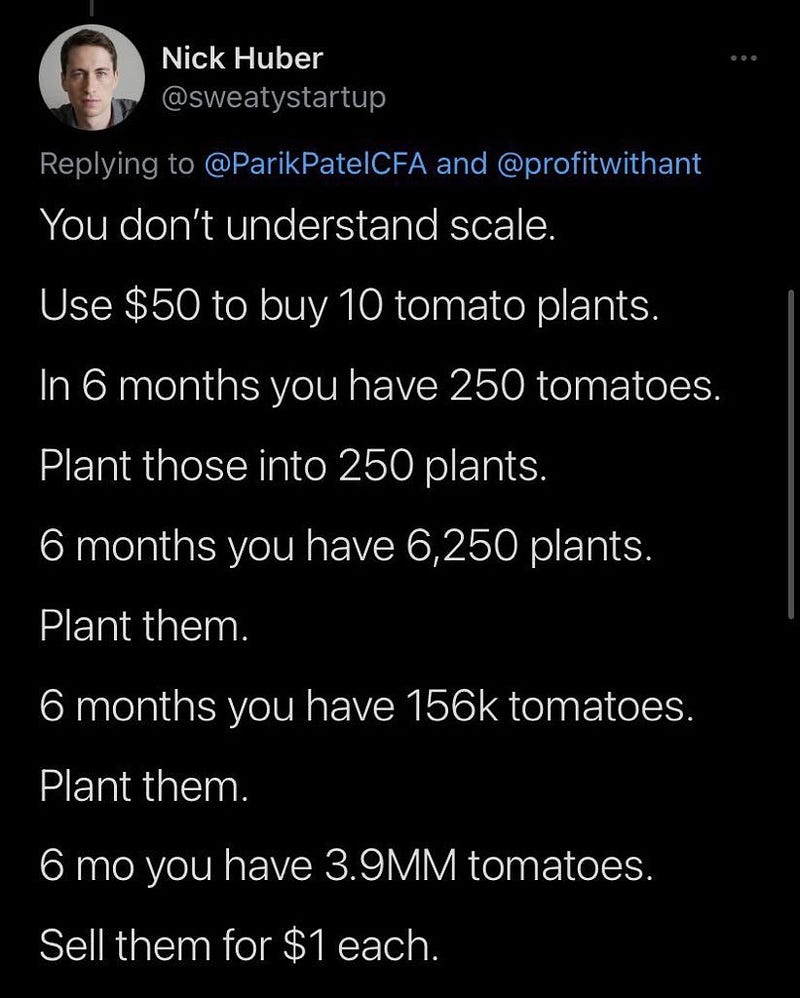
Sure Nick, let’s make every hustle bro out there into a tomato farmer. Surely they can manage to house thousands or millions of tomatoes in their home.
Surely they’re not going to run into any issues with growing those tomatoes too.
Surely some random person knows more about selling tomatoes than a produce farmer who has been going at it for decades.
Why aren’t farmers multi-millionaires then I wonder?
It’s easy to say all of these things than it is to actually do it all. And that leads to my second point.
The fact that this sort of stuff is spoken on Twitter and is circulated to other social media platforms.
One of the key points is to remove distractions during this time of intense focus. You need to focus on the things that are moving the needle of progress and drift away from the things that aren’t.
But one of those things that fits that category for many is social media.
We know social media and technology, in general, is highly addictive. Any hustle bro ought to remove themselves from social media if they were to take this advice. And yet they remain.
Now some can argue that being on social media is an exception. After all, they have monetized their audience. But that leads down a slippery slope.
It’s worth looking at how much money comes from it at that point. Zulie Rane recently deleted a lot of her social media accounts because she, a writer with a massive audience, doesn’t need the dozens of platforms. For her, there was a point where too many platforms were just another distraction.
And despite her massive following, there were a few other social media platforms where she is seeing success. Such as Youtube.
But therein lies the rub. For both Zulie and the hustle bros out there, they already have an established audience that they can monetize. They’ve nurtured it for years. And so it’s weird that the hustle bros are stressing to disappear for 6 months because their audeince are all wanna-be hustle bros.
In other words, they really don’t have the audience to help them grow and be more financially stable. In the end, if they were to spend more time on social media it could prove to be yet another distraction where they spend post after post getting hardly any views or new clients.
Taking the advice literally from hustle bros would mean removing yourself from social media, never to see any of their new posts for months. That or if the hustle bros did take their own advice, they wouldn’t be posting on social media for 6 months.
All in all it’s counter-intuitive and we’re only scratching the surface of this piece of advice.
Isolation Does Stuff To Your Brain
There’s a handful of reasons for why I have a roommate. Setting aside my financial standings, another core reason is so that I have some level of interaction beyond those I talk to online.
If I were to sever that connection by taking this advice, life would be needlessly difficult.
We’re all social beings and even if you’re an introvert, you still need some level of interaction with other people. You still yearn for that connection. This is on top of the fact that those around you who see this will naturally grow concerned if you suddenly stop showing up.
But ultimately, this isolation messes up your brain a lot more than you would expect.
If you have really close friends and start to take this advice, you might begin to look at the numerous flaws that all your friends have and consider them toxic. The problem is, everyone has flaws, even the rich and successful people. Even the hustle bros who spout all of this.
Beyond that, if you so happen to make a highly successful side hustle or business, you then have to deal with the mental aspects that money introduces. And no amount of walking in nature and mindful meditation is going to shield you from that. Especially if you’re stunting yourself by isolating yourself from previously close connections.
What’s Better Is Slow Increment Changes
Hustle bro logic doesn’t make sense because it’s by design. It’s not practical information. It’s inspiring and motivational stuff disguised as advice.
It sounds nice on the surface and inspiring when you only listening to that one piece of advice. But when you take into account every other piece of advice you hear from a hustle bro it makes less sense. It contradicts itself.
You have hustle bros tell you to disappear for 6 months while at the same time encourage you to make newer connections and spend hours on Twitter trying to sell your new side hustle.
They’re telling you in 2 years from now you can build a tomato empire from your parent’s basement if all you focus on is planting more tomatoes. You don’t need any more friends. Your tomatoes are your friends now. They’re the only ones who understand you.
Ultimately this advice is deceptive. Yes, people will transform, but chances are low that the transformation will be any good or helpful. Months of isolation doesn’t tend to go well and as humans we’re only capable of focusing on something for so long. We put ourselves in a bad spot mentally and physically when we do all this.
I understand the idea of this messaging is to have a large amount of dedication and committment to your goals, but people are overhyping this strategy and professing that all of this is a good thing. That there is no issue at all with going from what you’re doing now to suddenly being a tomato farmer out of your home or podcast expert.
But that’s not how you go about it.
Instead of rearranging your life, you want to be making slow and incremental changes. We’re all habits in the end and habits are very tough to break or change.
Want to get healthy? Start with going for a walk for an hour.
Want to meet new people? Attend a few town events or gathering spots.
Want to build a thriving side-business? Do some research and break down the building process into managable steps.
The big thing to keep in mind is committing to this stuff for an hour every single day. If that sounds too difficult for you, you need to start looking at a few cuts or efficiencies. You can even cut that activity back a bit and do three to five one-hour sessions focusing on the thing you want to accomplish.
The point is, you don’t need to disappear for 6 months in order to do something like this. There are far tamer methods to consider.
All of it is just hype.
Enjoyed the article? Please consider offering your support!
👉 Subscribe to my email list here and receive emails whenever I publish on Medium!


