
Too Much Money Is A Mental Illness We Need To Address
The cure is simple in concept but difficult in practice.
All she wanted me to do was sign up for a website and put $50 into an investing account the site provided. She wanted to share that with me because she wanted to see me benefit from it.
After all, she claimed she’s making $1,000 a day from this.
I’ve gotten a few dubious messages from people on Facebook in the past few weeks. The first was a “government official” giving away $30,000. The second happened yesterday, from someone very passionate about Bitcoin and investing.
She just wanted to share with me an opportunity.
The problem is that the site was dubious at best.
The About page mentions “two brothers” who founded the company. No names. No pictures. A review site noted the owner is hiding their identity on WHOIS using a paid service.
One was a “brilliant web developer,” and yet the images on the site don’t load. Also, several of its tabs redirect you to the main page when they suggest otherwise.
And yet she insisted that the company pay. She insists it is legitimate; after all, she recouped all of her losses from previous crypto scams.
I spoke more with her.
From the crypto investments alone, it’s clear she’s making six figures, provided that she is telling the truth about that. She then puts that money into real estate.
She rents out whatever properties she has.
I asked her if she was extorting her tenants. She says probably.
I propose she lowers the rent and puts that money towards much better causes. Make a positive impact. She calls it a philanthropic move. I call it being human.
She also asks from doing that charity how she’ll recover money. I ask her does she really need that much money to live.
This isn’t a sleight on the random stranger who added me on Facebook. She just wanted to rope me in on this investment opportunity. I think the last thing she expected was for me to do quick Google searches and think critically about exactly what she is asking of me.
But the exchange overall reminds me of the gap between those who are wealthy and those who are poor.
Aside from the obvious massive financial differences, the world of the rich is a very weird place. Even though I’m clearly not rich, we’ve seen some weird behaviour from rich people, as well as some unusual statements and claims.
The Clarence Thomas scandal involving Harlan Crow revealed Crow’s passion for collecting Hitler and Nazi stuff. As someone who collects frog figures, I can understand collecting items and such. But out of everything Crow could possibly select in the world, he picked Nazi stuff.
In a vacuum, the actions we’ve seen over several months from rich people are pretty bizarre as this article points out. But I’d argue that this isn’t because they are “self-made billionaires."
I’d argue that this is something that naturally happens when you have too much money.
The More Money You Make, The Less You Can Connect With Others
She called lowering her rent and putting her Bitcoin money towards something that would benefit her community and the world a philanthropic move.
What this tells me is that in this Facebook stranger’s mind, all of this is a transaction. A give-and-take relationship. She says she wishes for this opportunity to benefit me, but there are much better ways to support me.
Clicking on the links at the bottom of this article is a decent start. Heck, even reading this article is a help.
It’s not $1,000 per day, but I can be more certain that a site like Medium or Patreon isn’t at risk of folding in the next 24 hours.
The thing is, when you have more money to work with, the challenges that you face begin to shift. If you can easily cover your basic needs without worry, then the next logical step is how you can begin saving up money.
Along with that shift in problems, your mindset adapts to those changes accordingly. They affect you, and in turn, you begin to see the world in a different light.
It’s why I think giving your tenants affordable housing and giving money to the community is a natural thing to do if you have so much money laying around, and why the rich lady thinks it’s a philanthropic move. As if these transactions are all about leveraging a good situation.
We do have different problems and therefore different thinking, but that affects more than just ourselves.
If you make a lot of money, science shows you tend to be a bad tipper. While the idea of tipping is antiquated and should just be part of the cost of the meal, it still says something about how the rich treat one of the most underappreciated workers out there.
Even beyond that, the conversation I had with the rich lady made it obvious that a charitable act from her ought to result in a much bigger return.
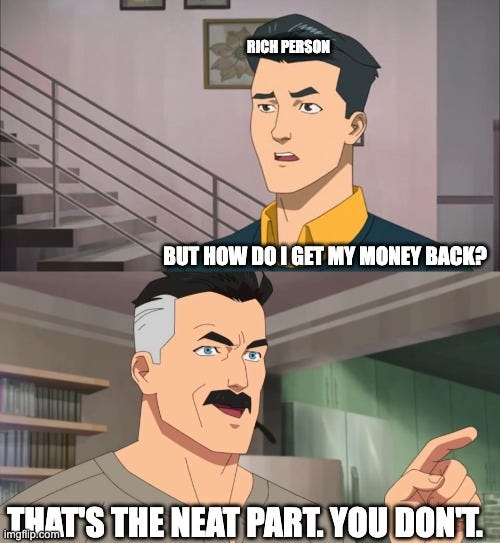
It’s clear that getting the warm fuzzies inside from doing something genuinely helpful for someone and helping them out in their time of need isn’t really enough.
And that’s the problem.
Once you reach a certain threshold of income, there becomes a bigger disconnection between you and those around you.
Mark Zuckerberg poured billions into the Metaverse and professed that it was the future and that everyone would be using it. A quick look at the graphics and most gamers can compare the graphics to an older generation console.
A console that was sold for hundreds rather than billions of dollars.
Either Zuckerberg got scammed in the most embarrassing way possible and doesn’t want to admit that, or he genuinely believes that we are so excited about one day having our entire lives in the Metaverse and that we will be living in a similar way to the film Ready Player One within the next 5 to 10 years.
Elon Musk carried in a sink on his first day of owning Twitter, thinking he was being funny about it.
Some even believe they are descendants of ancient pharaohs, destined to rule the earth.
Let that sink in for you.
Money Generates Less Empathy And Care For Humanity
I still remember Elon Musk babbling about how, if he ever got a solid case presented to him, he would “solve world hunger.”
Setting aside the fact his dad owns an emerald mine, the government kicked over nearly 5 billion dollars to him, and he skips payments routinely, he clearly has way too much money.
The guy lives in a tiny home that costs $50,000 to maintain.
Even if the former richest man in the world is lying about solving world hunger, the fact that he’s brought it up and has done nothing with his insane wealth speaks volumes about how much he cares about humanity.
In the eyes of people like Jeff Bezos, Elon Musk, and Richard Branson, it’s better to go to another planet entirely and rebuild there instead of trying to address issues impacting Earth right now.
To think Musk has any emotional intelligence is absurd when you think about these particular facts. Given the option to solve world hunger or rebuild humanity on another planet, he’s decided on the latter.
All of this leads back to what was said above. Your mindset changes dramatically to the point where you become ignorant of other people’s problems. This is due in part to the fact that when you make more money, you tend to isolate yourself more.
Sure, you might be friends with other rich folk, but that isn’t so different from what we non-rich people deal with on social media. On social media, the algorithms specifically give us the experience of an echo chamber, never changing or challenging our views.
Imagine what it would be like to live that outside of social media.
As soon as one rich person presents a rich versus peasant ideology, a rich person will find themselves in this constant cycle where the rich are superior and the poor are inferior and always will be. On top of that, we as a society reward that kind of behaviour.
This is why the scandal with Clarance Thomas and Harlan Crow is going to result in an obvious uproar but no real consequences despite the demand to remove him. The systems we’ve built aren’t designed to take down those already at the top.
On top of the overwhelming respect and frankly worship we provide to these individuals, they’re bathing in confirmation bias that they are the best, smartest, and most capable beings on the planet.
This is despite the fact that many had obvious advantages over the common human being from the very start. And that, too, affects how they see the world.
How can we call these individuals empathetic when even the Forbes 30-under-30 list consists of many of those individuals in jail?
Rich People Are Hoarders
I never saw an episode of Hoarders, but I know enough about it to know that the goal is to deliver a particular message.
When you have too much of something, your lifestyle is completely disrupted.
The reality TV show is just focused on stuff, but that same philosophy can apply to money as well. When we have too much money, our mindsets begin to change, and we become a less understanding human being.
Even with other people telling non-rich folk to adopt a solid money philosophy, science dictates we naturally feel this way, and it’s easy to get into this same cycle.
Scientists conducted an experiment around the game Monopoly. One player rolled two dice and started with more money, while the other rolled a single die and had less starting cash.
Furthermore, even though the game was obviously rigged, the experiment found that when the rich players were asked how they felt about the game and what led them to win, they talked about their strategy of buying up property and their performance measurements.
They completely ignored the fact they had a distinct advantage, and it was all dictated by the flip of a coin: random chance.
Monopoly is designed to show the dangers of oligarchies and monopolies in the business world. But this also provides some insight into how the average person behaves with money. Even though the money is all fake, we see this displayed in people who do have real money.
No amount of money or mindset philosophy training is going to change much of your attitude around this. We’ve seen this time and time again with those winning lotteries before burning it all on stuff.
All in all, there is a certain threshold for individual wealth that gives them happiness and meaning. But anything beyond that doesn’t provide benefits of any kind. It creates a regressive system that affects our overall mentality.
Hoarding money creates a psychological imbalance that even these “great and wealthy people” can’t even manage to re-balance.
The Cure
In the end, the cure to this problem is simple: we need billionaires to stop being billionaires. And the solutions that are proposed seem reasonable. Beyond forcing them to pay heftier fines whenever they do something terrible, having stronger tax systems in place to prevent the wealth gap from widening is a good start.
But the problem is more nuanced than that. Looking at MacKenzie Scott, a philanthropist, she’s donated $14 billion dollars already and yet she is still worth nearly $30 billion due to the fact that people can’t stop buying her books and buying from Amazon (she still has a 4% stake in Amazon).
It’s one thing to encourage philanthropy among those who can afford it, but it takes more than just someone proposing that idea to rich people. Their lifestyles have changed forever, and they have spent decades conditioning themselves to think in a specific way. It’s almost as if they are as much of a victim as those they exploit, ignore, or look down upon.
The only problem is that the rich are so conditioned to not even consider their fellow human beings.
It’s almost like this is a mental health issue.
But beyond those individuals, what we can control is ourselves and how we see these rich individuals. By no means are they completely heartless or evil people. The system made them that way.
But at the same time, these individuals are not “peak human achievement.” We don’t need to know what their habits are or try to be like them. After all, they were already in privileged positions. They’re rolling the double die and always have been.
That doesn’t make them better than us. It just means they were the lucky player who got picked in a game that has been rigged and stacked against the common individual.
When we look at it from that perspective, the insanely rich people are more like us. Human beings suffering from severe mental health problems with no actual way out.
Perhaps it’s time they call in a therapist. They have the money for it.
Enjoyed the article? Please consider offering your support!
👉 Subscribe to my email list here and receive emails whenever I publish on Medium!


