
Static Methods: Python OOP Complete Course — Part 6

Before we start let me tell you that:
- This article is a part of The Complete Course in Object Oriented Programming in Python which you can find it here.
- All resources are available in the “Resources” section below.
- This article is also available as a YouTube video here.
Introduction
So far, you have learned how to add methods and attributes on the class level which are class attributes and class methods and on the object level which are instance attributes and instance methods. But what if you want to define a method that does need access neither to the object nor to the class itself? Let us see in this article. So…
This article will cover the following outlines:
1. Attributes Types and Methods Types Reminder

So far, we have learned about the two types of attributes and two types of methods which are:
- Instance Attributes
- Class Attributes
- Instance Methods
- Class Methods
This article is focusing on the last type of methods that you will learn about in this course which is
- Static Methods
(If you like to remember the Instance Attributes and Instance Methods article, Just click here). (If you like to remember the Class Attributes and Class Methods article, Just click here).
Let us learn about static methods and in which context you have to define a static method.
2. Static Methods
Static Methods are the methods that have a logical connection to the class itself, but they don’t need access to neither instance attributes nor class attributes.

So, why do I have to define a method that doesn’t have any access to any of the attributes?
Simply, sometimes you have methods that are just logically connected to this class even if it doesn’t need this access to any of those attributes.
A common example of static methods is if you want to define some utility functions under one class, and these functions are usually used as helpful functions for the work of other class methods or other classes.
The question now is, how we can create a static method?
3. Static Methods Syntax
To create a static method:
- First of all, we define a class and give it a name ClassName.
- This method is defined using the keyword def as a normal function in Python and gives the method a name.
- After that, you can use as many as you want of positional arguments, and arbitrary arguments.
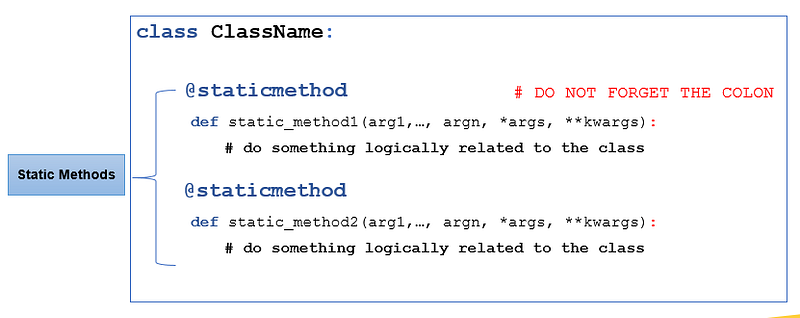
- For static methods, we use the decorator “@static method”, where this decorator will convert your method from a normal instance method into a static method.
class ClassName: @staticmethod
def static_method1(arg1,…, argn, *args, **kwargs):
# do something logically related to the class @staticmethod
def static_method2(arg1,…, argn, *args, **kwargs):
# do something logically related to the classAs usual, don’t forget to use the colon after your function definition to avoid a syntax error.
Note:
- The first parameter for this method is not (self: the instance) or (cls: the class) which means that this method doesn’t have any access to the class state “class attributes” ( any information related to the class itself) or to the object state “instance attributes” ( any information related to the object itself)
- Remember it does something logically related to the class.
- Finally, you can list as many as you wish of static methods and let them do something logically related to the class according to your use case.

Going back to the Student example which has been implemented in the previous articles. Where it has
- Multiple class and instance attributes.
- One instance and two class methods, as follows:
from datetime import datetimeclass Student: num_undergraduates = 0
num_ postgraduates = 0 undergraduates_age_range = range(19, 24)
postgraduates_age_range = range(24, 30) def __init__(self, _id, first_name, last_name, age): self.id = _id
self.first_name = first_name
self.last_name = last_name
self.full_name = self.first_name + " " + self.last_name
self.age = age if self.age in Student.undergraduates_age_range:
Student.num_undergraduates += 1 elif self.age in Student.postgraduates_age_range:
Student.num_postgraduates += 1 else:
raise Exception('Invalid Age') self.classes = [] def enrol(self, class_name):
print(self.full_name)
self.classes.append(class_name) @classmethod
def get_undergraduates_percentage(cls):
num_students = cls.num_undergraduates + cls.num_postgraduates return cls.num_undergraduates / num_students@classmethod
def create_student_from_birthday(cls, student_id, first_name,
last_name,birthday): age = round((datetime.now() - birthday).days / 365)
return cls(student_id, first_name, last_name, age)Assume we need a method that would return true if the student is passed and return false if the student isn’t passed according to his/her CGPA.
If you think about this method you will figure out that this method does not need any access to either instance attributes or class attributes, it is just logically related to your class.
Now, let us add this method:
- Define a new method which is a static method (using the decorator @staticmethod) and its name is_passed.
- This method takes the student’s CGPA as an argument, in case this CGPA is greater than 50 it returns True (passed) otherwise it returns False (failed) (refer to the last method in the next example).
Solution Input:
from datetime import datetimeclass Student: num_undergraduates = 0
num_ postgraduates = 0 undergraduates_age_range = range(19, 24)
postgraduates_age_range = range(24, 30) def __init__(self, _id, first_name, last_name, age): self.id = _id
self.first_name = first_name
self.last_name = last_name
self.full_name = self.first_name + " " + self.last_name
self.age = age if self.age in Student.undergraduates_age_range:
Student.num_undergraduates += 1 elif self.age in Student.postgraduates_age_range:
Student.num_postgraduates += 1 else:
raise Exception('Invalid Age') self.classes = [] def enrol(self, class_name):
print(self.full_name)
self.classes.append(class_name) @classmethod
def get_undergraduates_percentage(cls):
num_students = cls.num_undergraduates + cls.num_postgraduates return cls.num_undergraduates / num_students@classmethod
def create_student_from_birthday(cls, student_id, first_name,
last_name,birthday): age = round((datetime.now() - birthday).days / 365)
return cls(student_id, first_name, last_name, age)@staticmethod
def is_passed(cgpa): if cgpa > 50:
return True else:
return FalseKeep in mind that when you name your static method all the letters should be small, and we use underscore if there are more than two words.
Till now the static method has been defined but has not been called yet.
So let us try to call this method, simply to call it, you just need to:
- Define the variable cgpa.
- Use the class name Student.the_method_name
- Pass the method’s parameters
Solution Input:
cgpa = 30if Student.is_passed(cgpa):
print('Passed')else:
print('Failed')Output
FailedWe got Failed as a result because in this case, cgpa is less than 50 which means this student is not passed.
Now, let us try to replace 30 with 55…
Solution Input:
cgpa = 55if Student.is_passed(cgpa):
print('Passed')else:
print('Failed')print()Output
PassedGreat job, now you are familiar with all attributes and methods types.
Now, let us summarize what we have learned in this article:

- Static Methods are the methods that have a logical connection to the class, but they don’t need access to neither instance attributes nor class attributes.
- To define a static method, we define it as any normal method in Python, but we use the decorator “@static method”. Refer to Figure 1.
- Do not forget the colon when you define your functions. Otherwise, you will get a syntax error.
P.S.: A million thanks for your time reading my story. Before you leave let me mention quickly two points:
- First, to get my posts in your inbox directly, would you please subscribe here, and you can follow me here.
- Second, writers made thousands of $$ on Medium. To get unlimited access to Medium stories and start earning, sign up now for Medium membership, which only costs $5 per month. By signing up with this link, you can directly support me at no extra cost to you.
To get back to the previous article, you can use the following link:
Part 5:Class Attributes and Class Methods
To move on to the next article, you can use the following link:
Resources:
- GitHub here.


