
The (Hidden) Layers of Narcissism
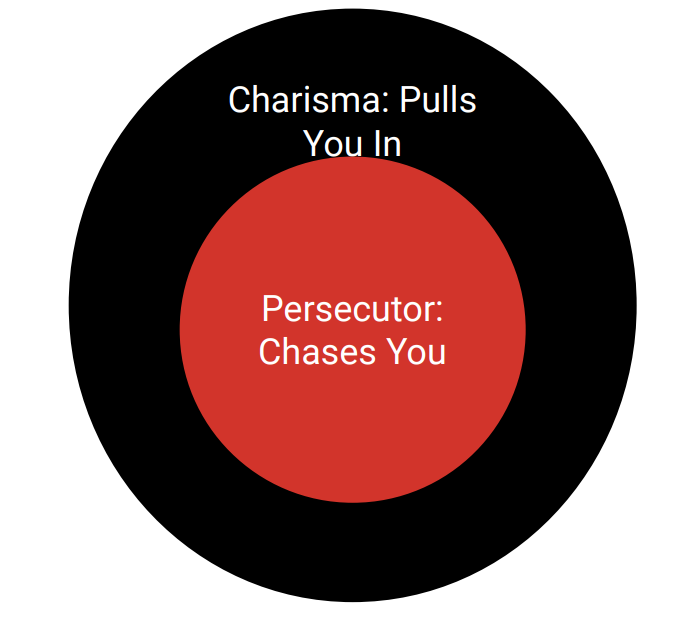
When you therapize a Narcissist, either you are going to make them more sane, or they are going to narcissize you. Narcissizing can involve pleasure or pain, though it usually means both, and in that order.
The First Gaslight: Charisma
Narcissists often initiate relationships with an overwhelming charm. Whether on a date or in therapy, they find your ego, and stroke it. It feels good. The last thing you think is how much power this person already has over you. But no drug is free, and you pay with your freedom.
The first gaslight is simply being made to feel good in preparation for feeling bad. When you look back, you will not understand why you enjoyed your enslavement until you realize that in small doses, being a Narcissist feels good. They put what is inside them into you, like a blood transfusion narcoticizing your psyche. Your reality gets warped the moment you enter their domain.
A gaslight is any manipulation that turns your natural experience on its head, causing you to think the opposite of how you naturally would, usually pathologizing a healthy response so that the gaslighter is no longer to blame. A Narcissist cheats on his wife, and tells her it is because of her sexual hang-ups due to her molestation, and so he is the victim of her dysfunction.
Gaslighting doesn’t require being told you are crazy; you merely need to experience an inverted reality in which your senses are made to work against you. The therapist who succumbs to toxic charm has lowered not only their defenses but their consciousness. Instead of making the Narcissist more conscious, the Narcissist has made the therapist less conscious. The intoxication is real:
The Second Gaslight: Persecution
Once the Narcissist has accessed your ego, they enter your psyche. This is akin to how a virus enters a cell: through the specific receptor for which it evolved. Biologists appreciate the molecular precision with which the virus initiates infection. And like a virus in a cell, the Narcissist enters the psyche and begins to make their own commands that work against the individual’s healthy nature.
The Narcissist’s victim will now steadily lose self-esteem as they yield the sex, attention, energy and obedience the Narcissist demands and reinforces by retracting love or enacting pain. Perhaps Narcissism is most similar to the human immunodeficiency virus (HIV) as it fights the body’s very ability to healthily defend itself, exhausting it in a war of attrition that leads to persecution.
The Persecutor was not created in this moment, but has been beneath the Charisma the whole time. At this point, the victim realizes all the Charisma was conditional, which is how the Narcissist was loved as a child. The victim then sees that the Narcissist turns off the persecution as easily as they had turned it on, both with equal shamelessness. This models for the victim not to judge the Narcissist for fear of more persecution. What I do to you is normal. This is what you deserve.
The biggest crime is not believing one is being committed against you.
The Gaslight Mirrors the Narcissist’s Psyche
We see the Narcissist establish rapport with elixir and then maintain loyalty with venom. The reason for this goes beyond tactics and into revelation. The Charisma-Persecutor sequence parallels the layers in the Narcissist themself.
The common trope is to describe the Narcissist as a Machiavellian who plots each moment until the trap is set and the demise, complete. This makes it sound like a conscious process, which defies the pervasiveness of a mental illness. While the Narcissist calculates their benefit, they never calculated whether to become a Narcissist. The Narcissist is a Narcissist for the same reason someone who isn’t, isn’t.
The Narcissist is not merely manipulating a ‘victim’ into becoming ‘supply’, they are pulling the individual through the layers of the Narcissistic psyche. In Nietzsche’s words, this ‘unconscious autobiography’ conveys not only what the Narcissist is doing, but who they are. On the outside, they are Charisma, but that is merely a shell for the Persecutor. Yet the Persecutor is merely protective layering for someone far more vulnerable.
The (Hidden) Inner Child
At the core is a severely wounded child who was not loved. The child received minimal empathy and so did not learn to believe in giving empathy. The child is immensely insecure, and believes the world is as lacking in empathy as he is.
We see a symbol of this in Harry Potter and the Deathly Hallows. When Harry dies, Voldemort is living his best life, laughing at the dead orphan. Meanwhile, Harry sees this in the afterlife:

Voldemort’s wounded inner child is in a fetal position, suggesting his underdeveloped humanity. While his Narcissistic facet was reveling in power, his inner self was in utter misery. But Voldemort never revealed this hidden vulnerability to others because he never revealed it to himself.
The Narcissist will almost never admit that they are terrified to be vulnerable, that they need to be vulnerable. Hence to therapize a Narcissist or simply to love them, you must own a more complete map of their consciousness than the edition they use.
Who We Are at Our Core
You have to believe that at their core, the Narcissist is no different than a non-Narcissist; that we all need love and suffer in its absence; that we hurt others when we are hurt; that we often need love when we make it hardest for those who would give it; that we all seek to return to love, only, we are terrified to open ourselves.
It’s hard to sit with someone whose entire personality is a pathologized defense mechanism, and see the love in them. It’s harder to see further into themselves than they do. Narcissism has taught me about love because love is not only an emotion, and not only for those who ‘deserve’ it. Narcissism has taught me to look at a Narcissist and see…a human.
The Narcissist eternally tempts you to eat the same forbidden fruit they gave themselves: the belief that this person really has no love in them. They may have no shame, but that’s only an outgrowth of their forgetting that they, too, are love.
To follow me: https://medium.com/@myartman
To subscribe: https://medium.com/@myartman/membership
Also read How Narcissists See Love, Why Therapists Fear Narcissists and What Narcissists and Borderlines Teach us About Love


