
5 Reasons Why Your Life Is a Jigsaw Puzzle Game
These are just a few of many.
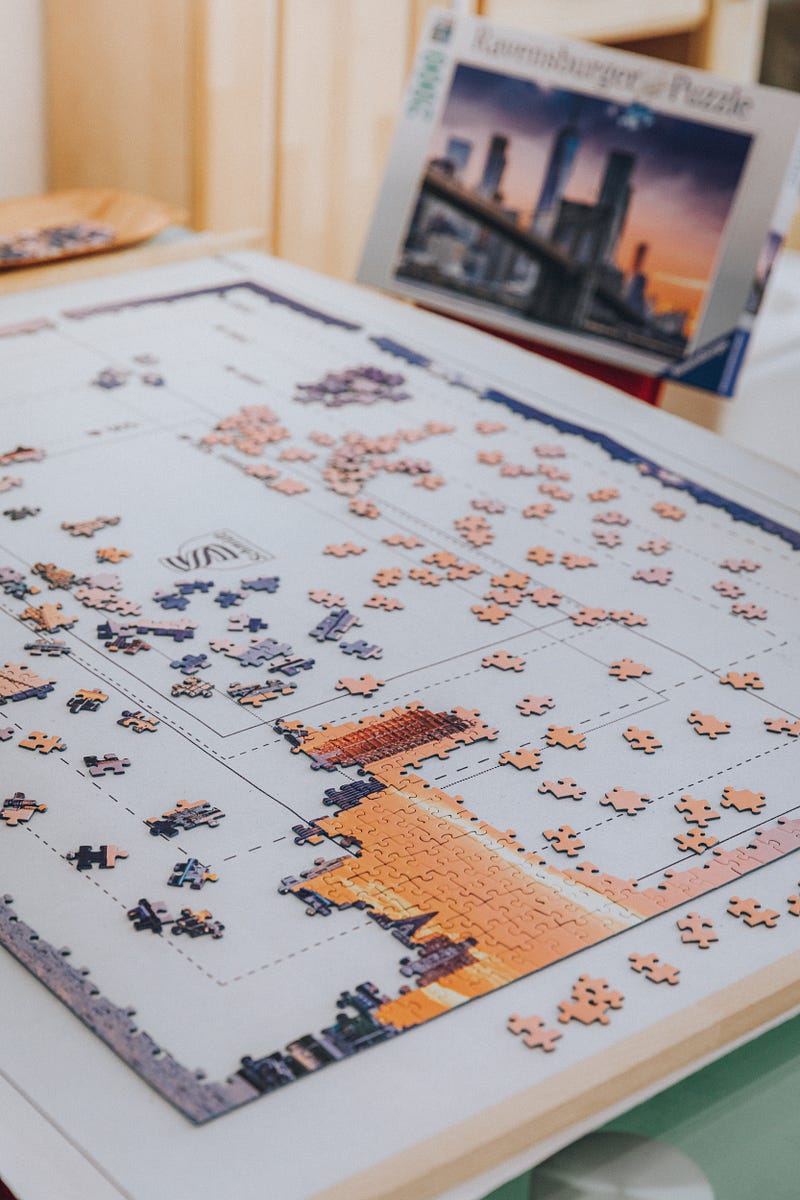
I often look for parallels between games and real-life. There are so many, and they are truly inspiring. Since recently, I embarked on an adventure to research various games — with or without playing them directly — and look for analogies and parallels in them and my life outside games.
Something new
My children got a little gift from their grandparents during this Fall’s vacation. Each got a 500-piece set of Jixelz, which are “colorful jigsaw-shaped building pieces for making colorful designs.”
It was interesting for me to discover this possibility to create a mosaic-like design using jigsaw-shaped pieces.
A jigsaw puzzle is a game.
At a recent workshop about turning life into games, I claimed that jigsaw puzzles were also games. This unnecessary obstacle of assembling a picture from many small pieces when you could just cut the picture out of the box that comes with the puzzle and hang it on your wall. But then you wouldn’t experience the fun of the challenge of the seemingly tedious assembling procedure.
Shortly after, I was delighted to find out that I wasn’t the only one considering jigsaw puzzles being games. This site collects and offers free jigsaw puzzles and writers the following in a call for action:
“Missing a feature? We’re working hard on keeping ahead of other jigsaw puzzle games, and every nice idea counts. Hit “Feedback” button on the right and let us know!” — The Jigsaw Puzzles
Parallels between jigsaw puzzle games and our lives outside of games
The more I learn about games, the more I am convinced that there are analogies and parallels to find in both games and our lives outside of games. Both sides get inspiration from each other. As I mentioned above, I embarked on a fun adventure to research games and discovered how they could inspire us to rediscover fun and joy in life.
Here are at least five aspects of jigsaw puzzle games where we can draw the parallels to real-life projects and activities.
1. Definition
The first parallel is in the definition.
“A jigsaw puzzle is a tiling puzzle that requires the assembly of often oddly shaped interlocking and mosaiced pieces. Typically, each individual piece has a portion of a picture; when assembled, the jigsaw puzzle produces a complete picture.” — Wikipedia
This definition is perfect for a potential project. We have all those scraps of ideas that somehow relate to each other, but we don’t know yet what the whole picture would be.
And each piece has a portion of a big picture of where we are heading. We might see the picture in our minds as we see them on the box holding the jigsaw puzzle pieces, but we don’t know how they connect and can’t discover all the details before we start assembling bit-by-small-bit.
2. Assembling the frame
Many jigsaw puzzlers start assembling the picture with the frame. They put out the pieces that have straight edges aside and put them together in a frame before searching and assembling the pieces inside the puzzle.
Once again, this sounds so much like a real-life project. When you start defining a project with a customer, you make a list of things to address. You go through the list and mark those bits that are clear (= have straight edges) and only later address those that need more consideration. Otherwise, you’ll be stuck and make no progress in your project.
As in the jigsaw puzzles, assembling the frame — the easy part — first will give you ideas and clues of those more complex and unidentifiable pieces.
I wouldn’t be the only one who has heard and used the phrase “let’s set the frame” for a project or activity.
I’m just in awe of how similar real-life projects and activities and progress in them is to assembling a fun jigsaw puzzle.
3. An indefinite number of variants
The Jixelz I mentioned above is just one of the multiple variants of jigsaw puzzles. The page on Wikipedia I quoted above and here has several fun pictures of various types of such puzzles.
There are even jigsaw puzzles without a picture of them. There are three-dimensional puzzles, and those made from different materials — such as wood and paper, and varying shapes.
My prejudice toward these puzzles being only of one or maybe two types (with the 3D effect) reminded me of my prejudice toward the supposed real-life project's one-dimensionality.
In the past, I used to look for traps. I even remember creating slides on traps for implementation of an international standard into an organization’s environment.
Concentrating on traps and possible failures takes away the excitement from looking at the big picture and the multiple exciting possibilities a project or activity could create when discovering and enjoying each step on the way.
4. How pieces fit
In a jigsaw puzzle, there is always a specific way of how the pieces fit together. If you need to apply pressure to make two pieces fit, there is a possibility that one of the pieces is in the wrong place.
Wow, what a brilliant tip for real-life projects!
Instead of forcing ourselves to do something, we can first look at what we resist and what might be the reason for that. In other words, we could recognize that maybe we are looking at the wrong piece (tool, method, approach, point in time, etc.) in what we do and do one of the following things we also do when we assemble a jigsaw puzzle:
- Put the “wrong” piece aside and look for another, which would fit perfectly in the space we are in at any specific moment.
- Leave the space we occupy (or concentrate upon) right now and follow the “story” of that “wrong” piece and try to find where it fits perfectly, in other words, where it becomes the “right” piece.
Another aspect of fitting the pieces together is that in a jigsaw puzzle, you are aware that you can’t solve it at once, even if you can’t wait to put in the last piece in place, solve the puzzle and announce to the world that you “did it.”
But in real-life projects, we often disregard that necessity to progress one little step at a time.
“Comparing” our lives non-judgmentally to jigsaw puzzles can help us come back to where we are and approach each little puzzle brick of our lives with full attention and engagement.
5. Final piece
There is only one way to lose in a jigsaw puzzle game. And that is to give it up.
And even if you give up, you are not considering yourself a failure.
Besides, setting aside a puzzle often doesn’t mean that you give it up completely. You might get an appetite for it again and continue assembling it at a later time until you put in the final piece in it.
Or if you decide that this puzzle is not for you, you might consider asking a friend who likes jigsaw puzzles and ask her or him whether they want to continue assembling the picture you started.
About a year ago, I started a sweet fantasy inspired picture puzzle with many books on it. At some point, after putting it aside and starting many times again, I stopped. I realized that I love reading books more than assembling puzzles. So I gave some of the fun gear I purchased to assemble this and other puzzles to a friend. I kept the jigsaw-puzzle-shaped cases for sorting small bits when creating and building something. My children and I use them when playing with Lego or for the Jixelz I mentioned above.
Sorry for the small detour. In this final section of this story, all I wanted to say is that you can give yourself a break in your real-life projects and activities. Just like in the jigsaw puzzles, don’t blame yourself if you don’t see the project through to put the final piece ASAP.
If the time and circumstances allow you, put the project aside, or ask someone interested in taking it over from you and solving the puzzle for themselves. Or find out how you can quit this puzzle game. There’s always a way out. Or in, if you wish so.
Your choices are the pieces of your life’s puzzle. They create an exciting picture of your life. You can stop criticizing how your life is evolving and instead approach it with joy and curiosity by turning and studying each step, each piece from various perspectives, and finding out how every one of these pieces fits into the already assembled sections.
Thank you for reading!
If you enjoyed this article, then in addition to the ones referred to above, you might also like these:
P.S. Disentangle a tough project by reading a free “awareness booster” along with a short story, which will provide for the first advice in it of taking time off your stagnating project. Get your “awareness booster” and the short story here: Optimist Writer.