
5 Business Lessons From Floyd “Money” Mayweather
Learn from the richest boxer of all time.
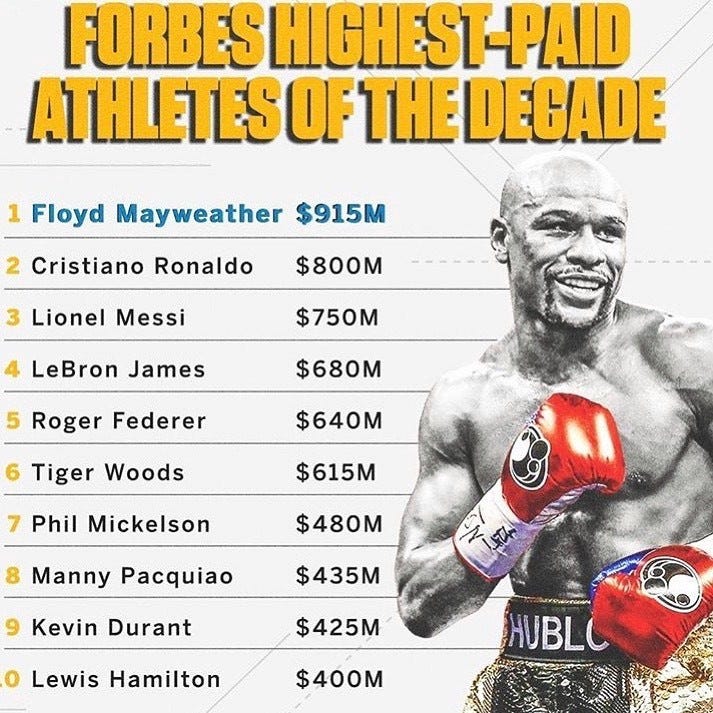
As someone who is both a martial artist and entrepreneur, I’ve studied Floyd Mayweather for years, and there’s a good reason why his nickname is “Money.”
He is, hands down, the smartest businessman boxing has ever seen.
Some time ago, I wrote an article detailing Mayweather’s masterful marketing strategies. I summarized:
The perennially polarizing Floyd Mayweather. Even his staunchest haters have to admit that when it comes to boxing and business, he knows what he’s doing.
Love him or hate him, they always pay to see him.
Mayweather is much more than just a successful marketer, though.
He’s a master businessman in his own right.
Beyond the ring and behind the bright camera flashes, Mayweather shows an acute entrepreneurial intelligence, deploying several shrewd tactics to build a multi-billion-dollar entertainment empire.
Here are five of Mayweather’s savvy business tactics.
These five tactics will give you a sneak peek under the often secretive business of sports and entertainment. If deployed, they won’t just help you become a better entrepreneur.
They’ll help you understand the game of “Money.”
1. An Artist Must Also Be An Entrepreneur
“Floyd has the only business model in sports where he keeps 100 per cent of the money. We changed the paradigm when it comes to the way revenue is generated and distributed.”
— Leonard Ellerbe, CEO of Mayweather Promotions
This is the foundation of Mayweather’s success.
Boxers, and indeed most artists throughout history, have been happy to sit back and let their managers handle the business aspect of the craft for them.
I understand. They got into the art, for well, the art. Not to play at being a businessman.
Things are different now, though.
The rise of the internet and consequently, social media, has ushered in a new age. An age where 6-year-old reviewing toys on YouTube can make millions. An age where streaming yourself playing video games is a legitimate, six-figure career.
And artists have sat up and taken note.
It is now arguably more lucrative for a writer to self-publish his book. He can cut out the middleman (traditional book publishers) by promoting his book through online channels, such as social media and an extensive email list.
And Floyd Mayweather has been cutting out the middlemen before it was cool.
After famously betting $750k on himself to tear up his contract with Top Rank, Floyd Mayweather created his own boxing promotion, Mayweather Promotions.
Floyd would go on to box in his own shows. This means he has unparalleled autonomy, as he is both the boss of the promotion and the athlete competing in it!
It allows him, among other things, to dictate the price of the event. How much to sell the Pay-Per-Views (PPV) for. How much each entrance ticket is priced. He writes his own paycheques. He even gets a cut from event food and merchandise!
A percentage of every hot dog sold, T-shirt purchased, and beer quaffed go straight to Mayweather, via Mayweather Promotions.
Being his own boss is how Floyd was able to land the single biggest payday in the history of sports, a cool $275 million for one night’s work against Conor McGregor.
“He completely changed the entire landscape of how the business of boxing is done.”
— Leonard Ellerbe, CEO of Mayweather Promotions.
It’s an extremely, extremely lucrative business model, and if you think its unfair — well, it really isn’t.
In giving up a fixed paycheque in favour of hosting his own shows, Floyd has the monumental and unenviable task of hosting an entire boxing event.
That means he carries more risk.
2. Take On Calculated Risk
“All courses of action are risky, so prudence is not in avoiding danger (it’s impossible), but calculating risk and acting decisively. Make mistakes of ambition and not mistakes of sloth. Develop the strength to do bold things, not the strength to suffer.”
― Niccolo Machiavelli, The Prince
The bad news is Floyd in charge of everything. Hiring staff, matching up fighters, booking a venue, making promotional footage for TV. It’s all handled by him and his company.
The good news is he’s in charge of everything.
We mentioned that Floyd gets to dictate pricing, but the benefits of being your own boss go way beyond that.
Because he’s the owner, Floyd gets ultimate creative control. He gets to pick things like his opponents, the venue, and the time and place the bout airs.
This means that Floyd has the ability to pick what is best for him.
And to paraphrase Mayweather himself,
“I trust Floyd Mayweather. Because Floyd Mayweather always wants what is best for Floyd Mayweather.”
Artists take note.
It’s fine to work for a company. Even hand-in-hand with a company. Writers have made good money self-publishing on Amazon, just like how entertainers make a great living off YouTube.
However, it’s worth keeping in mind that at the end of the day, businesses will always look out for themselves. They can, and they will pull the rug up from underneath you for their own benefit.
I’m not making things up. A couple of months ago, YouTube made a drastic change in their monetization programme: They restricted ads on videos targeting minors.
Overnight, millions of content creators on YouTube lost their rice bowl.
It’s nothing personal, only business, but this highlights a need for artists to diversify, and to be their own boss.
It’s fine to write on Medium, but make sure you run your own blog as well. Owning your own domain is a safety net, your hedge against the whims of fate.
It’s a high risk, high reward meta, true. Remember that more risk usually means higher rewards, though.
Like Machiavelli wrote in The Prince, “prudence is not in avoiding danger (it’s impossible), but calculating risk and acting decisively.”
Intelligent entrepreneurs always choose the option with the highest upside then do their best to mitigate risk.
As long as you’re alive, there exists risk. It’s impossible to completely eliminate it, but intelligent entrepreneurs do their best to simultaneously mitigate risk and maximize reward.
However, running your own business is an admittedly daunting task — especially a big company like Mayweather Promotions. It’s risky, logistics heavy, and a lot of plain old work. That means you can’t do it alone.
You need a great team behind you.
3. Surround Yourself With Great Business Partners & Mentors
“When you’re the best, you only want to surround yourself with the best.”
— Floyd Mayweather, Jr.
From the outside looking in, both boxing and business look like lonely, solo endeavours. That can’t be further from the truth.
Floyd may be the face of the Mayweather brand, but make no mistake, there are other savvy businessmen within the company, each with their own specific roles to play.
2 notables are Leonard Ellerbe, longtime CEO of Mayweather Promotions, and the reclusive Al Haymon, Floyd’s manager.
Ellerbe has long been Mayweather’s right-hand man. He can be seen doing interviews and brokering deals on behalf of Mayweather Promotions. This leaves Floyd free to focus on his own integral part in the company — promote the fight well — and win it.
As for Al Haymon, well, it’s safe to say that without Al, there wouldn’t be “Money.”
I mean this both in the metaphorical and literal sense.
Al Haymon is the original mastermind behind the Mayweather enterprise. You see, Al got his start in the music business, where he helped manage the likes of Janet Jackson, Whitney Houston, and Eddie Murphy.
After venturing into boxing, Al became Mayweather’s mentor and manager. He introduced the lucrative business model of music promotion to Floyd, and Floyd took to it like a fish to water.
Floyd was the first (and as of this writing, the only) boxer to adopt the superior revenue-generating model of the music biz into boxing, using it to earn several unheard-of 9-figure paydays.
Despite his unparalleled success, Floyd wasn’t content.
His next step, in my opinion, is what makes him a true genius.
In a masterful move, Floyd decided to expand. He created additional businesses independent of Mayweather Promotions.
And though they are seemingly unrelated, these side hustles serve the dual purposes of buttressing his promotional business, as well as providing Floyd with additional income streams.
Here are two concrete examples.
4. Sponsor Yourself
“I would lie in bed, and I was nine years old, and say to myself: ‘I want to be the richest man in the world.’ I’ve come a long way from there.”
— Floyd Mayweather, Jr.
Due to his love of playing the “heel” — the villainous role to promote fights, Floyd has traditionally been shunned by many big-name brands.
He has been outspoken when interviewed about this, saying that being himself is more important, and indeed more lucrative, than corporate endorsements.
While this might be true, corporate endorsements are still a major source of income in the entertainment industry. Floyd recognizes this and has found a unique way to circumvent this problem.
Instead of running around chasing sponsors, Floyd decided to create his own apparel company: The Money Team (TMT)
Creating TMT essentially allows Floyd to sponsor himself.
Get this: Floyd Mayweather owns his own promotional company (Mayweather Promotions) and his own apparel company (TMT). That means he‘s able to make unique moves, such as wearing his own TMT apparel to his own fights.
Conversely, he can also bedeck Mayweather Promotion events with TMT logos to advertise his clothing brand.
I mean, who’s going to stop him? He’s the boss of both companies!
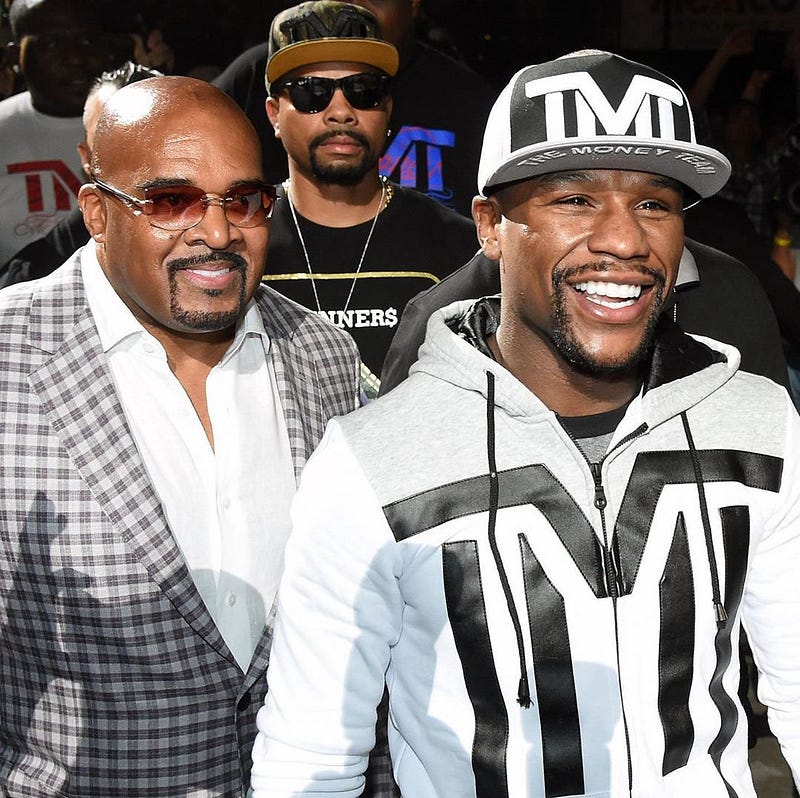
Selling merchandise via TMT opens up an additional source of income for Floyd. He wears his own clothes, draws his own paycheques and consequently has a self-made income stream while waiting on endorsements from big-name brands.
Hublot eventually signed Mayweather for a million-dollar deal, but millions were already made via TMT before that, and will continue to be made should Hublot or any other sponsors drop out.
A win-win system.
5. Capitalize On Your Brand
“I’ve set the model of showing fighters how they should conduct their business.”
— Floyd Mayweather.
Right after beating Conor McGregor to retire undefeated, Floyd announced he’s starting a franchise.
“Mayweather Boxing + Fitness ”is a chain of fitness gyms that possesses 2 unique hooks. It has the potent Floyd Mayweather brand behind it, and more interestingly, it utilizes groundbreaking Virtual Reality (VR) technology during workout sessions.
My personal opinion is that it’ll be a massive success.
Guests will literally be able to have Floyd Mayweather’s virtual self hold mitts for them, even have sparring matches and full-on fights with Floyd’s in-game character.
The best thing about owning these businesses is that they support each other.
If Floyd so chooses, he could have TMT products sold in his gym. Conversely, he could create a custom line TMT apparel specifically for Mayweather Boxing + Fitness to advertise his franchise.
He could sell tickets to Mayweather Promotion events, and at his events, he could sell TMT merchandise and membership packages to his gym.
His businesses fit in with one another like perfect jigsaw puzzles. They funnel millions of eyeballs and dollars from one point to the other. It’s a living, breathing, machine, an art-form, absolutely beautiful to watch.
Floyd doesn’t own multiple one-off businesses — he owns an entire business ecosystem.
Your Takeaway: Create An Unstoppable Ecosystem
“I’m just an American dream.”
— Floyd Mayweather, Jr.
Floyd Mayweather has far transcended the role of an athlete, or yet another mouthy, brash boxing promoter.
Floyd is a verifiable business genius. He doesn’t just own several businesses. He owns businesses that work together beautifully to elevate each other, forming an empire.
He did so by:
1. Realizing every artist must become an entrepreneur
2. Taking calculated risks
3. Surrounding himself with a great team
If there’s anything I’d like you to take away from this article, its to be your own boss.
Being your own boss gives you ultimate autonomy. When you call the shots, you’re free to make the best decisions for yourself.
When your main business is established, you’re also free to make another powerful play — create side businesses to buttress your main one.
Floyd did so by:
4. Sponsoring himself
5. Franchising his brand
That’s how Floyd was able to create a gigantic business empire whose roots and branches are inextricably linked. They nourish each other and will be here churning out millions for him and his descendants, long after Floyd is dust in the wind.
And isn’t that what being a great businessman is all about?
Thank you for reading my story :)


