
How I Started a 5-Figure Business With Just $1000

Not too long ago, if you claimed you could start a business with less than $1000 down, you’ll be laughed out the door.
And rightfully so.
In the era of brick and mortar businesses, $1000 is peanuts.
The arrival of the Internet changed everything.
We live in the Golden Age of Information, where teenagers can earn six-figures by streaming video games on Twitch, and kids not old enough to drive yet can become millionaire YouTube celebrities by reviewing toys.
In 2020, it is possible for anybody to create an online business with very little money upfront.
All you need is a great idea and an internet connection.
I know it’s possible because I did it.
Not only did I start my business with less than $1000 down, for the first couple of months I ran it solely using my beat-up old iPhone.
It’s not all sunshine and rainbows, though.
You have to keep in mind that running a business is still risky, and requires a lot of hard, hard work.
There is no way around it.
The difference is the vast reach of the internet allows you to leverage what little money you have.
It allows you to cut out the middleman of having a physical store and the expenses that come with it.
That’s big.
If you’re ready to put in the hard work, here are some tips that allowed me to transform a thousand bucks into a beautiful, well-oiled machine.
The more niche, the better
“Some people are just into lavish dwarf entertainment.”
You don’t want to get into a business that everyone else is already doing — there’s simply too much competition.
It’s hard to maximize your tiny startup cost if you’re competing with established giants in the industry.
You’ll run out of money faster than you can say “entrepreneur.”
A far better idea is something Tim Ferriss hilariously calls the Lavish Dwarf Entertainment Rule:
“Several years ago, an investment banker was jailed for trade violations. He was caught partly due to his lavish parties on yachts, often featuring hired dwarves. The owner of the dwarf rental company, Danny Black, was quoted in the Wall Street Journal as saying: “Some people are just into lavish dwarf entertainment.”
The story is funny and quite unforgettable, and like all good stories, it contains a shining nugget of truth.
Business-wise, it is far better to be a big fish in a small pond.
There are 7 billion people living on this planet right now. However, niche, kinky or downright strange something is, rest assured that somebody out there is into it — and willing to pay top dollar for your product.
Going into a niche market allows you to charge premium prices since you’re one of the rare handful bringing these customers exactly what they want.
Which brings us to our next point…
Price high and justify
“The bulk of companies set prices in the mid range, and that is where the most competition is. Pricing low is shortsighted, because someone else is always willing to sacrifice more profit margin and drive you both bankrupt.”
— Tim Ferris, The 4-Hour Workweek
I personally made this mistake at the beginning of my entrepreneurship journey — and it nearly killed my company.
I run a martial arts events business where people pay to compete.
In the beginning, I was charging $20-$30 a pop when I should have been charging double that amount.
It’s not greed.
Charging your worth helps keep your company afloat in tough times, pay your staff a fair salary, and above all, it helps you provide even more value to your customers.
Here’s a great example.
Before, because I charged the bare minimum, I was unable to hire experienced staff. I had to rely on volunteers, or pay my staff whatever I could scrounge up.
I didn’t have surplus money to upgrade my equipment, so I ended up renting cheap TV’s that sometimes did not work, and gave out cheap plastic medals to the champions.
Everything changed when I adjusted my prices. We started charging what we’re worth.
Suddenly, I was able to afford experienced referees and timekeepers. That gave my customers a smoother, more enjoyable competition experience.
I swapped out the tacky plastic medals and splurged out on expensive, shiny customized ones made of metal. I exchanged the discount rental TV for new ones that worked properly.
Suddenly, the vibe of my event was different. It was premium, professional — and that newfound professionalism drew more customers.
It also drew media coverage, and with coverage came sponsors.
Do you see how it works now?
The problem is many young entrepreneurs are subconsciously insecure about their product. Hence, they pull down their prices in a bid to compete against more established competition.
Don’t.
Competing with pricing is a race to the bottom of the barrel.
Instead, compete at a value differential.
What’s unique about your company? What do you do that your competitors don’t? What makes your product special, and how does it add to the life of the people who purchase it?
Double down on your unique selling points.
And above all, make sure you actually provide the value promised.
Go above and beyond to make your customer’s experience a good one.
Most people would rather pay extra to have a good experience, to have all their needs taken care off, than skimp on a few dollars and have a bad experience.
Remember, compete with premium value, not with cheap pricing.
Participate actively in your community
“The reason I was able to grow my business was that every day, after producing 30 minutes of wine television, I spent 15 hours a day replying to every single person’s e-mail and every single person’s Twitter @ reply.”
— Gary Varynerchuk
Lastly, remember to connect with your customers.
A big reason for the success of my company is because of two-way communication.
Social media and it’s accompanying direct messaging tools have changed the game completely.
You can now do things like run polls to gather feedback straight from the source — your fans and your customers.
Here’s a poll I ran on my company’s Instagram Story right after my last event. We amassed over 80 votes:
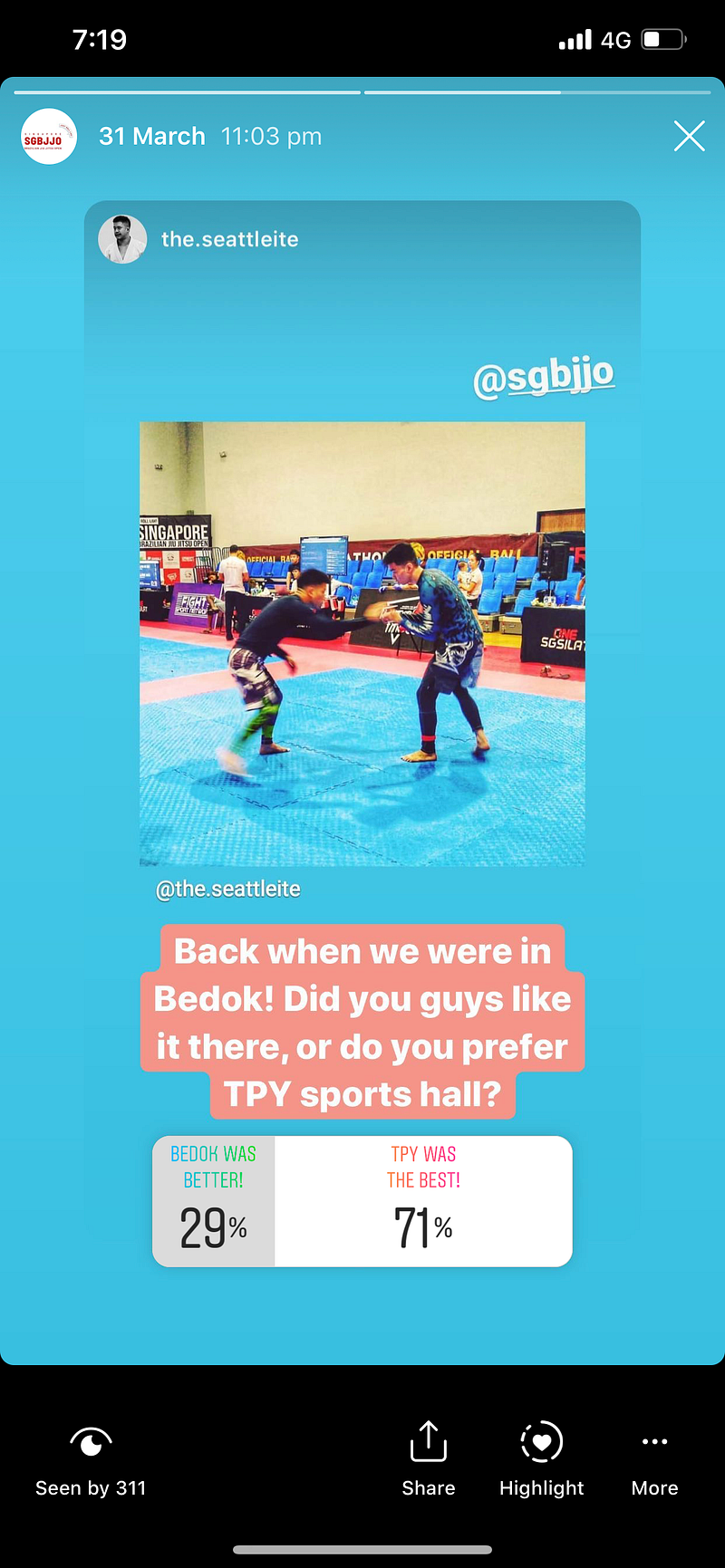
Even if the feedback isn’t useful (and it usually is), it’s a great way to engage with your followers.
People appreciate that.
They appreciate the fact that they’re not supporting a soulless organization but a brand that cares about their opinion, one that will go the extra mile and initiate a conversation with its customers.
Facebook, especially Facebook Groups, is another fantastic resource.
Best of all? All of these engagement comes at no cost. It’s completely free.
All it takes is a few minutes of your time. And you know what?
This is a better way to connect with your customers than splashing big money on advertising costs and hoping for some kind of ROI (return on investment.)
I fully agree with Gary Vee when he says:
“You cannot underestimate people’s ability to spot a soulless, bureaucratic tactic a million miles away. It’s a big reason why so many companies that have dipped a toe in social media waters have failed miserably.”
In fact, whenever I hear another marketer mention ROI or SEO, or any fancy-schmancy “engagement tactic”, I know they’re leading the cart before the horse. They’re worried about short-term goals.
The power of social media lies in its ability to seamlessly enable two-way communication. This is true engagement and the best way to build and nurture a community that will support you through thick and thin.
In 2020, communication is king.
Your Takeaway
“There’s never been a better time to start a business.”
— Richard Branson, CEO of Virgin Group
The future of business has changed, and in my opinion, for the better.
Startup costs have never been lower, and with the boom of social media, you reach thousands of potential customers for free.
In fact, I never paid for advertisements until very recently, and even then it only cost about $60. All hail Facebook ads.
Don’t think it’s going to be easy though — running a business takes grit and persistence.
The startup costs have changed, but the rules of the game have not.
Remember to find a niche market that you can contribute to. Growing fast in a small pond is better than going toe to toe with the other predators in the big blue ocean.
Being in a niche market will allow you to charge premium prices — make sure you provide great value to justify your price tag.
And lastly, always actively be a participant of your community. Talk to your supporters. Engage them.
Find out what it is they truly want.
And give it to them.
Thanks for reading my story :)