
The Marketing Genius of Floyd Mayweather
How did he make over $100 million in a single night?
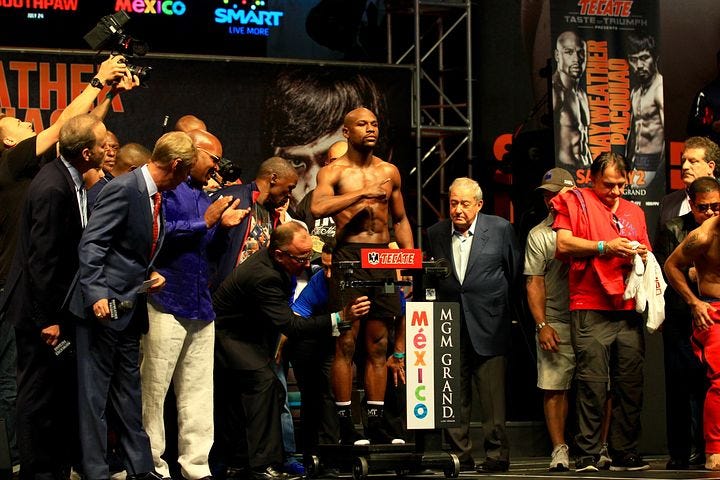
Floyd Mayweather is, hands down, the most business-savvy boxer of all time.
Don’t believe it? Just check the cash register. Floyd made a whopping $275 million for his retirement fight against Conor McGregor. His paydays since starting his own sports entertainment company, Mayweather Promotions, have all been north of 8, even 9 figures.
He’s a virtuosa of violence inside the ring, having amassed an undefeated record of 50–0 before retiring as the best defensive boxer of his generation — but his financial success outside the ring makes him a true anomaly.
In this article, we will look at how Floyd’s masterful marketing strategies made him the highest-paid athlete of our generation.
Actively Promote Yourself
“Some pay to see me win, some pay to see me lose, but they all pay.”
— Floyd Mayweather
If you take away only one thing from this article, take away this:
If you want to make a living doing what you love, you have to treat yourself like a business.
That means promoting yourself. Promote yourself hard and often, to the point of shamelessness.
In the past, in order to get people to notice you, you had to spend an obscene amount of money on advertisements. Advertisements on traditional media with zero solid proof of ROI.
Meaning you wouldn’t know for sure who and how many people actually saw the advertisement you paid for. When it comes to print, TV, and radio, you had to use the old-school spray and pay tactic and hope for the best.
Social media has leveled the playing field. Now with just a few taps on your phone, you have the potential to reach thousands of people for free. I even used my crappy iPhone to build a five-figure business!
Floyd Mayweather understands the power of self-promotion intricately. He has a whopping 23 million followers on Instagram, and he didn’t get there by accident.
Case in point: even on fight day, where most fighters are focused on the task at hand and tend to shy away from the media, Floyd can be seen taking pictures with fans and celebrities, routinely updating his Instagram account.
He doesn’t do it because he’s narcissistic — he does it because he understands the immense power of social media marketing.
A point to note, Floyd uses social media extensively, but he does not shy away from traditional media. He’s the master of using reality shows to promote himself.
He was the executive producer of HBO’s 24/7, using it to promote the fight between him and Oscar De La Hoya. The bout generated $130 million dollars in revenue — making it the most lucrative boxing match ever at the time.
Floyd would go on to surpass his own record multiple times.
A good rule of thumb is: if people aren’t mocking and complaining about how much you’re marketing yourself, you aren’t doing it nearly enough.
Treat yourself as a business and promote yourself shamelessly — and watch your fan base and bank account grow.
Don’t Be Afraid to Be Play the Villian
“You’ve got to have a villain and they’ll always make me the villain. I’m used to it, it makes me work harder and it makes me fight harder.”
— Floyd Mayweather
You know the phrase “nice guys finish last”?
Well, in the entertainment industry at least, that appears to be accurate.
Negativity generates interest. It is an unfortunate truth, but it’s the truth nonetheless. The mainstream media knows this very well. Turn on the TV and you’ll be endlessly bombarded with news depicting mass shootings and deadly viral epidemics — even though we live in the most peaceful era in human history.
That’s because drama and conflict sell. It gets people's attention. It gets clicks, buys, butts in seats, and eyeballs on the screen.
Humans often think we’re 100% rational creatures when we’re really not. Conflict gets our attention because 10,000 years ago — a mere blink of an eye in terms of our evolutionary timeline — conflict meant danger. It meant we better get off our asses and check out what's happening right now because it may be a freaking saber-toothed tiger.
Conflict hijacks our brain and demands our full attention.
And great promoters like Floyd know this all too well.
That’s why Floyd gets in his opponent's face during weigh-ins. That’s why he taunts them when the cameras are on, why he calls them names and ridicules everything from their dressing to their boxing style to their nationality. It's not because he hates them.
It’s because he’s trying to sell the fight.
In professional wrestling, this is called playing the “heel.” I’ve written about this before in a Better Marketing article here:
What the UFC realized with TUF 1, the WWE had already perfected as an art form. Pro wrestling is arguably harder to promote than real fights. The story arc becomes even more important when the match is scripted. Fans really have to care about the demise of the “heel” and the rise of the “babyface.”
Floyd Mayweather is playing a character. A bad guy. The antagonist. Someone vulgar and villainous, flouting the rules of the game. Most importantly, he’s playing someone that will draw an emotional reaction from the audience.
And no doubt about it, playing a character sells. It’s one of the key reasons that allowed Floyd to draw the attention of countless fans and make millions along the way.
The next step is to insert this character into a good story.
Craft an Engaging Story
“Floyd’s like a WWE character come to life.”
- Kurt Badenhausen, Forbes senior editor
While we’re at the subject of turning drama into dollar bills, we‘d be remiss not to discuss how storytelling is a crucial, often overlooked aspect of marketing.
Emotions are absolutely critical to engage viewers — especially when it comes to the entertainment business. Like I mentioned in my article above:
Storytelling is also an essential but often overlooked part of marketing. Done well, it is one of the most powerful ways to build your brand. Stories can take your target audience on an emotional journey that is simply not available through any other medium and leave them coming back for more. Stories create culture, shape perceptions, and have the power to breathe life — genuine life — into your business.
Imagine you’re reading a novel and everyone is morally good. There would be no conflict, no drama, and worse of all — no advancement of the plot. There would be, quite simply, no story to tell.
The hobbits would have been content to stay in the Shire if not for the threat of Sauron’s army and the War for the Ring. Harry Potter would likely have remained an ordinary, mistreated orphan, content to stay in a tiny room underneath the staircase, if Voldermort didn’t start the second wizarding war.
Antagonists are vital to any good story. They serve to advance the plot, to serve as a foil to the main characters, to help them explore themselves and grow.
Floyd has always cast himself in the bad guy role. A classic example of good storytelling is Mayweather vs Pacquiao, a fight so hotly anticipated it was dubbed “The Fight of the Century.”
Fans were sold the idea of the devout Christian and humble Filipino Manny paired up against the money-loving braggart that is Mayweather. Pacquiao was the “babyface,” the good guy fans were rooting for and Floyd, as always, was happy to play the “heel.”
It worked wonderfully — the “Fight of the Century” broke all past pay-per-view records and remains the most lucrative bout in the history of professional boxing.
Harness the oft-untapped power of storytelling, and watch your marketing game explode.
Collaborate With Other Stars
“When you’re the best, you only want to surround yourself with the best.”
— Floyd Mayweather
Floyd Mayweather understands the power of collaboration.
Aside from appearing on other platforms such as WWE and Dancing With The Stars, Mayweather has been known to invite celebrities to his own fights as VIP guests. Some are even invited to enter his dressing room, hold his belts and walk out with him for the fight!
Notable names include celebrity rapper 50 Cent and famed singer-songwriter, Justin Bieber.
Being seen publicly with A-listers such as Bieber opens up Mayweather to new fans of entirely different demographics. When teenage fangirls (not traditionally huge supporters of boxing) of Justin Bieber see him walking out with Floyd, they’ll ask themselves: “Hey, who’s this boxer that Justin is hanging out with?”, and in the grander scheme of things, “what’s so cool about this boxing thing that even Justin is interested in it?”
That’s how Floyd amasses new fans and gains credibility in a single stroke.
That’s also how he transcends the somewhat niche sport of boxing to become a mainstream superstar.
Be open to collaborations with others, even if they may initially seem to be from totally unrelated fields.
When it comes to success, no man is an island.
Use Catchphrases
“You know, everybody has a slogan, and once you beat people over the head with it so much, then that’s what you’ll eventually be called….”
— Floyd Mayweather
Famous Mayweather catchphrases include:
“God only made one thing in the world that’s perfect, and that’s my boxing record.”
“Hard work, dedication!”
“TBE — The Best Ever”
“Man lie, women lie, numbers never lie” — often quoted while showing off the zeroes on his cheques.
Every successful business has a catchphrase or three.
Mcdonalds?
“I’m lovin’ it”
7–11?
“It’s a store and more!”
You get the gist.
Why? Because catchphrases are powerful. Good ones cut through the bullshit and get straight to the point of what your brand is about. They have a way of sticking in your head. That’s why they’re called catchphrases — they’re catchy phrases that you can’t help but remember.
Catchphrases can even be turned into another means of generating income.
Think about Nike’s slogan, Just Do It! Nike solidified the perception of their brand with a tough, take-no-prisoners ethos, and furthermore made millions selling merchandise printed with that very same catchy tagline.
Win-win.
Floyd Mayweather has a similar strategy.
He often shouts “hard work!” to his fans and supporters, with them chorusing back “dedication!” in response. In many interviews I have watched of him, he never fails to rattle off a couple of Mayweather one-liners for all fans present.
A simple but terrifically effective way to brand yourself. It certainly doesn’t hurt being associated with the words “hard work” and “dedication.”
Similar to Nike, he also has his catchphrases printed on the apparel company that he owns, appropriately named The Money Team, and they sell like hotcakes.
Remember, catchphrases are a cliche for a reason. They are simple, direct and powerful.
Use them liberally.
Be Authentic
“I’d rather be hated for being real and who I am, than be loved for someone that I’m not.”
— Floyd Mayweather
This last point is the glue that holds all the aforementioned tips together.
It is, therefore, the most important point.
For any of this to work at a high-level, you have to be authentic. You have to be true to yourself.
Too many people think self-promotion is about pretending to be someone you’re not when that cannot be further away from the truth.
Self-promotion is more akin to holding up a magnifying glass to aspects of your personality, making them larger than life. It is most definitely not making them up. There is a difference.
When Floyd Mayweather is ranting about how much he loves money, he’s being himself. He’s magnifying certain aspects of his personality — you can be sure he’s not that much of a loud-mouthed braggart 24/7, but the character he’s portraying is.
If Floyd tried to sell this character of a larger-than-life big spender, but deep down in his heart he’s actually a thrifty miser, the character will eventually fall flat on its face.
To be sure, he can keep up the ruse for some time, but keep in mind that when you’re an entertainer of Floyd’s level, it means a lifetime of being in the spotlight with millions of people watching your every move. In these circumstances, it’s too draining to be someone you’re not.
It’s far more effective to identify, magnify and present the personality you want to show to the public. To pretend to be someone else entirely is to be a pale shadow. A pretender.
Remember, your superpower is your authenticity. You do you better than anybody ever could.
Embrace that.
Conclusion
“I’ve set the model of showing fighters how they should conduct their business.”
— Floyd Mayweather
Floyd Mayweather is the best businessman that boxing has ever known.
In the ring, he’s one of the best to have ever laced on the gloves— that in itself is remarkable, but outside of it is where he truly shines brightest.
He promotes himself shamelessly and plays the perfect villain to foil every babyface that he has faced. He worked together with stars and businessmen both to build an empire, has catchy taglines for days and most importantly, is always true to himself.
The perennially polarizing Floyd Mayweather. Even his staunchest haters have to admit that when it comes to boxing and business, he knows what he’s doing.
Love him or hate him, they always pay to see him.
And isn’t that what great marketing is about?