
15 Fascinating Anatomical Differences between Men and Women That You Probably Didn’t Know
Women are more genetically diverse, men have a higher pain tolerance threshold, women have stronger immune systems, men are more likely to be geniuses, and much more

The old saying goes that men are from Mars and women are from Venus, whether consciously speaking there is as much truth in that as people often say is up for debate, but anatomically speaking, it is very true.
After all, a 2017 study entitled “The landscape of sex-differential transcriptome and its consequent selection in human adults”, found that out of the 20,000 genes that exist in men and women, one-third of them present differently in men than women.
On top of that, in some ways, men are more related to male apes than they are to women, just as women are more related to female apes than they are to men.
Here are 15 fascinating anatomical differences between men and women.
Women do legitimately have superior immune systems
Whether or not man flu is real is often debated, but women truly do on average have superior immune systems, and not just for one reason. The first reason is the size difference between men and women — not height, body mass.
My doctor best explained this to me, explaining in the simplest terms he could that, “Imagine a battle of 500 versus 500 compared to a battle of 1000 versus 1000. Which one will more often than not be bloodier? As men are typically bigger, when they get a virus, it has more room to replicate, this typically leads to a bigger battle between the virus and the immune system.”
On a side note, he told me that this was one of the reasons why children, despite having weaker immune systems than adults, can often so easily bat off viruses — they have less virus to bat off. He also told me that this was one of the reasons why obese people tend to struggle so much when they get ill compared to those who are in shape. In obese people, the virus simply has far more room to replicate, and so the battle between it and the immune system is often more brutal.
Returning to the point, women have more than just a pound-for-pound advantage over men when it comes to batting off viruses, their immune systems are also legitimately stronger. The development of the immune system is linked to the X chromosome, and women have two.
This matters because if there are any genetic defects in one of the X chromosomes, there is another one that can override that error. However, because men only have one X chromosome, if there is a genetic defect in their one X chromosome, it stays there because there is nothing to override it with.
Of course, nobody knows for certain if this is the main reason why, after all, it should be remembered that genetics is a very new field, but it is the current consensus belief over why women have overall stronger immune systems.
Note: it should be noted that it’s not all bad for men, women having two X chromosomes is believed to be the reason why they are 4 times more likely to suffer autoimmune disorders than men.
Men have a higher pain tolerance level and threshold
The popular belief is that women have a higher pain tolerance level than men. However, repeated clinical studies have found this is not true. For example, the 2013 study entitled “Sex differences in pain: a brief review of clinical and experimental findings” found this, and many other studies have done the same.
As such, the majority of the current evidence appears to show that women report feeling more pain more often and feeling that pain to a higher degree of intensity than men. On top of this, the female body has been found to have a far more intense natural response to painful stimuli than the male. Also, the female body has been found to have a far higher density of pain receptors than the male.
For example, the American Society of plastic surgeons back in 2005 found that women have 35 nerve fibres per centimetre of skin versus 17 in men, and it is believed that this may account for the biologically lower pain threshold in women.
To go with this, Ed Keogh, professor of psychology at the University of Bath and deputy director of The Bath Centre for Pain Research, commented in a post for Stylist, “Biology is clearly important here. The differences in pain seems to emerge around puberty, with fewer differences found in children, suggesting sex hormones might have a role.” Plastic surgeon Dr Paul Banwell agreed, commenting in the same piece, “The fluctuating nature of female hormones can increase the body’s perception of pain. When oestrogen levels are low — during the menstrual cycle or post-menopause — pain receptor activity is increased.”
In terms of why this is, one belief is that it may be linked to men's and women’s differing evolutionary roles. Because men have evolved to face down violence, the idea goes that they have built up a high pain threshold and tolerance level i.e. if you are going to get hit a lot, pain is not your friend.
However, because women have evolved more to avoid danger and violence, they have evolved to feel pain to a higher level as a means to motivate them to avoid getting hurt i.e. the purpose of pain is to help us avoid hurting ourselves, women have evolved a greater need to do that. As such, they feel more pain. At least that is the theory.
But it’s not all bad for women, because despite the apparent lower pain threshold and the fact that women report feeling more pain more often, and are more likely to suffer from chronic pain conditions, repeated studies have also found that women are better at processing the after-effects of pain than men, and are better at pain management.
So, it seems that all that extra pain women suffer serves only to make them stronger.
Note: pain is a very subjective thing, just because studies say men on average have a higher pain threshold and tolerance level, does not change the fact that pain can cripple anyone — regardless of gender.
Women utilise more mirror neurons than men
Numerous studies have found that women score higher on tests of emotional recognition, social sensitivity, and empathy. They do not just score higher on verbal tests, brain scans have also shown that women utilise more mirror neurons when they process their emotions.
Mirror neurons allow us to experience the world from other people’s perspectives, to understand both their actions and their intentions. It’s believed this is why women tend to be better at reading people than men — at least on average. It’s also believed to be why they feel the emotions of others more intensely than men — again, at least on average.
It is also believed to partially explain why women typically express more pro-social emotions such as gratitude, which are strongly linked to happiness, and why women are typically more reliant on social groups and relationships for happiness than men.
In terms of why women are believed to utilise more mirror neurons, one theory is it may again be linked to the fact that men faced down the danger, whereas women raised the children.
So, because women have historically been focused on raising the children, whereas men have not been, women have needed to be very skilled at reading what a child needed, and teaching a child how to feel. As such, they have evolved greater tools to help them express and process emotional recognition, social sensitivity and empathy than men have. Again, at least that is the theory.
Men experience anger differently than women
A friend of mine who works in psychology, I’ll call her Jess as she is not public facing, told me that “The majority of current research shows that women are more prone to internalising anger and directing it at themselves and those close to them rather than the source, they are also more prone to suppressing anger and as such not dealing with it; whereas men are more prone to externalising it and expressing it at the source, which allows them to better manage it — at least on the level of not allowing it to ferment inside of them.”
Jess added that this is likely shown best by just how much more prone to violence men are than women, she also added, “What further exacerbates this difference is that women appear more prone to presenting anger as fear and anxiety, whereas men appear more prone to presenting fear and anxiety as anger.”
A reason for this could be linked to the fact that men had to face danger and women had to focus on childcare. As such, typically when men felt things like fear and anxiety, they have needed to get angry.
However, when women have been in danger, rather than anger, they have typically needed to show fear and anxiety to call in a man to help. But it is highly complex, and the jury is well and truly out.
Also, it should be noted that though some studies have shown men experience anger more intensely than women, others have shown that men and women experience anger just as intensely, it is just they will more often experience it and present it in different ways.
That means some of the differences will be societal based, but considering the different historical roles of men and women, and how long that played out, it would be extremely surprising if there were not some innate difference in the way men and women have evolved to experience, process and handle anger. But time will tell on this one.
Men are more likely to be geniuses, women are less likely to have very low IQs
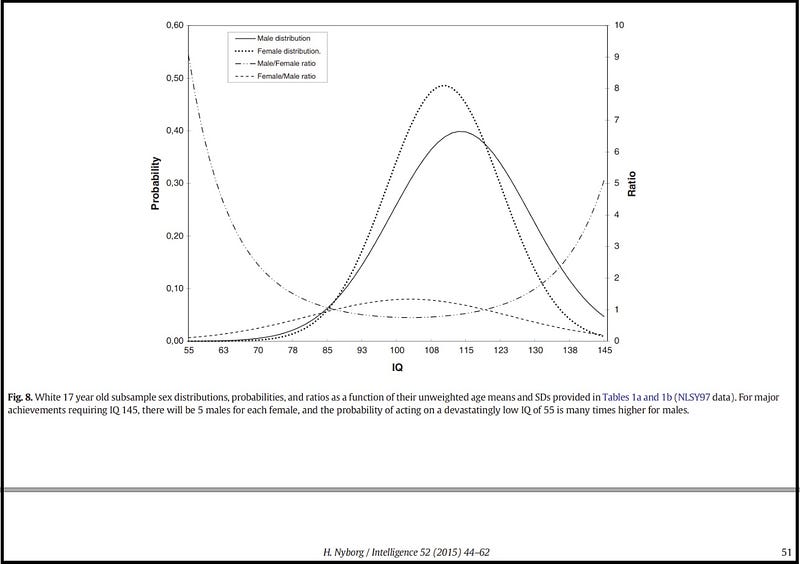
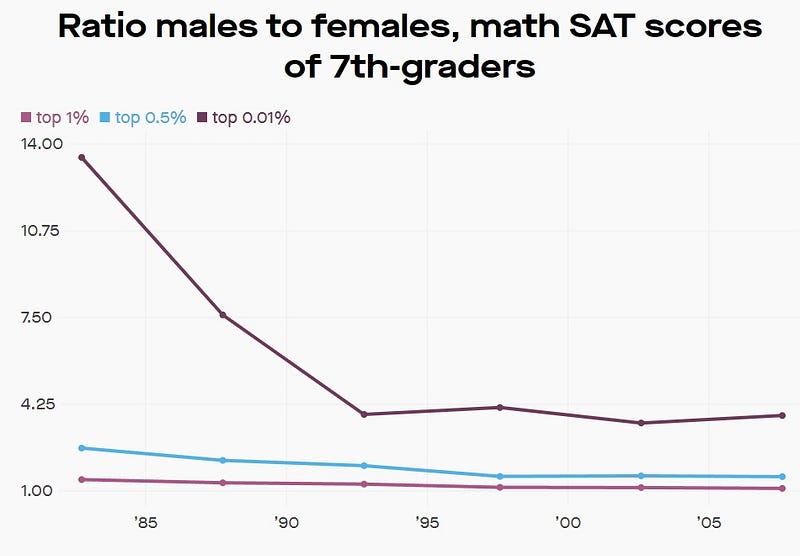
Men are more likely to present traits associated with genius than women — at least if you use IQ scores and test results from STEM subjects as gauges, along with entry to gifted schools — but they also are more likely to have severe learning difficulties i.e. to never mentally develop beyond the toddler stage.
It is not just on the intelligence scale where this seems to exist, Jess added that, “Men appear more likely to be extremely creative but also extremely uncreative, to have extremely high EQs but also extremely low ones, they are also more likely to be extreme monsters but also extreme saints, and are more likely to be extremely confident but also extremely shy.” Jess adds that, “It’s possible to go on and on. Men literally appear to flood every extreme end of every spectrum.”
I cannot comment on the validity of the latter points, as there seems to be much debate over the merits of what is becoming called the male variance theory, as there does seem evidence in favour of it, but there are questions over why the evidence is as it is. Regardless, when it comes to IQ tests and STEM subject tests, men do appear more likely to populate the extreme ends of the spectrum, so the absolute top and bottom.
In terms of why men may be more prone to genius traits, one theory is it may be to be linked to our hunter-gatherer days. Because hunting requires an extreme focus and one-mindedness, whereas raising children requires a more rounded intelligence, natural selection has favoured men more on the extreme traits than it has women.
Stepping outside of evolutionary theory, another reason may be linked to the fact that women have two X chromosomes. For example, autism is linked to both genius and severe learning difficulties, and even once biases are removed it has been found that men are between 3 and 4 times more likely to have autism than women, and one of the reasons why is postulated to be linked to the fact that women have two X chromosomes and men don’t.
For example, a 2022 study entitled “Rare Maternally Inherited Coding Variants on Chromosome X Carry Predominantly Male Risk in Autism, Tourette Syndrome, and Attention-deficit/Hyperactivity Disorder”, found that rare gene variants inherited from the mother’s X chromosome appeared to lead to an increased likelihood of autism.
As such, it has been postulated that because females have two X chromosomes, they are able to compensate more often for this rare gene variant whereas men are not able to because they only have one X chromosome, and as such men are much more prone to autism and the traits that come with it.
It has also been long postulated by many that genius may be the result of genetic defects, as such, this would potentially tie into the fact that because men are more likely to have genetic defects due to the lack of a secondary X chromosome to override any defects, they are more likely to be geniuses, present extreme traits, have severe learning difficulties and die younger. But the jury is still out, so keep that in mind on this point.
Men’s armpits smell more than women’s, but women’s nether regions smell more than men’s
Men typically have smellier armpits than women because, on average, they have more corynebacteria living on their armpits. The more corynebacteria, the stronger and the more cheese-like the smell — hence, why male armpits are more known for smelling like off cheese.
The reason for the higher corynebacteria count in male armpits is that they have thicker skin there and sweat more fatty substances — which is the perfect recipe for creating corynebacteria. Also, women have a higher sulphur content in their sweat, which gives them a more onion-like smell which is preferable to off cheese — at least that’s what studies seem to show. So, the combination of fewer corynebacteria and higher sulphur content gives women an advantage in the armpit area.
However, when it comes to the nether regions, men have the advantage. This is because the vagina is full of bacteria and when that bacteria mixes with things like sweat, it releases fishy-smelling amines. Men inevitably have substantially fewer bacteria in their nether regions and so inevitably on average have a lesser smell down there.
Note: everyone has a natural smell, and when it comes to natural smells, there is no known gender difference i.e. anyone who practices good hygiene, will more often smell no better nor worse than anyone else.
Male punching power is vastly superior to females
A 2020 study from the University of Utah entitled “Sexual dimorphism in human arm power and force: implications for sexual selection on fighting ability”, compared the punching power of highly fit and active men and women and found that the difference between the sexes was far greater than expected.
It showed that men who were fit and healthy were on average capable of exerting 162 percent more force in a punch than women who were fit and healthy. When height and weight differences were taken into account and compensated for, the figure stood at 90 percent.
The difference was found to be so great and so universal, of those who took part in the study, even the least powerful male exerted considerably more punch power than the most powerful female.
The conclusion was that men’s upper body strength has likely evolved specifically for punching, hence, why there is such a disparity in this area. So, because men evolved to fight each other for the right to mate with women, and because they have evolved to protect women, they have evolved to hit hard.
Note: there is not as big a disparity in pulling strength between men and women, especially in the overhead area. It’s believed this is because women have built up strong pulling muscles due to their historic task of carrying babies — in our primaeval days, women would carry an infant permanently until it could walk.
Girls go through puberty sooner than boys
Most girls go through puberty between the ages of 8 and 13, whereas most boys go through it between the ages of 9 and 14, and girls typically go through puberty two years sooner than boys. Puberty also lasts for a shorter length of time on average in girls than it does in boys — 2 to 4 years versus 2 to 5 years.
Also, the majority of girls are fully developed physically speaking by 15, whereas boys don’t typically reach this stage until 17 — though in some cases both boys and girls can still keep growing until they are 20 (more boys than girls).
It’s believed that girls develop faster simply because pregnancy is tough on the body, and historically, due to the high number of pregnancies required to sustain the human race, women have needed to start young.
Boys on the other hand, due to needing to build up resources and the skills to protect a woman, have needed to develop slower i.e. historically, it was no good boys getting with girls before they could provide for them and protect them. However, if they went through puberty at the same time, they would try to get with them, as such, it is believed a divergence in growth rates has evolved between boys and girls to stop this from happening.
Girls’ brains develop faster than boys
By accident, researchers at Newcastle University found that girls go through a form of brain optimisation, which is called “fire and wire”, between the ages of 10 and 12, whereas boys typically don’t go through it until the ages of 15 to 20.
Fire and wire is the extremely important process where the brain removes stored neural connections that it does not think are important. So, it gets rid of all the rubbish and reorganises the brain into an efficient brain capable of properly processing the world around you i.e. it allows you to form proper long-term memories and as such to start focusing on essential information, a key element in the path to maturity.
In terms of why girls go through this so much sooner, 10 years at the widest stretch, one theory is that it is linked to the fact that girls need to develop faster cognitively for childbearing reasons, and boys need to develop slower to build the tools and resources needed to be useful to girls.
Women do legitimately cry more than men
Repeated studies have shown that women typically cry a lot more than men. The average woman in Western society is believed to cry between 12 and 15 times a year, and it is believed that women on average cry for upwards of 6 minutes at a time.
However, it’s believed that men typically only cry on average twice a year at most, and when they do cry, it lasts for less than 2 minutes. Also, many women have crying sessions that last upwards of an hour, which men very rarely have.
It should be noted that in poorer countries, people cry a lot less, though women still typically cry more than men. The reason for the higher crying rates in richer countries is believed to be that richer countries encourage tears and so people embrace crying, whereas poorer countries typically discourage it.
Also, research has frequently shown that people in richer countries have a lot more mental health problems than people in poorer countries, so those in richer countries paradoxically have more reason to cry.
In terms of why women cry more than men, it is believed to be biological. Nobody knows exactly what the biology is, but it is believed the change occurs during puberty — prior to that boys and girls cry in equal amounts.
One theory is that it is linked to the different levels of prolactin and testosterone in men and women. Prolactin is a hormone linked to crying and women have higher levels of it. Also, testosterone, which is substantially higher in men, may inhibit tears.
So, it is postulated that the difference in the balance between these two hormones in men and women explains why women cry more frequently than men. It is also believed to explain why so many men report wanting to cry but being unable to, something women rarely report.
Note: it is widely accepted that cultural teaching likely leads to men crying a lot less than is healthy, women as well. This is why promoting that tears are nothing to be ashamed of is so important. After all, there’s nothing better than a good cry.
Men typically have more powerful jaws — but only because of their size advantage
A 2006 study published in the Journal of Applied Oral Sciences, compared a group of females to a group of males in terms of how powerful their jaws were. The female results ranged from 108.9 to 834.6 N (mean of 424.2), whereas the males ranged from 262.8 to 999.3 N (mean of 587.2).
However, once weight and height differences were taken into account, male and female biting power showed similar results. That means males do have a more powerful bite, but only because they are typically bigger rather than because they just naturally have a more powerful bite.
Note: both men and women have on a pound-for-pound basis more powerful bites than even apes. This is because the human jaw is far more efficient, with studies consistently showing it to be upwards of 50 percent more efficient than apes. However, because apes are bigger, they have a stronger bite.
Women need more body fat to survive than men do
The bare minimum amount of essential body fat needed for survival in males is 2 to 5 percent, whereas in females it is 10 to 13 percent, and on average fit and healthy males typically have between 6 and 17 percent in body fat, whereas fit and healthy females typically have 14 to 24 percent.
Also, females do not reach obesity until they hit 32 percent body fat, whereas for males it is 25 percent. But if a female drops below 10 percent body fat, it can lead to severe health complications, least of all being the messing up of their menstrual system. In men, dropping below 2 percent can lead to severe health complications.
The reason for the differences in required body fat between men and women is linked to child-rearing purposes. The female body is geared for making babies and as such needs more fat than the male body, which is more geared toward functional efficiency.
Men typically have a lot more skeletal muscle mass than women
In terms of skeletal muscle mass compared to body mass, males below 40 on average have 38.4 percent whereas females typically have 30.6 percent. This means that males typically carry 30 percent more skeletal muscle mass on a pound-for-pound basis than females i.e. so compensating for height and weight differences.
However, the difference is greater in the upper body versus the lower body, with men having 40 percent more in the upper limbs compared to only 33 percent more in the lower, and at the extreme levels, males are capable of achieving up to 75 percent more muscle mass in the arms, and upwards of 50 percent more in the legs. This leads to men being capable of exerting 90 percent greater strength in upper body and 65 percent greater in the lower.
When men's size advantage is taken into account, these differences become even more pronounced. As per the 2009 study published in Evolution and Human Behaviour, “Costs and benefits of fat-free muscle mass in men: relationship to mating success, dietary requirements, and native immunity”, men on average have 61 percent more muscle mass than women, which translates to men typically being more than twice as strong as women on average.
Again, the reason for the extreme differences is related to the female body being geared toward making babies, and the male being geared toward functional efficiency.
The male sex drive is predominantly dopamine fuelled whereas the female sex drive is predominantly oxytocin fuelled
When a woman has sex, oxytocin is the dominant chemical that floods her body. Oxytocin increases levels of empathy and openness amongst other things. It also makes a person want to bond.
However, when men have sex and especially when they orgasm, they get flooded with mainly dopamine. Dopamine simply makes a person want to do the act again.
This means the male sex drive is fuelled more by the desire to simply have sex, whereas the female sex drive is fuelled more by the desire to bond.
In terms of why this is, men can get lots of women pregnant at the same time, women can only get pregnant by one person at a time. Women also have to carry the child which comes at a heavy price — one men do not have to pay. As such, men have never needed to be choosy nor have they ever had to fear the repercussions of sex.
However, women have, as such rather than evolving to desire to just have sex — so a dopamine fuelled sex drive — they have more evolved the desire to bond through sex because that helps them improve their odds of having sex with the right person. Hence, why their sex drives are fuelled predominantly by oxytocin.
Note: the different driving forces behind the male and female sex drives can be most seen in the same-sex scene, same-sex male couples have far more sex than heterosexual couples, but same-sex female couples have far less sex than heterosexual couples. This is because men typically have sex, whereas women typically bond, and if you are already bonded, it’s hard to feel the need to bond so often.
Women are more genetically diverse than men
Thanks to the fact that humans produce through sexual reproduction, everybody born is unique, but females — at least on a genetic level — are more unique than males. This is for two reasons; the first reason is the Y chromosome.
The Y chromosome in effect evolves asexually. This is because in a male-female pair, there is only one Y chromosome, but there are three X chromosomes. As such, the Y chromosome has no pair to swap parts with, whereas the X chromosome does. That pair exists in the mother.
This is why a mother, rather than giving a child just one or the other of her X chromosomes, instead gives all her children an X chromosome that is made up of both of her X chromosomes, in effect creating a brand-new X chromosome. She does not give each child the same one, each child she has will get a different combination. That means every X chromosome that comes from a mother is like none that has come before it.
However, because fathers have an X and a Y chromosome, there is no similar process for the Y chromosome. As such, the Y chromosome barely changes from generation to generation.
It does have a copy of itself which it uses to try to fix any errors when it has been passed on, and it is estimated that 5 percent of the Y chromosome can be influenced by the X chromosome from the mother, so it’s not an exact copy per se that gets passed from father to son, but it near enough is.
This matters when it comes to genetic diversity, because even if an equal number of men procreated as women, women would still be more genetically diverse than men due to the near enough asexual nature of the Y chromosome. But considering that men and women have not procreated equally, you end up with the big difference in genetic diversity between men and women.
For example, the “alpha” males have always had a lot of children when compared to other males. This is why so many people are related to Genghis Khan — 1 in 200. Also, whether it be through men taking many wives and cutting other men off, or through men being massacred through war, more women have always had children than men, which has further increased the female diversity versus the male.
All in all, the combination of these factors, so the in effect asexual nature of the Y chromosome added the fact that the “alpha” males have always had so many children compared to other men, genetically speaking, women are a lot more diverse than men.
That’s all for me, thanks for reading! If you enjoyed this post, you may also enjoy the following:
35 Things That Men and Women Experience Differently From Each Other
Four Fascinating Facts about How Men and Women Have Evolved to Work Together
27 Of The Best Bad Dad Jokes To Brighten Up Your Day
To learn more about me see this link, to support me click the link below:


