
4 Leadership Quotes From Augustus — The First Emperor of Rome
He’s not called “the revered one” for nothing.
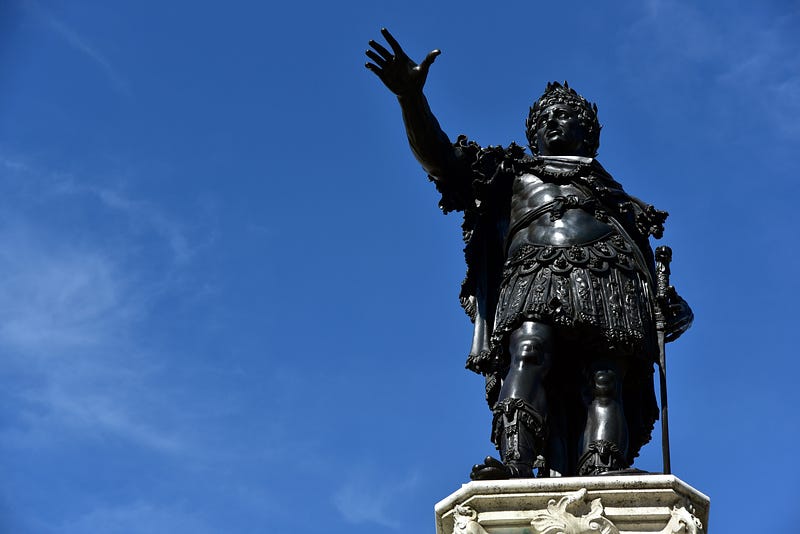
“Young men, hear an old man who old men hearkened to when he was young.”
Considered by many to be Rome’s greatest emperor, the man who would become known as Augustus did not exactly come from humble beginnings.
Born Gaius Octavius into an old and wealthy Roman family, he was the adopted son and heir of Julius Caesar.
Yes, the Julius Caesar.
After Caesar’s infamous assassination on the Ides of March, 19-year-old Octavius avenged Caesar’s death and went on to crush many civil wars in Rome, bringing much-needed stability to the realm.
He was conferred the title Augustus — roughly translated as “the revered one”, and eventually became Emperor of Rome in all but name.
In this article, we take a look at Augustus’s enduring legacy as one of the most effective leaders in history.
1. “Wars, both civil and foreign, I undertook throughout the world, on sea and land, and when victorious I spared all citizens who sued for pardon.”
Augustus had a ruthless reputation. What he could not eliminate with the strength of arms, he did so by manipulation.
Augustus (he was known as Octavius then, but we’ll use his more well-known sobriquet to avoid confusion) famously committed sacrilege by forcing his way into the temple of the Vestal Virgins to obtain his rival Mark Antony’s secret will. He then promptly publicized the contents of the will, revealing Antony’s Egyptian sympathies.
The Roman Senate was outraged and proceeded to declare war on Mark Antony and his lover, Cleopatra.
Augustus relentlessly harried them across land and sea, and after suffering a crushing naval defeat at the Battle of Actium, the couple elected to commit suicide rather than be captured.
Antony fell on his sword, dying in Cleopatra’s arms, and the last Queen of Egypt poisoned herself. Augustus then had anyone who was a threat to his position executed, including Cleopatra’s eldest son.
Augustus’s ruthless actions were tremendously unpopular with the Roman people. However, it would be remiss to dismiss him as yet another mad dictator.
I am reminded of a great quote about leadership by Tywin Lannister, a fictional lord from Game of Thrones.
“When your enemies defy you, you must serve them steel and fire. When they go to their knees, however, you must help them back to their feet. Elsewise no man will ever bend the knee to you.”
And that is the hallmark of a true leader.
Augustus was harsh when he needed to be. He was not above shedding innocent blood to further his ends.
However, when his authority was established, he proved to be a fair-handed and capable ruler. He pardoned those he could afford to — including the rest of Cleopatra’s children.
Augustus’s initial ruthlessness paradoxically brought about a period of peace known as the Pax Romana — the Roman Peace, a 200 year period of relative peace and stability.
Be firm when needed — but never overly cruel.
2. “My dear Tiberius, you must not give way to youthful emotion or take it to heart if anyone speaks ill of me; let us be satisfied if we can make people stop short at unkind words.”
— Augustus counselling his heir and future Emperor, Tiberius.
The higher you soar, the more haters you will pick up.
After all, it’s much easier to kick back and criticize than man up and perform bold deeds.
You could start a 5-figure events business with only $1000 down like I did, helping tons of people in the process.
You’ll still have haters.
You could run said business solely on a beat-up old iPhone SE and take it to profitability within a year.
You’ll still be criticized.
Lee Kuan Yew, the late great founding father of Singapore, once said:
“I have never been over concerned or obsessed with opinion polls or popularity polls. I think a leader who is, is a weak leader.
Trust me, it’s never easy to go against popular opinion. It particularly stings when you are hated by the very people you’re trying to help.
However, to be an effective leader, you have to shut out the noise and ignore the rabble.
You have to do what you know is best.
Whether it is popular or not.
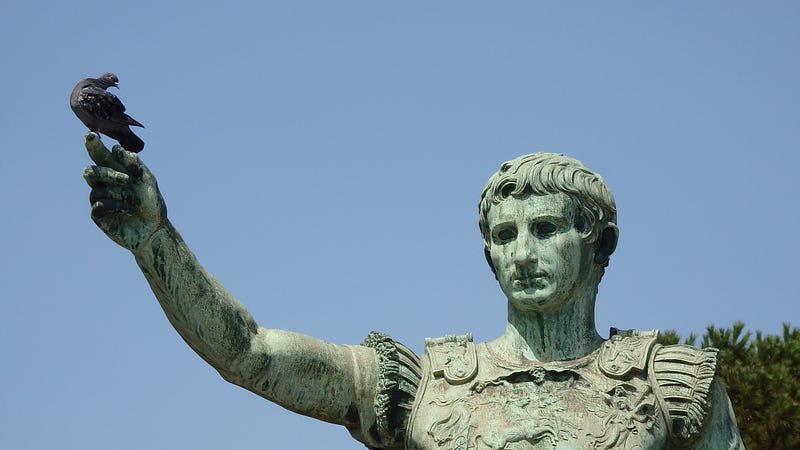
3. “I found Rome a city of bricks and left it a city of marble.”
— Augustus’s official last words to the public.
This quote essentially sums up effective leadership.
If you’re a good leader, the organisation will be in better shape than when you first joined. It’s as simple as that!
And Augustus could honestly boast that he had found the city “brick and left it marble.”
There is some literal truth in this. During his reign, Augustus constructed many amenities for the wider good. He notably built aqueducts, fountains, temples and bathhouses — many at his own personal expense.
He also introduced sweeping reforms, such as the creation of a standing army. He also revitalized essential services such as the police, fire brigade and the transportation of food to Rome.
This quote mainly serves as a metaphor for the Empire’s strength, though.
Augustus’s legacy would endure far beyond his death. In fact, the Roman Empire that he founded would survive for another 1500 years.
His reign would be so fondly remembered that the subsequent Roman Emperors would be sworn into office with this salutation:
Felicior Augusto, melior Traiano
Be more fortunate than Augustus [and] better than Trajan.
It does not matter how you begin. Your organisation can be in shambles, torn apart by conflict, as Rome was when Augustus came into power.
What matters is how it ends.
4. “Have I played the part well? Then applaud as I exit.”
— Augustus’s last words to his friends
This last quote is my personal favourite.
Augustus was a shrewd politician who understood the power of propaganda. Throughout his reign, he would intentionally project himself as an image of an idealized Roman ruler.
In fact, his official images depicted him being youthful even when he was well in his seventies, by which time they had developed “a distanced air of ageless majesty”.
His last words show that he was in on the joke, though.
He deliberately cultivated a cult of personality but did not seek admiration for admiration’s sake. He was self-aware and humble enough to know that adulation is a tool, a means to an end.
British author Anthony Everitt summed up Augustus’s life accurately in his biography when he said:
“The story of his career shows that Augustus was indeed ruthless, cruel, and ambitious for himself. This was only in part a personal trait, for upper-class Romans were educated to compete with one another and to excel. However, he combined an overriding concern for his personal interests with a deep-seated patriotism, based on a nostalgia of Rome’s antique virtues. In his capacity as princeps, selfishness and selflessness coexisted in his mind.
While fighting for dominance, he paid little attention to legality or to the normal civilities of political life. He was devious, untrustworthy, and bloodthirsty. But once he had established his authority, he governed efficiently and justly, generally allowed freedom of speech, and promoted the rule of law. He was immensely hardworking and tried as hard as any democratic parliamentarian to treat his senatorial colleagues with respect and sensitivity. He suffered from no delusions of grandeur.”
As Shakespeare said,
“All the world’s a stage”
You can play any character you want. As Patrick Rothfuss said, “A mask is a powerful thing — we all become what we pretend to be.”
Just remember where the character ends and the real you begins.
Your Takeaway — An Effective Leader Does What He Must
Augustus was a controversial and effective leader — and would go down in history as one of the greatest — if not the singularly greatest, Emperors of Rome. He was certainly the very first.
His policies would be lauded, studied and emulated by his predecessors for centuries to come.
Just like how we are studying him now.
Remember, to be a great leader, you have to be firm when needed — even harsh. But take care never to be cruel.
Ignore the naysayers. Don’t be affected, if anything, be glad that they stop at just unkind words.
Let the haters talk rhetoric all they want, your job is simple — to leave the organisation in better shape than when you joined. In Augustus’s words, “find brick, and leave marble.”
Lastly, remember that this is all a grand game. Leadership, life — everything. We play our parts the best we can, but as the Italian saying goes,
“At the end of the game, the king and the pawn go back in the same box.”
Keep these four traits in mind, and you’re well on your way to becoming a leader as revered as, well, Augustus.
The revered one.


