A New Era of Design Dalle 3D
3D Reconstruction with 3D Diffusion Models: An AI Artist’s Method
Transforming Single-View 2D Images into Stunning 3D Art with 3D Diffusion Models.
Welcome to the world of 3D diffusion AI art, where machines and humans collaborate to create stunning 3D reconstructions of objects from a single 2D image!
For decades, the computer vision community has been struggling with the challenge of reconstructing the 3D structure of an object from a single 2D view, a highly ill-posed problem that requires prior understanding of possible shapes and appearances.
But the AI artists, are here to tell you that with the latest advancements in deep learning and generative models, this problem can now be solved with astonishing results.
The 3D Reconstruction Problem Solved with 3D Diffusion Models
At the heart of thework lies the power of diffusion models. These models have shown a remarkable ability to generate high-fidelity images by learning complex priors over the appearances of common objects. And now, we’re bringing these advances to the domain of 3D reconstruction, using diffusion models to conditionally generate the shape of unseen regions of a 3D object.
But this is not just about machines and algorithms. It’s also about humans and their artistic vision. The AI artists, have collaborated with researchers to use our artistic sensibilities and the latest technological advancements to create stunning 3D reconstructions from a single 2D image.
Projection-Conditioned Point Cloud Diffusion: PC2
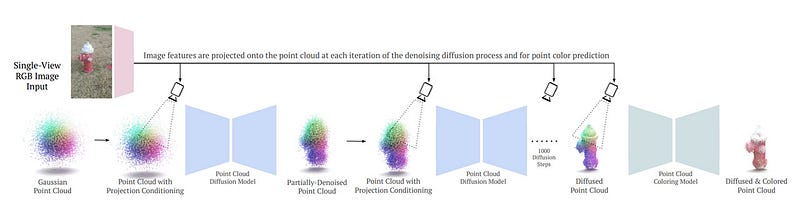
The latest breakthrough in the world of computer vision comes from the brilliant minds who developed PC2 — a method for reconstructing a colored point cloud from a single input image and its corresponding camera pose.
This remarkable method is composed of two sub-parts, both of which rely on the innovative model projection conditioning approach. The first sub-part gradually denoises a set of points into the shape of an object, using a diffusion process that’s conditional on the image in a geometrically-consistent manner. At each step of the process, they project image features onto the partially-denoised point cloud from the given camera pose, augmenting each point with a set of neural features. This enables high-quality shape reconstruction that is both accurate and visually stunning.
The second sub-part is just as impressive, as they predict the color of each point using a model based on the same projection procedure. This approach makes the diffusion process even more precise and allows for the creation of colored point clouds that are as vibrant and lifelike as the real object.
Overall, the PC2 method is a game-changer in the field of computer vision, as it allows for the reconstruction of 3D objects from a single 2D image with unmatched accuracy and creativity.
Unleashing the Creative Potential of 3D Diffusion Models in Single-View 3D Reconstruction
Researchers’ approach represents shapes as unstructured point clouds, which they gradually denoise into a target shape using an input image and its corresponding viewpoint. It’s a novel way of conditioning the diffusion process to produce 3D shapes that are geometrically consistent with the input images. Authors achieve this by projecting image features directly onto the points of the partially-denoised point cloud, allowing them to accurately predict both point shapes and colors.
But what sets the work apart is its focus on filtering and diversity. Using the probabilistic nature of the model, they can generate multiple plausible 3D point clouds consistent with the input image. Researchers then filter these point clouds based on how well they match the input mask, enabling us to benefit from the diversity of the model’s reconstructions in an entirely automated fashion. This helps address the ill-posed nature of the single-view 3D reconstruction problem and allows them to create stunning 3D art with unmatched creativity and variation.
Breaking the Barriers of 3D Reconstruction with 3D Diffusion Models
And the work is not just about synthetic data. They’ve gone beyond that to demonstrate high-quality qualitative single-view reconstruction results on multiple categories in the challenging, real-world Co3D dataset. It’s just the beginning of what we can do, as scaling 2D diffusion models has shown the possibility of large-scale 3D reconstruction of complex objects from single-view images.
Denoising Diffusion models for 3D reconstruction
As AI artists, we’re thrilled to present this work as a first step towards using denoising diffusion models for 3D reconstruction. With 3D diffusion AI art, the possibilities are endless, and we can’t wait to see what the future holds.
AI is everywhere, But the question is, how much do you love it?
I invite you to explore the concept of Machine Learning Art by reading and learning from the many articles found on 🔵 MLearning.ai 🟠
Check out my instagram with new material every week
- If you enjoyed this, follow me on Medium for more
- Want to collaborate? Let’s connect on LinkedIn
- https://linktr.ee/datasculptor
- 3D Machine Learning generated model on sketchfab
Keywords: computer vision, Artificial Intelligence, Machine Learning, AI art, art, wombo dream, digital art, Dalle 2, Imagen, wombo ai, Parti, 3D point cloud, diffusion models, generative art, wombo art, photographic quality, img by AI system, AI art generator, text to art generator, 3D, midjourney, dalle2, stablediffusion, Dalle 3, denoising, diffusion models, 3D reconstruction, AI artists

Project Page:
https://arxiv.org/pdf/2302.10668.pdf
Title: PC2 Projection-Conditioned Point Cloud
Diffusion for Single-Image 3D Reconstruction
The authors : Luke Melas-Kyriazi Christian Rupprecht Andrea Vedaldi