
5 Incredible Nudes from the Art World
Controversial photography, painting, Japanese erotica prints, and more
Born we are, naked. With time though — now in a historical “human” context — we started covering ourselves for warmth, for status, for everyday life. This state of always being dressed rendered the naked body the most vulnerable and “essential” state for us, but much like clothing, the naked body imprisons and reveals meanings. Especially in the arts.
Controversy is now often a word associated with nudity, even in the arts, but it wasn’t always the case.
As Carré D’artistes’ blog teaches us, ancient cultures assigned various meanings to male and female nude statues. As shown in Egyptian, Mesopotamian, and Greek art, naked women were emblems of happiness, reproduction, and fertility. Naked female goddesses who signify fertility or love are shown in very early prehistoric artworks. In Mesopotamian mythology, Ishtar, the nude goddess of love and battle, is an excellent example.
Unlike naked female sculptures, which are connected with childbearing, naked male sculptures are associated with strong moral ideals and strength. Men competed in naked competitions for sporting events in Ancient Greece. They also got naked at symposia (large parties involving drinking, music, dancing, discourse, and performances). The nude man was naturally associated with triumph, grandeur, and strength by ancient Greek sculptors.
Nowadays (as well as in other times) nudity in art is much associated with the complexity of humans and their diversity. While many accept meanings and artistry of nakedness with ease, others don’t. Besides, while some nudes are easier to understand as works of art, others are way more controversial (read Sensual Art or Outright Pedophilia? by Kamna Kirti for a good example).
Now, without further ado, follow along for five great examples of nudity in art.
1. Photography: An Immoral Woman and a Nude Man, On Mount Rainer by Imogen Cunningham.
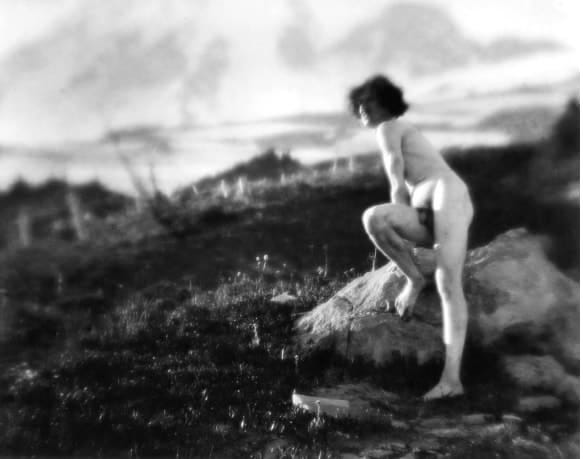
Naked photography has been a fine art photography genre since the beginning. Nude photography has aided in the acceptance of photography as a legitimate medium for fine art practice. This is not to suggest that female photographers who shot nudes were welcomed in 1915.
Imogen Cunningham (1883–1976) is widely regarded as one of America’s best photographers. However, she was considered rude and immoral at the time the shot was taken. Here, a quote from the photographer:
“I don’t know who tells me this, but somebody said, that I’m the first woman that ever photographed a nude man. I was made fun of at that time, when I photographed in 1915, my husband nude on Mount Rainier. Of course they were not acknowledged as being a nice ladylike job, I was condemned, by the newspaper[..]they called me an immoral woman.” — Imogen Cunningham
2. A Reclamation. The Ark Collection by Wangechi Mutu
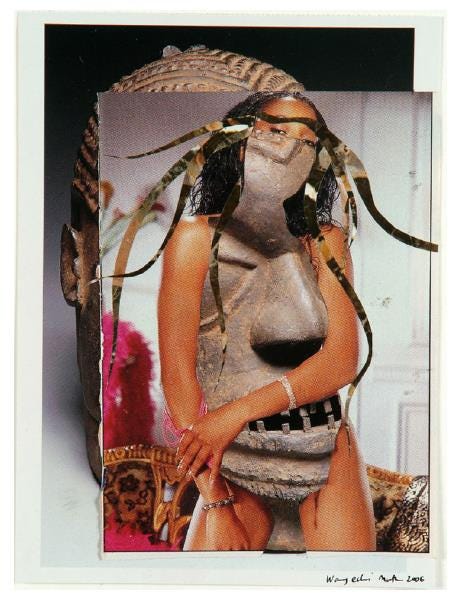
I am only sharing one piece from the collection. But you should definitely go check it all out.
Wangechi Mutu is a Kenyan-born artist who developed the Ark Collection (2006). The collection includes a series of collages combining pictures from African American porn magazines with photographs of traditionally dressed African women. Mutu’s purpose is to make the crass pornographic use of the black female figure — which is already prevalent in western culture — more artistic. Mutu’s collages replace the most exposed body portions of photographs with parts of the images she found on African locals.
As Black Art in America explains:
Mutu and others feel the black porn industry is an affront to the image of black women who have had to continuously fight for respectability in the face of the Jezebel stereotype.
3. The Female Orgasm as for A Man: Frenzy of Exltations, Władysław Podkowiński
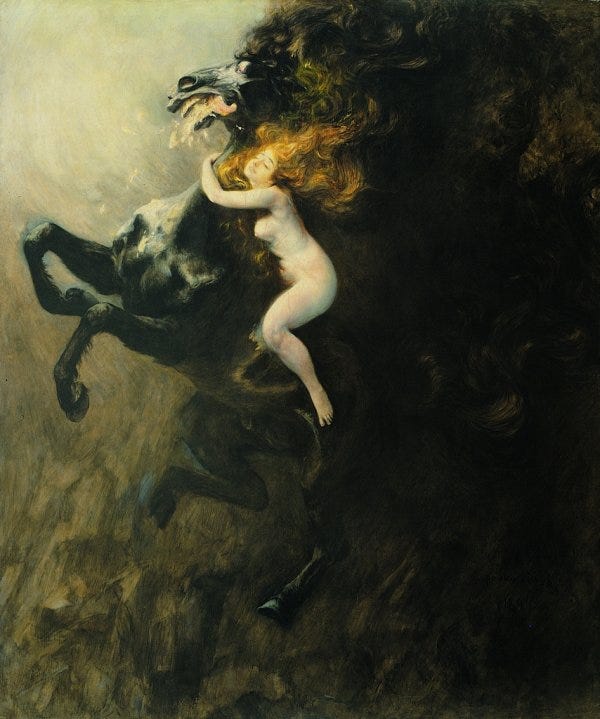
So bad, it’s almost good. As some readers may know, I have written more extensively about this painting in the past. And, in all honestly, I think it fits this list pretty well, bringing its own style and story.
Frenzy of Exultations, or Szał uniesień, is a big tall painting depicting a naked, redheaded woman riding a wild, black horse. The horse clenches its teeth and sticks out its tongue. It has dilated nostrils and froth pours from its lips. With her eyes closed, the woman riding the horse securely grips its neck, her loose hair spreading out and drifting upward as it blends with the horse’s mane.
The artwork became famous after its initial public exhibition, but it also sparked controversy. Podkowiski ruined (by slashing) the canvas which was renovated (after the artist’s passing) by Witold Urbanski. According to Podkowiski’s friend Stefan Laurysiewicz, the artist had the idea for a painting depicting a naked lady on a horse during his visit to Paris in 1889. As per the artist, he was terribly unwell in the previous several weeks, and simply getting up in the morning took a lot of work. Podkowiski’s act of destruction may have fueled the rumours that the artwork depicted a lady for whom the artist harboured unfulfilled feelings.
4. Tentacle Erotica Challenging Western Perceptions
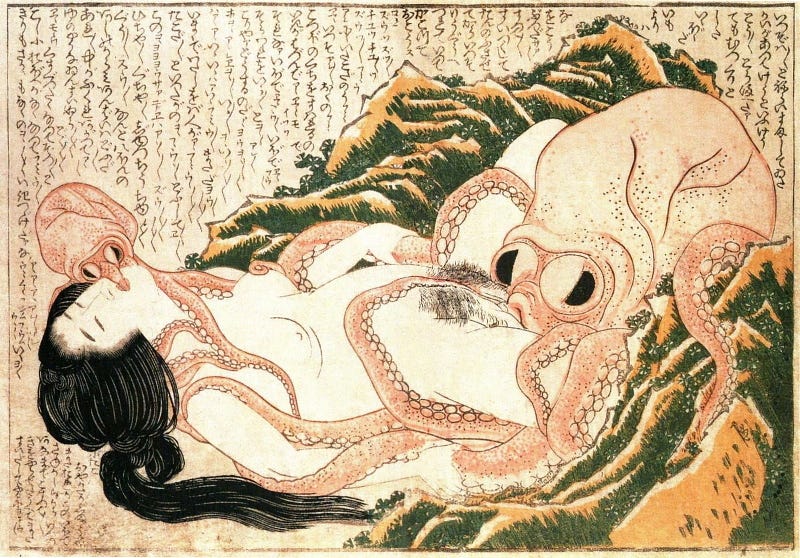
The most renowned image in Kinoe no Komatsu is The Dream of the Fisherman’s Wife. It was created during the Edo era by Katsushika Hokusai (c. 31 October 1760–10 May 1849), also known as Hokusai. Within the ukiyo-e genre, the volume is a creation of shunga (erotic art). The artwork shows a lady wrapped in the arms of two octopuses, perhaps an ama (shell diver). Cunnilingus is performed on her by the larger of the two invertebrates, while his progeny participates by enveloping the mouth and left nipple of the woman.
It is a piece forever in the history of erotica art, Japanese art, and well… the ancestor of much hentai.
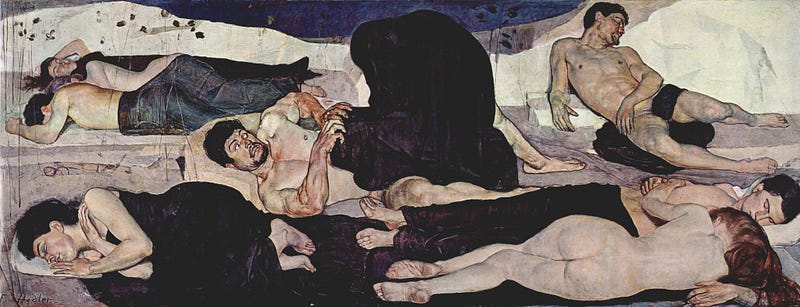
5. Naked at Night. Night, by Ferdinand Hodler
Ferdinand Hodler painted Night (Die Nacht) in 1890 as a Symbolist painting. It is on display in the Bern Museum of Fine Arts in Switzerland. I believe it would be fascinating to learn the artist’s thoughts on the artwork. Night was actually described by Hodler in writings for his friend Louis Duchosal, as follows:
“Up to now, my most important painting, in which I reveal myself in a new light, is Night. Its appearance is dramatic. It is not one night, but a combination of night impressions. The ghost of death is there not to suggest that many men are surprised by death in the middle of the night, as the Cologne Gazette has claimed, but it is there as a most intense phenomenon of the night. The coloring is symbolic: these sleeping beings are draped in black; the lighting is similar to an evening effect after sunset, showing the approach of night, but the effect is completed by those black drapes which partially cover the figures everywhere; they are the low, muffled notes of an austere harmony, which is merely a transcription of the effects of night. But the most striking feature is the ghost of death and the way — both harmonious and sinister — in which this ghost is represented, hinting at the unknown, the invisible. Night is what I claim to be my first work; it is mine by its conception and setting. At the Champ-de-Mars [exhibition] it was the most original picture.” Ferdinand Hodler
Is nude art vulgar? When is nude art not art at all, when controversial, and when problematic?
The questions remain, but are now presented to you, my dear reader:
Is nude art vulgar? When is nude art not art at all, when controversial, and when problematic?
If you’d like to read about my piece on the best nude sculpture in history (or so I claim):
If you’re interested in more art history:
28 stories about Art History and more curated by Jess the Avocado — Medium
To read more about human psychology and behavioural sciences:
21 stories about On Humans and Applications curated by Jess the Avocado — Medium
If you’d like to support my writing, consider offering a coffee for my caffeine addiction:
Buy Squeeze the Avocado a Coffee. ko-fi.com/squeezetheavocado — Ko-fi ❤️
For a cool newsletter on art history: Art Avo | Jessica Nunzella | Substack


