
Sensual Art or Outright Pedophilia?
Balthus’s obsession with cats and adolescent girls
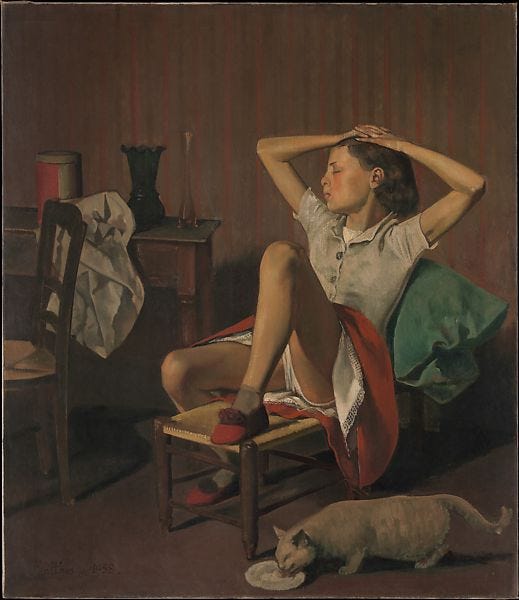
The first time I encountered this painter’s work, it reminded me of the classic and controversial novel— Lolita.
And then I came across that the painter’s composition did make it to one of Lolita’s book covers.
Balthus, born Balthasar Klossowski on 29 February 1908, developed an inclination for cats and art early.
In simple words: he had a long-standing obsession with cats and girls in puberty, whom he often featured nude, asleep, or in repose.
His earliest painting, The King of Cats, shows him posing stylishly towards the viewer. He is wearing high waist yellow trousers and an abbreviated necktie. A fluffy cat nudges his left calf, and a tile placed on the other side says: “A portrait of HM the King of Cats.”

Another surrealist painting showcases a human-sized grinny cat devouring straight into his fresh fish and champagne. Doesn’t the white bib on the cat look cute?
A shoal of fishes form a rainbow and refills the cat’s plate one after another. A whole crab lies on a serving plate, and an adolescent girl waves from the boat.

As Balthus progressed in his artistic career, he started creating eye-catching pictures of adolescent girls, in particular, Thérèse Blanchard, a 12–13-year-old girl who was Balthus’s neighbor.
Girl and Cat(1937) show Blanchard gazing at us with her arms and hands crossed behind her head. She wears a mini skirt, and bobby socks, and her panty is exposed.
An obese cat looks at us too.
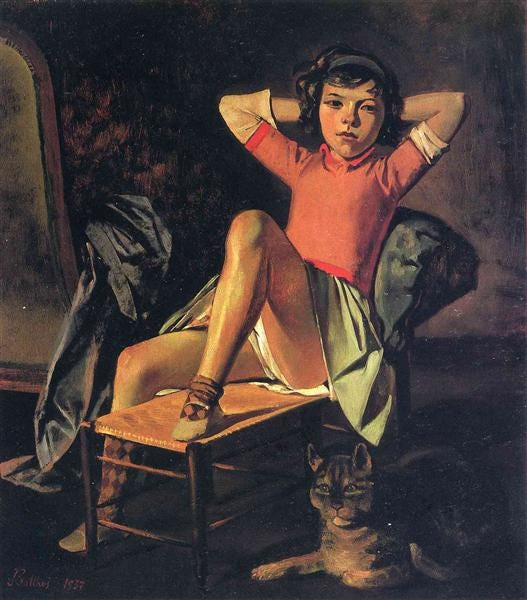
A year later, another version of Blanchard’s series came out — Thérèse dreaming.
This painting shocked many. Two years ago, during Balthus’s exclusive exhibition, a petition was filed against the Metropolitan Museum of Art stating:
“The artist of this painting, Balthus, had a noted infatuation with pubescent girls and this painting is undeniably romanticizing the sexualization of a child … Given the current climate around sexual assault and allegations that become more public each day, in showcasing this work for the masses, The Met is romanticizing voyeurism and the objectification of children.”
Blanchard poses in a red mini skirt, bobby socks, and red ballet flats. Her eyes are closed, head turned, knee raised, and panty exposed.
Is she daydreaming? Or is she perhaps disconcerted by the viewer’s gaze?
A white cat slurps milk beside Blanchard.
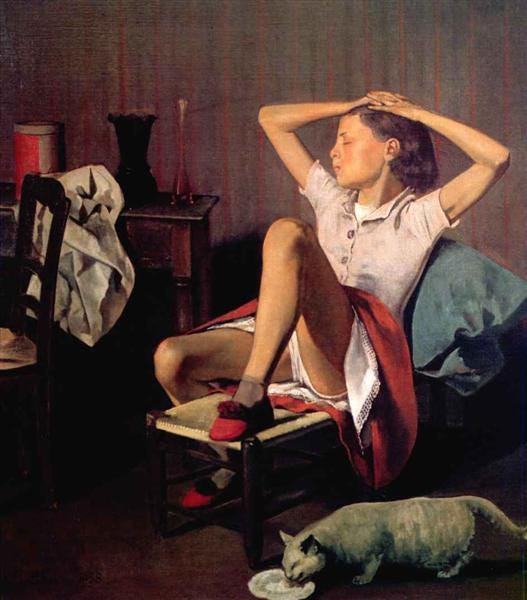
The Golden Days portray a 14-year-old model, Odile Bugnon, in a short skirt, her legs spread across a divan, and a shirtless man near the fireplace.
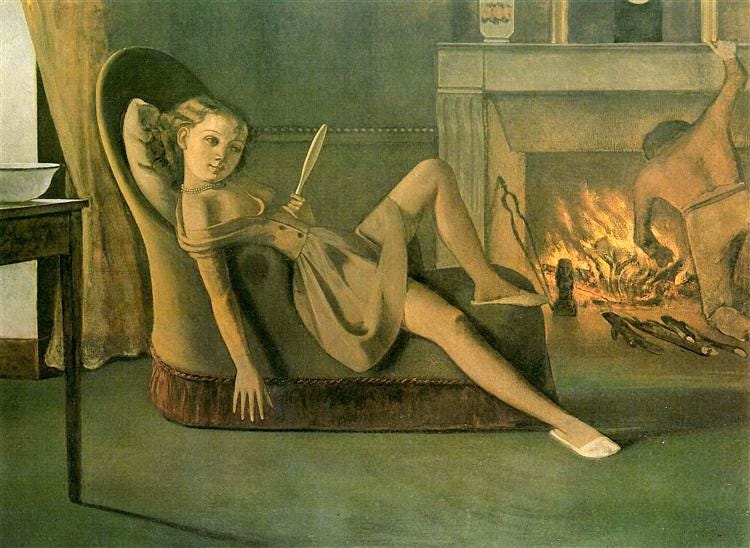
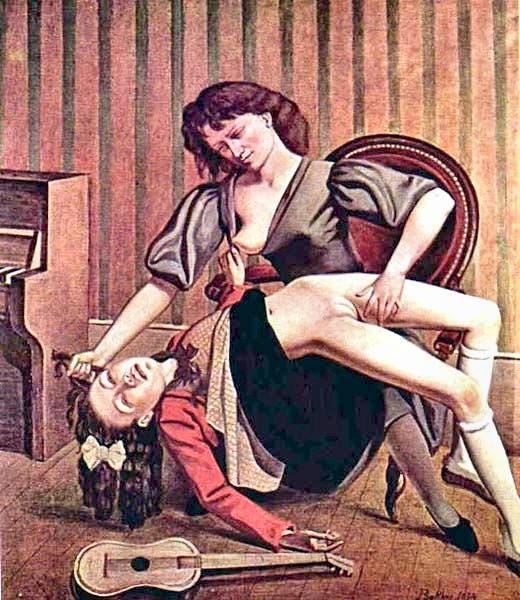
The Guitar lesson (1934) became Balthus’s most infamous artwork. It received a lot of wrath from the general public.
A bare-breasted woman strums the vulva of a schoolgirl with one hand and pulls her hair with another. The girl pulls the woman’s nipples and the guitar on the floor.
Considering his times, Balthus unquestionably pursued a fragile and bold subject of adolescent psychology and vulnerability. Girls daydreaming, being lost in their vanity, or being completely self-absorbed show a few puberty traits.
Their unselfconscious postures sometimes suggest sensuality and sometimes inelegance, a contradiction that perfectly matched puberty’s phase.
However, the artist’s mindset and orientation towards making these subjects remain enigmatic.
Why was the Guitar Lesson made in the first place? What was Balthus's intent?
Was it artistic infatuation or outright romanticism of pedophilia as viewed by the audiences? Although he and his keepers denied these allegations.
Balthus confessed late in life that few of his subjects, especially Guitar Lesson, might have crossed the line of decency.
Let me know your thoughts in the comments.
If you like my articles, please subscribe to Medium using my landing page, as your fee directly supports me. Check my YouTube channel for interesting videos on art history.


