
3 Lessons From My First $100 Medium Month
I became a Medium member in September 2019, but I only really started writing seriously on Medium last month.
When the COVID-19 pandemic struck, my country, Singapore, was placed in full lockdown. My busy life as an entrepreneur came to a screeching halt.
Unable to run my sports event business, I decided to work on my mental health, get in great shape, and read voraciously.
As they say, one thing leads to another. In my case, the voracious reading led to ferocious writing.
In the month of June alone, I wrote 16 articles on Medium. Not as prolific as others, but an obscene amount for me. Along the way, I also picked up Top Writer status in Entrepreneurship, Business and Sports!
I’m chuffed. A Top Writer tag doesn’t really do anything, but still, it’s nice to have a pat on the back, a nod of acknowledgement from a website I’ve spent countless hours writing for.
What I’m most happy about, however, is that June is the first month I crossed the $100 Medium milestone.
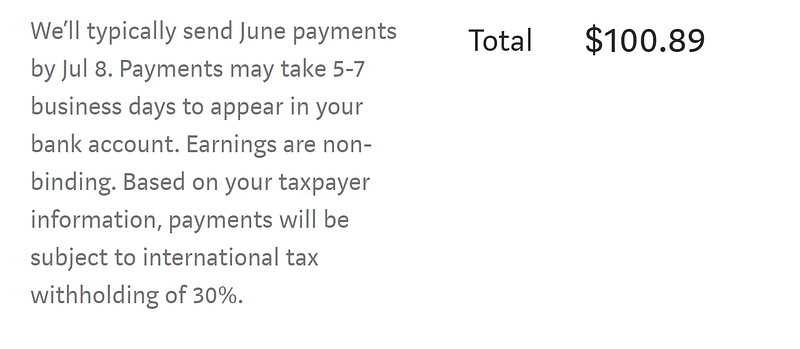
I actually made over $200 on Medium last month. When it rains money over here it pours, and I love it!
See, out of the myriad of writers honing their craft on Medium, only a small fraction cross $100 in monthly earnings. Around 7–9%, to be exact.
Although two hundred plus dollars isn’t a life-changing sum, it’s the first time I’ve made a substantial amount of money writing. It’s a great feeling being able to pay your Netflix bills from your words and still have some left over for a cup or three of Joe.
And if there’s one truism I learned from my years in martial arts, it’s to remember to celebrate the small wins. To quote Abishek Ratna,
“Celebrating the small wins is a great way to build confidence and start feeling better about yourself.”
For just as failure comes before success, small wins are the herald of monumental victories.
Here are 3 lessons I’ve gleaned from joining Medium’s rarefied air of seven percenters.
I consider these 3 lessons key takeaways, open secrets, almost. These are the three tips I wish I knew when I first started writing on Medium. Knowing them would’ve shortcutted my Medium journey manyfold. They would’ve been a veritable godsend.
And now I’ve listed them here, all three, that you might have a smoother journey than I did.
If these 3 lessons are applied, dear reader, you’ll be well on your way to the top.
Write Prolifically — But Focus On Writing “Whales”
“Our job as content creators is not to make more noise. It’s not to put our names on more words.
It’s to create high-quality content that matters.” — Sergey Faldin
Many people think you need to publish every day on Medium to succeed.
And to be fair, there are worse things a beginner writer can do than to write every single day. I completely agree with Neil Gaiman’s advice on writing:
“Assume that you have a million words inside you that are absolute rubbish and you need to get them out before you get to the good ones.”
The first thing I do, every morning without fail, is to sit down and journal, longhand. I picked up this technique from a $2000 writing retreat I attended in Bali, and it has completely eliminated my writer’s block.
Writing is practice, and perfect practice makes perfect.
However, once you’ve established a healthy writing habit, to get to the next level, you have to change your writing methodology. As Marshall Goldsmith said, “What you got here won’t get you there.”
To actually write articles that pay your bills while you sleep, you have to leave the kiddy pool behind and dive into deep waters. You have to become a professional writer.
And professional writers aim to write whales.
Full disclosure, I took the idea of writing “whales” from an amazing article written by my Medium buddy, Sergey Faldin. In it, Sergey wrote that: “90% of the money I made in 2020 from Medium comes from 3 articles.”
And you know what? I’ve noticed the exact same phenomena.
In fact, more than half of the $220 I made last month was from this one article alone.
The strangest thing is that I didn’t think there was anything special about this piece.
I mean, it was double curated, but so was this article, this one, and this one, too. Yet it ended up outperforming all of them many times over.
Sergey suggests that there are 3 types of articles content creators write.
- Keyword Clouds
- Trumps
- Whales
1. Keyword Clouds
These are SEO positive articles. So-called because they look like a ‘cloud’ of keywords and tags, these articles bring little value to the reader. Their sole purpose is to drive traffic to a blog.
2. Trumps
Trumps are content that resonates with people initially but invariably fades into obscurity days later. Think news about the coronavirus, the latest scandal, or politics.
Sergey makes the argument that 99% of Medium articles fall into this category, and I am inclined to agree.
3. Whales
We’ve finally come to the motherload.
Whales are evergreen content that grows organically over time.
They are timeless content that never goes out of style, and crucially, they consist of high-quality, relevant work that people feel compelled to share.
Whales grow organically in this manner — like fine wine, they actually get better with the passing of time.
One such article can go viral and kickstart your career — just look at Amardeep Parmar.
Whales are the Holy Grail of content writing. That’s why elite writers like Ryan Holiday focus on quality over quantity. They know that writing keyword clouds and trumps may give you a short term viewership spike, but they also know that in the long-run, careers are built and fans are made by great content.
The catch is you never know what article will turn out to be a whale. As attested by my best-performing article, one can never know what your audience will end up loving.
The art of virality is just that, an art. You can analyze it all you want but at the end of the day, you can never be truly sure what’s going to be a hit, and what’s going to flop and be forgotten.
Therefore, the best writing tactic is to continue writing as prolifically as possible, but with a focus on high-quality, evergreen content.
That’s how you join the ranks of the extraordinary writers.
That’s how you make real money writing online.
Tell Personal Stories
“Storytelling is the oldest form of education.”
— Terry Tempest
Can I let you in on a secret?
Medium isn’t about information. It’s about how you convey that information.
There’s rarely a single, life-changing fact or style that a writer possesses that can completely change the playing field and make them a superstar — and even if there is, once they publish that particular work it’ll be read, copied and repeated Ad Nauseum by the horde of hungry writers here on Medium. It’ll be rendered obsolete within weeks.
So how do you stand out from the millions of aspiring writers out there? The answer is simple.
Write stories. Personal ones. In fact, the more personal the story, the better.
My favourite Medium writer is Nicolas Cole. He has a really cool backstory, and he knows how to use it.
I started building my personal brand online when I was 23 years old.
I had just graduated from college, had spent about six months working my first full-time job, and felt like real life had just punched me in the face.
I was living in a small studio apartment on the north side of Chicago with no air conditioning and a heater from the 1950s…
This is how Nicolas starts all his articles, with a personal story that segways to the main point.
Instead of repeating cookie-cutter advice that literally anyone can find with a 10-second Google search, Nicolas takes a different route. He injects his own personal experience into his writing. He tells of his struggles. His journey. His eventual triumph.
Nicolas’s strategy serves to make his writing one-of-a-kind and plays an essential part in his writing success.
There’s a reason why Steve Jobs said:
“The most powerful person in the world is the storyteller.”
Stories are literally the building blocks our minds use to make sense of the world. Patrick Rothfuss hit the nail on the head when he wrote, “It’s like everyone tells a story about themselves inside their own head. Always. All the time. That story makes you what you are. We build ourselves out of that story.”
I can’t agree with Gary V enough when he said: “Storytelling is the most underrated skill in business.” However, I would like to add that storytelling is also, ironically, the most underrated skill in writing.
Storytelling, done right, is nothing short of magic. Personal stories have the threefold effect of:
- Hooking your readers immediately with an interesting tale
- Making your message irreplaceable (There is only one you)
- Building your personal brand online
So include personal stories in your articles. Tell them in a deft and daring manner, and always with your audience in mind. Make them laugh. Make them cry. But most of all, make them feel.
And watch your writing, and your views, explode.
Remember, when it comes to creating art, always be yourself. Nobody can do you better than you.
Always Write More Than You Read
This is the last point, and I would argue, also the most important.
I briefly touched on the topic here:
If you aspire to be a writer but you spend 80% of your time reading, then you’re in the wrong sport, buddy.
The numbers should be flipped. You should be spending 80% of your time honing your craft, and 20% brushing up on the information regarding it. (Pareto’s Law)
To paraphrase Gary Vee, you can watch all the motivation workout videos you want, but you’re not going to get jacked unless you actually go to the gym and lift the weights!
As writers, this is an especially easy trap to fall into.
99% of all writers I know adore reading, myself included. Stephen King said in his memoir, On Writing, that “If you want to be a writer, you must do two things above all others: read a lot and write a lot.” In my experience, I have found this to be very true.
However, the problem is most writers take the former advice to heart but fail to adhere to the latter. They read much more than they write.
One must keep in mind that in the same breath, Stephen King also says he writes 2000 words a day. Minimum.
Whenever you feel like you’re reading too much, keep in mind this harsh yet hilarious truism:
“If more information was the answer, we’d all be billionaires with perfect abs.” — Derek Sivers
You don’t need more information on how to formulate plot structures or more prompts to kickstart your story. You need to sit down and practise your craft. You need to write, period.
When in doubt, always err on the side of productivity. The path to success can be summed up in one phrase:
Create more, consume less.
The true measure of a writer does not lie in how much he has read, but how much he has written. To paraphrase Bukowski, “It doesn’t matter what you die of. Everyone dies. The only thing that matters is the words you leave behind.”
At the end of the day, readers read, and writers write.
Decide which one you want to be.
Then go forth and do that.
Your Takeaway
In summary, these are the three lessons I’ve learned from my first $100 Medium month.
- Write prolifically — but focus on writing “whales”
- Tell personal stories
- Always write more than you read
If a newbie writer from Singapore can crack Medium’s top 7%, you can too.
All it takes is a change of strategy. To redouble your efforts on high-quality, evergreen content. The goal is to write articles that are well-crafted and timeless, articles that will be viewed and shared in the years to come.
Articles that will make you money while you sleep, forever.
The next step is to inject personal stories into your work. Is there a funny anecdote, or a tear-jerking piece of your past that relates to your topic? Be sure to share it!
Stories are spice. They not only add flavour to your writing, but they also make your work uniquely yours. Stories add a human touch to otherwise bland and played-out advice. Remember this: the more poignant and personal the story, the more flavourful your writing becomes.
Lastly, always, always, write more than you read. As the Woody Allen quote goes, “Just showing up is half the battle.”
And that’s how you start making some real money from Medium.
Be sure to apply these tips, dear reader.
I’ll see you at the top.
Thanks for reading my story (: