
How To Write a Blog Post That Makes You Money While You Sleep
You’re allowed to do anything, except one thing: let them get bored.

If you think about what people write online, you can break them down into three major categories.
1. Keyword clouds
‘Keyword clouds’ are SEO-positive articles.
It’s content that’s easily indexed by search engines like Google, but brings little (or none) value and often looks like a cloud of tags and keywords.
Google anything, and you’ll find a bunch of keyword clouds.
This is because the sure way to ruin anything is to add the word ‘marketing’ to it. (Think: content + marketing.)
The goal of such articles is to drive traffic to your blog. Listicles, self-help advice from famous people, fall into this category. (Their big names are SEO-friendly.)
2. Trumps
If most of Google is ‘keyword clouds,’ then 99% of the media (including Medium) is ‘trumps.’
‘Trumps’ is where articles about Donald Trump, coronavirus, and the news falls into.
Not just news — but any content that gains resonance for a day, a week, maybe two, only to eventually die in obscurity.
Think to headlines like, ‘I Kissed Him, and He Went Away’ or articles about making money on Medium (‘A Complete Breakdown Of My $2,000 Article’).
Most of the ‘trumps’ are hype and noise.
Yes, such content can really resonate with people initially, but over the long-term, it fades away, ceasing to be relevant.
Such articles are like butterflies — they live beautifully for a day and die at sunset.
3. Whales
Finally, we’ve got ‘whales’ — the ‘evergreen content.’
It’s the type of content that never (or won’t for a long time) go out of fashion. It’s content that works for you, keeps resonating with people long after you’ve stopped working on it.
Such content doesn’t even need pushing; it grows organically.
It’s high-quality writing that people can’t help but share with their friends — showcasing their good tastes as a result — and it gains traction with time.
This is what it looks like:
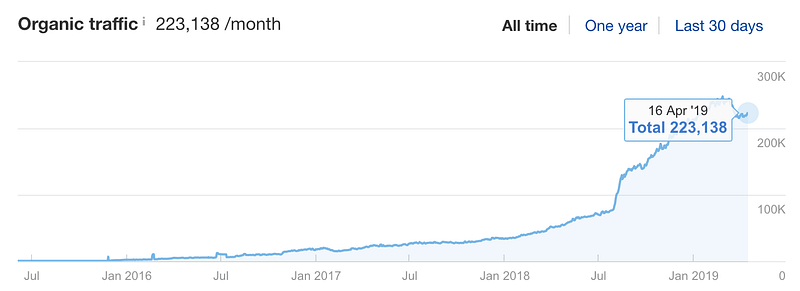
One such article can go viral and help you build a career.
It’s a whale among the sharks. And it’s what Naval Ravikant meant when he talked about content as leverage.
«You can create software and media that works for you while you sleep. If you can’t code, write books and blogs, record videos and podcasts.» — Naval Ravikant
It might not get the same resonance as the ‘trumps’ do initially, but over the longterm, it all evens out. If the views on your article are growing with time, you know you’re doing something right.
On Medium, almost nobody creates ‘keywords clouds’ (although you see it everywhere on Google when searching for useful information, and it can really get you) because the platform itself was created to fight shit like this.
Plus, you don’t get curated for writing those.
However, most Medium writers make ‘trumps’ because that’s the easiest way to get views, claps, and followers. And because new writers blindly copy successful writers, Medium simply becomes a collection of trumps.
This is not Medium’s fault, nor the writers’.
It’s how the media is structured: you’ll always have 99% of content that’s shit.
I’ll be the first to admit that 99% of what I wrote for the past 12 months are trumps. (Or shit.)
There are two reasons why this happened:
One, I (naively) thought that writing trumps is what makes you successful on this platform. I believed that to be seen; I have to write the most eye-catching stuff that resonates now.
I was wrong.
And two, writing whales is hard. If you write a lot, you might have one whale among 99 trumps, and that’s even if you’re lucky. I wrote daily from October, and I had just three articles going viral, which I could call whales.
Everyone wants to write ‘evergreen content’ that keeps making you money and getting exposure while you sleep — but it’s more difficult than it sounds.
It’s extremely easy to write SEO articles.
You can hire a guy on UpWork for $8/hr and have ten articles by Monday.
It’s a bit harder to make ‘trumps.’
And that’s where journalists come into play. They are brilliant at writing these.
I recently googled my name (yes, please don’t say anything) and discovered that my content is being reposted on some website where I am called a ‘Medium journalist’ — even though I never called myself that.
But most successful writers on Medium are just that — self-taught journalists.
Personally, I could never ‘hype’ because I could never catch the latest trend.
I usually don’t have a well-thought-out opinion (or I just don’t care) about what’s happening in the world on a minute-by-minute basis, unless it’s something big like global warming, or a financial crisis.
And I feel uncomfortable writing way too personal stories with cheesy eye-catching headlines like I Decided To Break Up With Her And This Is What Happened… to me, that’s evidence of a bad attitude towards the reader.
But I am more experienced now.
I know that writing ‘trumps’ is not how you become successful on Medium.
Such ‘hype’ pieces are the equivalent of fast food in writing. Great for quick and cheap calories, but awful for you over the long-term.
You could call it ‘fast content.’
And when all you have is trumps, nothing sticks long enough to become an asset. Nothing goes viral — although you might get a lot of initial traction.
You’ll have to keep creating, writing, and coming up with more ‘trumps’. You can never relax.
Writing whales is the most difficult task.
And arguably, the most important.
I wrote an article in November that still brings me, new followers. That’s a whale.
Another whale came in early February, and the most recent one on May 30, when I wrote about content creation as the job of the future.
Not only will these articles keep growing, making exposure, money, and following months after published them — but writing them will also give you a sense of fulfillment.
You’re doing something important. You’re influencing people, possibly even changing lives. People will save such content and reread, share it with friends.
Such content will be building a tribe, a community while you sleep.
It will work for you, instead of you working for it.
An obvious question to ask.
How do you write ‘whales’?
It’s not easy.
But to start answering this question, we must first remember what writing really is.
Writing is a game where whoever holds the reader’s attention the most — wins.
I like to imagine it as a contest on a carnival.
Your job is to hold the reader’s attention.
You’ve got 26 letters and a handful of punctuation marks.
Ready, set, go!
You’re allowed to do anything. Do whatever you want to hold the reader’s attention as long as possible.
This is why the best writers in the world — Neil Gaiman, Steven King, Iain Banks, J.K. Rowling — write such page-turners. They know this.
They start with a story and dialogue to engage you in. Or create suspense by starting the story with the end.
Or…
They…
Use…
Breaks…
to keep you reading further.
No writer in the world can claim that 100% of people who buy their books, finish them. So don’t imagine everyone reading your articles to the end.
But the closer you get there, the better your writing will be.
Whatever keeps the reader going — works. You’re allowed to do anything, except one thing: let them get bored.
This is what makes writing art.
When you write whales, your goal is to write something so compelling, engaging, and convincing, that people can’t stop reading it. Then they will share what they’ve read. And that’s how content goes viral.
It can be advice that resonates with the reader in a personal way. It can be an interesting perspective. It can be something that evokes emotions (including negative) and launches a discussion as I did here.
If your writing is impossible to stop reading and it’s widely shareable, you’ve got a whale.
6 Tips On Writing a ‘Whale’ Story
1. Give it time.
Ideas are like wine; they need time to mature and get better. You can write a Petit Chablis, but a Grand Cru is more valuable. Why? It’s more mature.
Let your ideas grow and mature before you sit down to write. Think it through.
2. Ask yourself this question.
«What can’t my audience miss?». Or this one, «What do I really want to say?».
3. Keep your head empty.
As Zhenya Zerkalenkov said in our Discord server for creatives (which you can join here), «I meditate before writing and like to keep my head empty before writing.»
A cluttered, busy mind, will only create trumps. Or keyword clouds.
4. Don’t rush to hit publish.
Procrastination is a disguise for insecurity. But publishing too early is a sign of immaturity. You don’t eat apples when they’re still green and sour.
As Hemingway said so eloquently,
‘The first draft of anything is shit.’
Whales take long hours, often days, to become juicy stories.
Rule of thumb: write today, edit tomorrow. When you’re finished, give it one more day. Come back tomorrow, with a refreshed perspective.
Let creativity compound on creativity.
5. The secret is in the line.
Charles Bukowski said,
«If no one reads, all is lost. The key to getting someone to read is taking it one sentence at a time, ensuring your readers are so compelled by that sentence that they want to read the next. The secret is in the line.»
You create page-turners (or its equivalents in blogging) by making every word count.
6. Get angry.
Some of the best writing I had was when I got angry, emotional, and needed an outlet. The writing became that outlet.
If you feel neutral towards whatever you’re writing, chances are, everybody will feel the same. Anger is energy. And readers like energy. Yes, you risk not being read by everyone — but you don’t need them all. You need those readers that will care.
And the best part, if your writing is a ‘whale,’ Medium will do everything on its part to promote it. Which is to say, forget about growth hacking.
Do your job — create content people can’t stop reading — and let the platforms do theirs by promoting you.
This last bit of advice will save you months.
I am a guy who likes to reflect, analyze, structure, and systemize stuff. And writing was no exception.
I used to think there’s some ‘rule’ you have to follow to ‘make it’ on Medium.
I used to believe that some articles do better than others.
Or that some pace of writing is better for growth.
This is bullshit.
If you look around, you’ll see all sorts of writers that do all sorts of things.
Some growth hack, others don’t. Some write several times per day (like Tim Denning), others several times per week (like Michael Thompson). Some write long pieces, others short. Some write personal stuff; others write listicles. So on, so forth.
There’s almost no correlation between what and how writers do and their success.
The only two things that matter are:
A) that you actually write;
B) that you find your particular style.
Successful creatives are those that tap into their strengths and make their personality work for them. Whatever you think is a bug, maybe it’s a feature.
So don’t waste your time analyzing and invest it in writing instead.
Creating content is just like entrepreneurship: very action-based.
It’s doing and writing that gets you places, not overthinking.


