
30 Fascinating Facts about Ancient Egypt That You Probably Didn’t Know — 2nd ed.
Women had equal rights with men, there were female doctors, divorce was possible, pyramid workers were revered, and much more
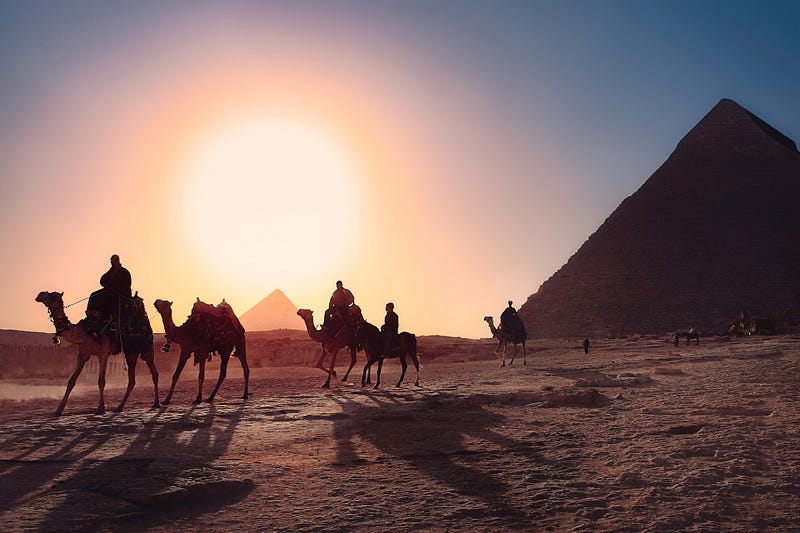
Ancient Egypt is legendary due to all the advances it brought the world, things like paper, pens, toothpaste, and much more. Here are 30 facts about ancient Egypt that you probably didn’t know.
The Pyramid of Khufu is the largest Egyptian pyramid and the second largest in the world — behind the Quetzalcóatl Pyramid in Mexico.
The Pyramid of Khufu, rather insanely, is believed to weigh as much as 16 Empire State buildings, and all of that weight would have to have been transported from the mines to the site of the pyramid.
Herodotus, the ancient Greek historian who visited Egypt in 450 BC, wrote that it took 100,000 or more workers 30 years to build one pyramid. However, it is believed that he vastly exaggerated these numbers, in actual fact, it’s believed it took on average 10,000 workers 30 years to build one. This takes into account that the workers would mostly only work three months out of the year — during the flood season. Even the biggest one, the Pyramid of Khufu, is believed to have taken only 20,000 workers 23 years to build — again working in mostly 3-month shifts each year. However, those numbers are still crazy high and managing a workforce that size to build a pyramid is still an insane feat for an ancient society.
Thus far, there have been 118 Egyptian pyramids found and it is widely accepted that there are likely more out there just waiting to be found. In terms of how many the ancient Egyptians are believed to have built, nobody knows but the consensus is likely a good number more than has been found thus far.
Whenever people think of slavery, they think of ancient Egypt. However, slavery was not as big a part of Egypt as it was in other societies of the time, and unlike popular belief, slaves did not build the pyramids — off-season farmers and farm hands are believed to have built them. But slavery was ripe in ancient Egypt. There were three types of slaves: chattel slaves, bonded labour slaves, and forced labour slaves. Chattel slaves were mostly captives of war and as such, they belonged to the Pharaoh who could do with them what he/she wanted — sell them, resettle them, put them to work, execute them, whatever. Most of them were given to temples or soldiers as spoils of war. Bonded labour was a form of slavery where a person would either sell themselves into slavery or sell their children into it. It was rarely done out of free will, and mostly was done due to a person either being starving and having no choice, or because somebody owed a debt. If a debt was owed, the indebted person would have to sell themselves and their entire family to the person to settle the debt, they would also have to give up all their possessions. Forced Labour was basically an early form of conscription. Labourers would be conscripted for any number of things, from military purposes to aiding with mining and quarrying, to much more. These workers would be paid wages and were not owned, but rather had to do a duty for the state. Forced labour basically helped turn Egypt into a military power.
The workers who built the pyramids were highly respected for their work. So much so, that those that died during construction were honoured by being buried near the sacred pyramids of the pharaohs. Also, it’s believed that they were well fed, with a consistent diet of meat — no doubt needed to give them the strength to do the backbreaking work.
It was mostly poor people who built the pyramids, and it was truly backbreaking work. The skeletons of workers found to have worked the pyramids showed that they suffered from bad health, with the skeletons showing signs of arthritis and heavily suppressed lower vertebra. So, they were free men and ordinary citizens, but the work was backbreaking and unquestionably vastly shortened their lives.
If you unwrapped an Egyptian mummy, on average, the bandages would stretch out between 1 and 1.25 miles long. That’s between 65 and 87 rolls of toilet paper.
Unlike popular belief, women had near enough the same freedoms and rights in ancient Egypt that men had. Egyptian women could have their own business, they could own and sell property. They also worked, and if they did the same job as a man, they got equal pay. Amongst the peasantry, they typically worked alongside their husbands. For women married to business owners, when the men went away, the women would manage the businesses in their absence. None had a problem with this, because the women were literally legally the equals of men, even to the point they could be witnesses in court, and enter into legal contracts on their own vocation. However, women rarely held important positions and those that did mostly gained those positions through relation to male kings. This is because the child mortality rate was so high—just like in all none modern societies — it did not make sense for women to be in the general workforce i.e. the women had to get pregnant pretty much on a yearly basis and had to start as young as possible and keep going for as long as possible. Considering this, most women who worked, worked from home. But, despite this, unlike comparable societies of the time, the women in ancient Egypt were the legal equals of men.
There were female doctors in Egypt. Peseshet is believed to be the first known female Doctor/physician in human history, she is believed to have been a part of the fourth dynasty and to have lived sometime around the 25th century BC.
Divorce was legal in ancient Egypt, and they were not rare nor were they frowned upon i.e. it was accepted that sometimes a couple just did not get along and needed to divorce. Also, both men and women could initiate one. However, there were differences in how a man and woman could initiate a divorce. A man had the right to divorce his wife without her consent and without going to court, whereas a woman had to go to court. But, if a man did divorce his wife without her consent and without cause, she would be entitled to compensation of at least two years maintenance, and would be entitled to the return of her dowry. Also, men had to pay a fine and offer compensation if they divorced their wives—they had to do this even if their wife divorced them. Also, if there was a marital property, in the case of divorce, the woman would gain one-third of that property — regardless of who initiated the divorce. All in all, it was typically more costly for a man to divorce a woman in ancient Egypt than it was for a woman to divorce a man. But as ever it was complex, and varied based on personal circumstances. Also, as ever with laws in ancient societies, many simply ignored them.
The Egyptians are synonymous with the Bronze Age and needless to say one of the most important advances ancient Egypt gave to the world was in metallurgy. The advances in the smelting process of gold, silver, lead and copper and the like had a profound impact on the world, and laid the foundations for many more advancements which have led us to the world we now have, where metallurgy is at the heart of everything.
Ancient Egypt had the Nile River to thank for its prosperity. The predictability of the tidal system, and the fertile soil it brought forth, gave them the perfect environment to advance their agriculture techniques and provide food for an ever-growing and prosperous population.
One of the greatest innovations that ancient Egypt gave the world was basin irrigation techniques. Basin irrigation is where water is allowed to flow into a field — it either is allowed to flow over the whole field or through dikes. The ancient Egyptian’s use of basin irrigation in the floodplains of the Nile allowed them to mass-produce things like wheat and barley, but also things like flax and papyrus, which allowed them to feed an ever-growing and thriving society. Without these techniques, ancient Egypt could never have become the society it became because it could never have fed its people.
The ancient Egyptians were experts in horticulture, which gave them the ability to grow flowers, fruits, nuts, vegetables, herbs, and much more. However, these gardens usually took a lot of effort to maintain, mainly because they were built away from the floodplains and so water had to be carried to the gardens, and a lot of water was needed to keep the gardens thriving.
The ancient Egyptian penchant for horticulture laid the foundations for modern horticulture. That means all the fruit and vegetables we now take for granted, all the herbs, all the gardens we now have, so much more, it was the advances of ancient Egypt that laid much of the foundations for the majority of it.
It is believed by many that the ancient Egyptians were the first society to invent writing, with ancient Egypt providing the first solid evidence of reading, writing and literature.
The writing form the Egyptians used was hieroglyphics, and in hieroglyphics, there are more than a thousand distinct characters — this includes both alphabetic and logographic characters. Needless to say, you had to be especially clever to use it, and even more clever to invent it.
The ability to read Egyptian hieroglyphics was lost in the 5th century, and remained lost for over 1300 years. The rise of Christianity in the Roman Empire was the reason, it saw the closing of all non-Christian temples, including Egyptian ones. The loss of the Egyptian temples took with them the knowledge of hieroglyphics.
It was only with the discovery of the Rosetta Stone in 1799 that it became possible again to read Egyptian hieroglyphics. Though it still took until the 1820s for Frenchman Jean-François Champollion to decipher the Egyptian hieroglyphics. The reason he was able to was because the Rosetta Stone has a decree on it in three languages: Egyptian hieroglyphics, Demotic scripts, and Ancient Greek. Ancient Greek was still known and so it was possible to decipher Egyptian hieroglyphics.
Some pharaohs had their servants sacrificed so that they could be buried with them. The reason, so the servants could continue to serve them in the afterlife.
The ancient Egyptians used to play board games and they were very popular, so much so some pharaohs even got buried with them so that they could keep themselves occupied in the afterlife. The most popular games were Senet and Mehen. Senet — full name Senet Net Hab, which means game of passing through — is believed to be the oldest board game in the world, dating back as far as 3100 BC. The aim of the game is to get your pieces from one side of the board to the other, but rather than throwing dice, you throw something called senet sticks. These are small sticks which have one side painted white, the other painted black. How much you get to move is based upon which colours the sticks land on.
The ancient Egyptians invented the 12-month calendar, and if the calendar was still in use today — 2022— it would be the year 6263.
The ancient Egyptians only had three seasons. The first was the season of flooding, which was known as Akhet a.k.a. the season of inundation. This ran from June until September. During this period, most farmers and farmhands would have worked on the pyramids or made money through fishing. The second season is known as Peretor a.k.a. the season of emergence. This ran from October until February and was the period that farmers would work the fields and grow crops. The third and final season was known as Shemu a.k.a. the season of the harvest. This ran from March to May and was a very intense period, mainly because the farmers had to do the harvest quickly before the floods returned.
The ancient Egyptians were big fans of make-up, and both men and women wore it. Galena, also known as kohl, which was often made of soot, would be used to darken the eyelashes; while malachite powder, which is a green mineral, would be used on the eyelids and above the eye. Also, red ochre — a natural clay — would be used to accentuate the cheeks and as lipstick. The make-up was typically applied using ivory, metal or wood sticks. In terms of why make-up became so popular, it is believed it began as a form of protection against the sun, but once it was realised it could be used to enhance appearance, it soon became mainly about that.
Cleopatra is the woman who made red lipstick popular. She wore a unique red lipstick that was made using a mixture of flowers, red ochre, fish scales, crushed ants, carmine, and beeswax. Prior to that, other colours had been just as popular, including orange, magenta, and blue-black. That means only at the very end of ancient Egypt was red lipstick the most popular lipstick, prior to that it was more varied with colours going in and out of fashion.
The Egyptians created one of the first forms of waxing. It is called sugar waxing and is made from a mixture of sugar and beeswax. A form of sugar waxing is still used to this day. Many argue that it is a far better form of waxing than the more abrasive modern versions.
For a long time, it was believed that the ancient Egyptians were the first to domesticate cats; however, recent evidence suggests that the human relationship with cats likely started 10,000 years ago — so 5000 years before the beginning of ancient Egypt. It’s believed that the human relationship with cats started once we invented agriculture. The cats would start to make themselves at home around the fields to take advantage of how the crops attracted mice and other vermin. It’s believed this led to humans beginning to domesticate cats.
The ancient Egyptians may not have been the first to domesticate cats, but they were the first to popularise cats as domestic pets, and to make cats mainstream to the point of worship. It is believed that thanks to the ancient Egyptian's immense advances in agriculture, which led to ever bigger harvests, they had ever bigger insect and vermin problems. This gave them an ever greater need for cats as a defence against vermin, which made cats become increasingly important. Through this importance, cats eventually became revered animals and domesticated pets.
The Egyptian love affair with cats was so great that the women would try to make themselves look more feline in appearance, and it’s believed that the ancient Egyptians sparked the craze for women being praised for being feline in appearance, a trend which exists to this day. So, if you’ve ever wondered where the penchant for calling women pussycats comes from, where the penchant for apps which make women look more feline comes from, why we have Catwoman, it can all be traced back to the Egyptian love affair with cats.
That’s all from me, thanks for reading! If you enjoy this post, you may also enjoy the following:
27 Fascinating Facts about Ancient Egypt That You Probably Didn’t Know
38 Fascinating Facts about the Mongol Empire That You Probably Didn’t Know
25 Random but Fascinating Trivia Facts That You Probably Didn’t Know — 3rd ed.
To learn more about me see this link, to support me click the link below:
