
Predict Crypto Prices Using Market Cap
Latest Data for 2021 Bull Run
Making cryptocurrency price predictions is a form of dark art.
Unlike the discounted cashflow model for shares, there is no agreed method to value cryptocurrencies.
Different approaches have been proposed depending on the token use cases. We can make a simple classification as follows:
- Bitcoin. Use case: store of value asset that competes with gold.
- Altcoins. Use cases: dApps, DeFi, NFTs and so on. Real value is being created on top of quality Layer 1 solutions like Ethereum, Polkadot and Solana.
- Memecoins. No real use cases. Buy because you enjoy gambling. Some investors (read: gamblers and hardcore speculators) profit, but the vast majority lose money.
Depending on the use case, one may focus on different metrics, including: hash rate, network effect, number of dApps, TVL, and so on. One can spend days debating the merits of each metric and their relevance.
To keep things simple, investors typically use market capitalization as an easy-to-use guide for forecasting. Consider the current situation for ETH and ADA.


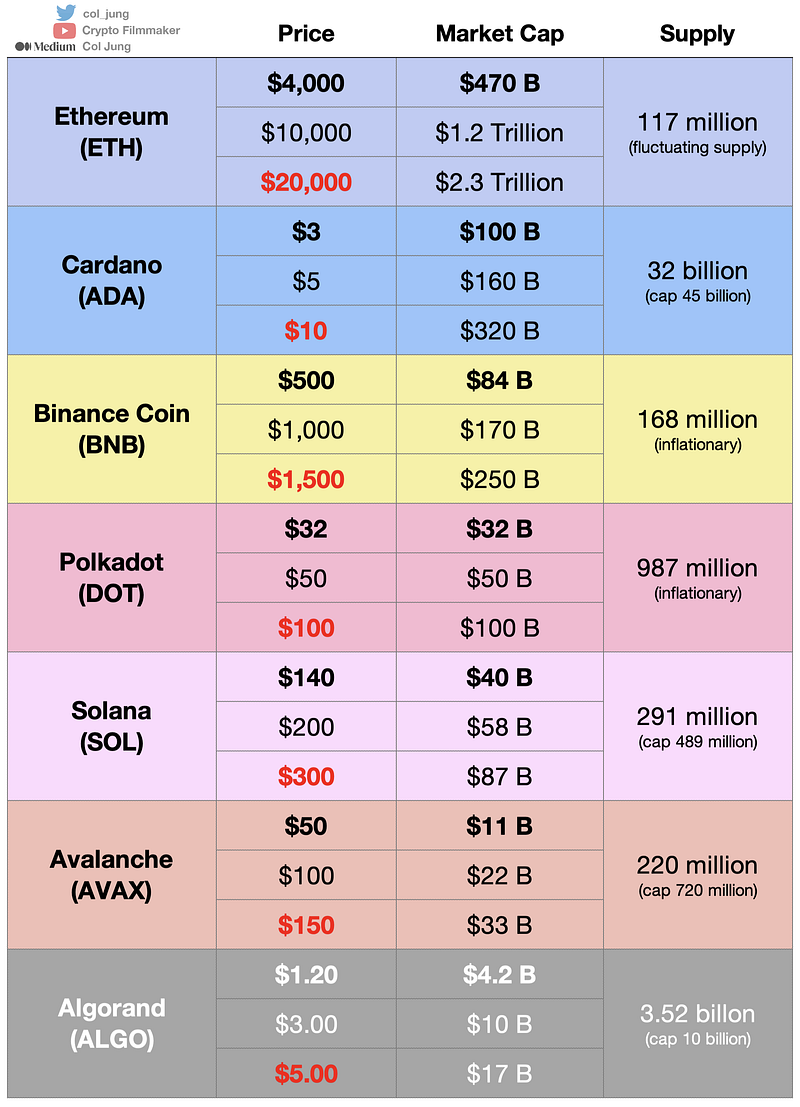
If you believe we’re at the beginning of the DeFi revolution, then you may feel ETH’s market cap is worth trillions. In that case, a $4000 ETH is a bargain.
If you believe mass adoption on Cardano will explode after their Smart Contracts launch, then you may feel ADA’s market cap will go into the trillions too. In that case, a $3 ADA is a bargain.
The process is to make an argument for a market cap forecast, which then determines the price of the token.
You should never directly make a price prediction without considering factors like the market cap. I have written an article about that here.
For example, it makes zero sense to say:
“ADA is cheaper than ETH because ADA is only $3!”
1 ADA costs far less than 1 ETH primarily because there’s almost 270x more ADA circulating around than ETH.
However, it makes total sense to argue:
“ADA is cheaper than ETH because its market cap is small given Cardano’s cutting edge blockchain technology.”
The rest of this article is dedicated to presenting market cap data and corresponding price predictions.
Join Medium here and gain unlimited access to the best crypto & investing articles on the internet.
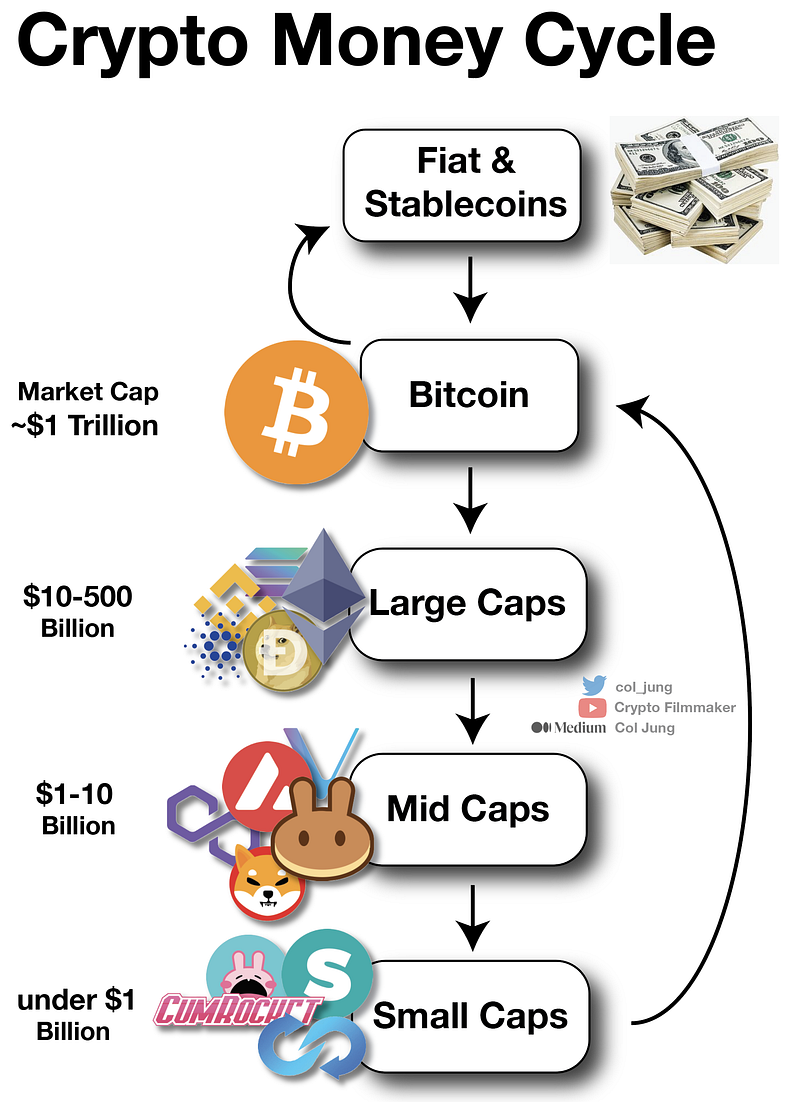
Crypto Money Cycle
An important fact for the traders.
Money flows in the crypto market in a semi-organised loop, swirling from larger to smaller market cap tokens and back.
I explain this on YouTube.
Capital first enters bitcoin. This requires the least investor risk profile.
Profits then rotate into the large-cap altcoins, particularly the solid Layer 1s like ETH, ADA, DOT, SOL and so on.
Profits from the large-caps then rotate to the mid & small-caps, as investors raise their risk profile to chase returns.
Eventually, capital flows back to bitcoin and stablecoins as the entire market runs too hot. Some capital may exit back into the fiat system.
Alright, let’s now look at the numbers.
Bitcoin & Total Market Cap
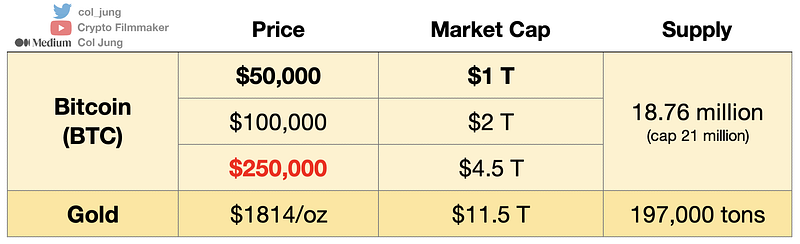
The stock-to-flow (S2F) model predicts a market cycle peak corresponding to bitcoin at $200,000 to $300,000, giving a market cap of around $5 trillion, or half of gold.
Want to grow your bitcoin?
Get $25 free BTC on Nexo with $100 deposit (link) and $50 free BTC on Celsius with a $400 deposit (link).
Nexo and Celsius pays you 5–6% annual interest on BTC. Perfect for HODLers!
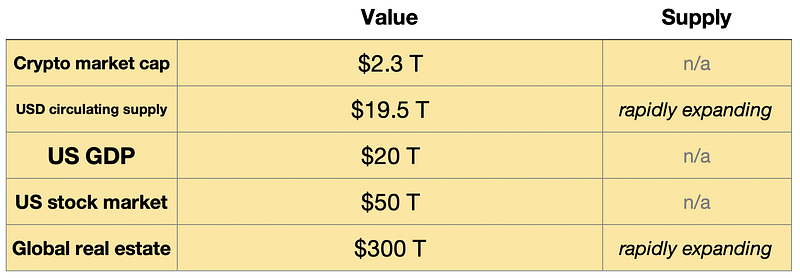
Here are some other figures for comparison.
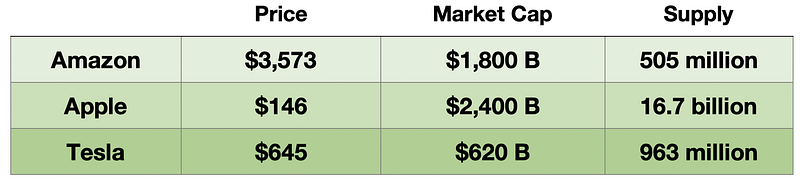
And here are a few tech stocks from the NASDAQ for good measure.
Layer 1 Altcoins
The safest altcoins to buy are quality Layer 1 cryptocurrencies.
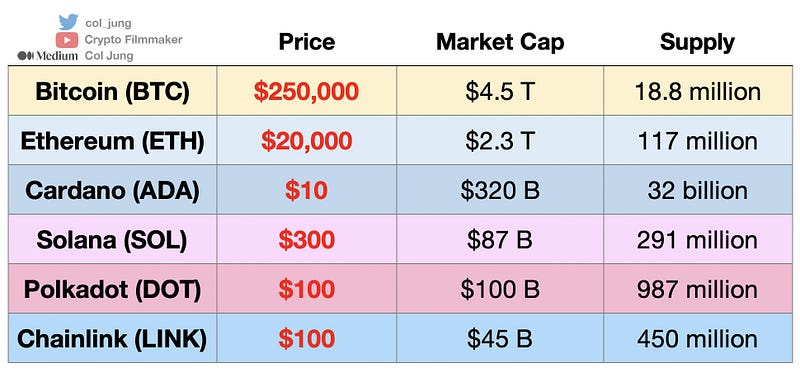
Here, you’re buying into competing blockchains upon which entire ecosystems of businesses and dApps are built. Infrastructure like this serve as good picks and shovels investments. I’ve listed the best and biggest below.
I have already covered ETH, ADA, SOL and AVAX on YouTube: here, here, here
Red represents my price predictions near the market cycle peak.
Other Great Altcoins
Beyond quality Layer 1 solutions, there are many altcoins with great use cases. Ask yourself:
- Is there a working proof-of-concept?
- Is it scalable?
- Is there a good team behind it?
Here are some of my favourites.
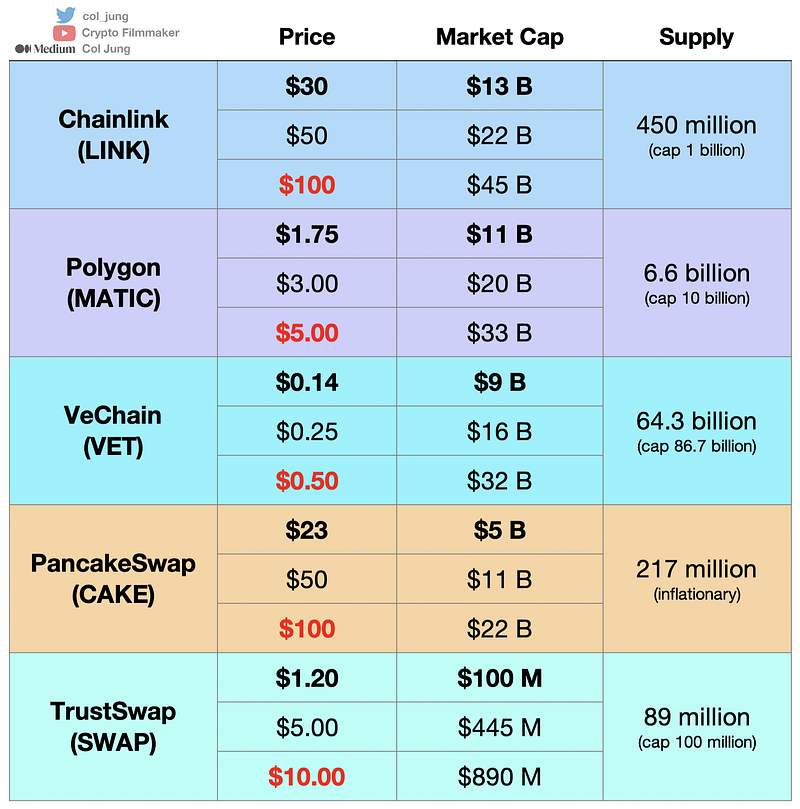
Chainlink is the leading oracle in the cryptocurrency space, bringing in external data into smart contracts — a crucial task for dApps use cases.
Polygon is the leading Layer 2 scaling solution for the Ethereum blockchain, which continues to be plagued by scalability issues.
VeChain is the leading blockchain-based supply chain management solution.
PancakeSwap is the largest DEX on the Binance Smart Chain and a favourite for DeFi fans. I’ve spoken of CAKE at length on YouTube.
TrustSwap is a leading IDO platform, giving ordinary people the opportunity to become venture capitalists and get in on quality new altcoins at initial offering prices. I’ve written about IDOs here.
Memecoins
This is the space for crypto’s fiercest speculators. High-risk, high reward.
Memecoins (a.k.a. sh!tcoins) are cryptocurrencies without real use cases. There are thousands out there.
Many are fun, a few will succeed, some are downright scams.
But that doesn’t mean you can’t make money.
Dogecoin is the most well-known memecoin. Pumped tirelessly by Elon Musk, it’s now a top 10 cryptocurrency by market cap and serves as a conduit for new capital entering the space. Its success has spurred hundreds of dog-themed memecoins, the most notable of which is the Shiba Inu Token.
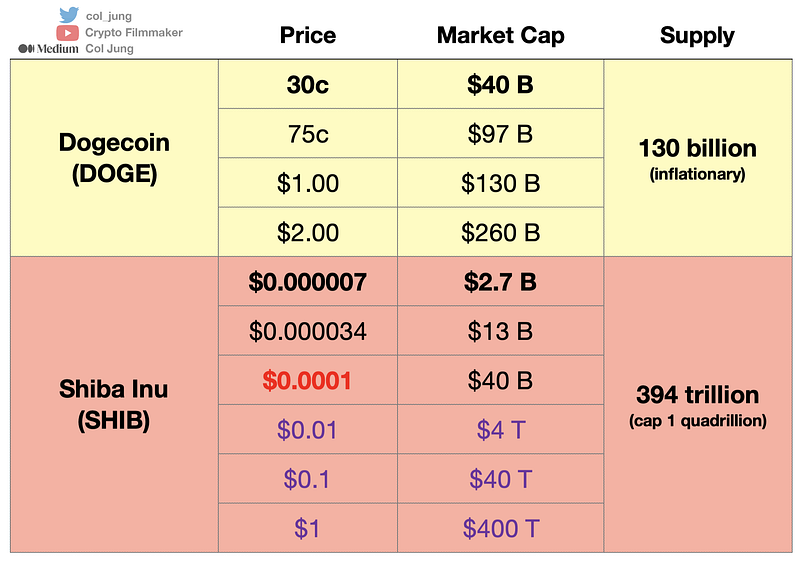
Note the price predictions in purple. They represent popular predictions on internet forums that are completely disconnected from reality.
I explain here why people make these sorts of silly price predictions. It is a combination of greed, ignorance and psychological manipulation.
On YouTube here, I discuss more realistic SHIB price predictions.
Final Words
Even though there is no agreed consensus on how to value cryptocurrencies, looking at the market capitalization provides an easy guide for forecasting.
For example, many believe the crypto market cap in 2021 can reach $10 trillion dollars. If we assume bitcoin holds roughly 50% market dominance, you’re looking at $5 trillion invested into BTC. That translates to a $250,000 bitcoin, which aligns with the S2F model.
Second example — Cardano-believers argue ADA will eat up a substantial share of the DeFi space within the next 5 years, justifying a trillion plus market cap. That’s another of way saying ADA will hit $30+ within the next 5 years.
Make an argument using market cap and arrive at a price.
I hope you found this article useful!
Follow me on Twitter & YouTube for regular analyses and guides.
My Crypto Articles
- Unlock unlimited access to Medium by joining here.
- When Will the Bear Market End? Macro 101 for Crypto Investors
- A Review of the Cryptocurrency Market in 2022
- Web3 Gaming — What do Crypto, NFTs & Metaverse offer?
- FTX’s Collapse & Solana’s Long-term Impact
- Polygon & Solana — 6 Killer Crypto/NFT Use Cases
- A Brief History of NFT Marketplaces
- Compound Interest is the 7th Wonder of the World
- How to Generate Passive Income with Crypto
- Crypto Passive Income on BNB Chain
- Move & Earn Crypto — 6 Month Review of STEPN
- PancakeSwap’s High APY Pools — What’s the Catch?
- Cardano, Avalanche, Solana Staking Guides (2022)
- Cardano, Avalanche, Solana Price Predictions (Bull Market)
- How to Make Crypto Price Predictions
- Top 3 Price Prediction Mistakes
- Crypto VISA Cards — Cashbacks for Every Purchase?
- How to Build Wealth like Smart Money
- Is Crypto.com’s Earn Program Worth It?
- Understanding Terra’s Anchor Protocol
- How to Participate in Initial DEX Offerings
- Memecoin Speculation — Is It Worth It?
- Why SHIB Can Never Reach $1 (or even close)
- Want to Retire Early? Buy Bitcoin
- Democrats vs Republicans — Which Party Better for Markets?