
CLUSTER B PERSONALITY DISORDERS
10 Signs You Might Have Antisocial Personality Disorder
For those who ever wondered whether they are psychopaths

Antisocial Personality Disorder is probably one of the most exaggerated and misunderstood mental health disorders. A Google search on psychopathy will provide a lot of information about criminality and violence, without any consideration of the psychology and inner world of those who have the disorder.
Here are 10 ways to tell if you or someone you know may be a psychopath:
1. You are compulsively rebellious
Most psychopaths are contumacious — they hate authority. They are proudly and often openly nonconformist. Following conventions is considered to be for the weak. This is where the name of the disorder ‘Antisocial’ comes from.
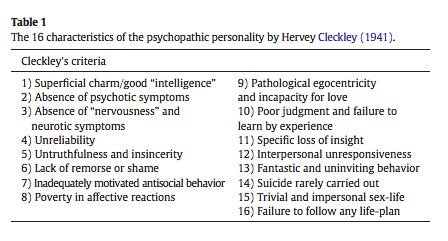
Inadequately motivated antisocial behaviour is one of Hervey Cleckley’s criteria for psychopathic personality. The goal of such behaviour is often to rebel against all authorities whom psychopaths disdain. Psychopaths hate any expectations placed on them including social, relational, moral and even legal. They are eternally locked in adolescence and can never be told what to do.
2. You like to shock people
Psychopaths often behave in ways that are perceived as unpredictable and shocking. This is usually for their own amusement and sometimes to create a threatening presence in order to deter people from attacking.
Why did you walk naked out in the rain?
Well, I arrived last night. You have to make an impression on the other inmates right away when you get shipped to a new place. I saw you standing there by the TV room. You noticed how all the other inmates got a bit nervous when I walked by. Even the big ones get nervous when you do shit like that. You just got to establish yourself right away. If you don’t, then inmates think they can test you.¹
3. You are highly promiscuous and/or sexually deviant
Typically, someone who would be considered promiscuous by normal standards may have had 20–30 sexual partners. Psychopaths’ promiscuity is usually even more extreme, where it is unlikely they will remember the number of people they have slept with.
Psychopaths also have a strong propensity towards extreme and immoral sexual practices. However, with the exception of a minority who are sexual sadists, this does not come from a desire to obtain genital pleasure. Cleckley wrote in his book Mask of Sanity that none of the psychopaths he had observed had come across as having strong sex cravings.
Sexual exploits often seem chosen almost purposively to put the subject himself, as well as others, in positions of sharp indignity and distastefulness. The male psychopath who goes through legal matrimony with the whore he has picked up for the evening furnishes a clear example. And so does the well-born woman who submits to several men in rapid succession, none of whom takes the least trouble to conceal his contempt for her.²
Highly immoral situations that would repel normal people tend to attract psychopaths. They often have the goal of mocking human morality almost as if it’s a mere prank. In most cases, this comes from a mischievous attitude arising from the desire to violate social and behavioural norms in order to demonstrate their stupidity as well as triviality.
4. You have a dismissive-avoidant attachment style
This is an attachment style where the person considers love and affection as threatening and therefore avoids them. Due to early childhood experiences, psychopaths learn to deny and repress their need for trust and intimacy and become extremely independent. They refuse to be vulnerable and see dependence and needing others as a threat. Love or any desire to draw closer to someone is very uncomfortable for them because intimacy induces feelings of paranoia.
If we are indifferent to others or dislike them we disarm them of any power to hurt us. Now this indifference was absolutely the characteristic of every one of these children. They neither showed affection nor appeared to care they got it. ‘Whatever we do,’ we might imagine them saying ‘do not let us care too much for anyone. At all costs let us avoid any risk of allowing our hearts to be broken again.’ This, I think, is the explanation of much of their hardboiledness and apparent indifference, traits which puzzle and irritate almost everyone who has to deal with them. It is a policy of self-protection against the slings and arrows of their own turbulent feelings.³
5. You identify as autonomous, strong, self-sufficient and a loner.
Psychopathy is essentially an attachment disorder and it can be described as the search for painless freedom from emotional attachments. The word ‘search’ needs to be emphasised here because such painless freedom can never be found in humans as it is merely an ideal.
Psychopaths are dismissive of close attachments. They desire to be free of them as they consider dependency, trust and love as traps. Their desperate search for freedom is a defence against the intolerable feelings of powerlessness and helplessness brought on by being vulnerable in any way.
“The only danger I can see for myself is if I ever feel I really need to become involved with others. When I borrow a pack of cigarettes from another inmate, I try to return it as soon as possible so that I don’t think I need him for anything. Sometimes I think I would like to change and be like other people and sometimes I worry that maybe they have something that I don’t. Then I start to think that I might lose so much of my strength if I ever became like the others. I have to hold on. I can talk to people, use them and enjoy them, but I can’t let them mean anything to me.³
6. You believe love, emotions, empathy, trust and caring about others are weaknesses.
These beliefs will vary in severity from person to person depending on how socialised they are, however, at their core psychopaths experience a lot of fear and anxiety regarding the motives of others, which usually manifests as paranoia and hypervigilance. They believe if they try to be understanding of other people, acknowledge their own emotions and admit to any weakness, these will be used to manipulate or take advantage of them.
Richie admitted that he had no need for friends. He’d really never been close to anyone in his life. He preferred to do everything on his own. He also didn’t trust anyone.¹
7. You are preoccupied with power and/or resilience
Psychopaths perceive the world as hostile and a ‘dog eat dog’ place, where success is based on the survival of the fittest. As a result, they are extremely preoccupied with being resilient. If they seek power and status, this is less about glory and any attention or admiration it may bring, but more to do with increasing their resilience and therefore safety.
Psychopaths believe people who are good are weak and unreliable. They experience devaluation and contempt against people they perceive as such. The powerful, on the other hand, are considered unreliable and untrustworthy as they are potential enemies. Psychopaths are convinced that only their own power is reliable and that being in control at all times is the only alternative to being a victim.
8. You are very impulsive
Impulsivity can take many forms such as substance abuse, reckless spending, gambling, making foolish investments without thinking, binge eating, promiscuity and reckless driving.
Nike probably never envisioned a psychopathic inmate embracing their slogan ‘Just Do It’ in a manner quite like this.
When I do stuff like that, inmates don’t know what to think. I’m unpredictable. Sometimes I don’t even know why I do what I do. I just do it.¹
Compared to other personality-disordered patients, psychopaths tend to be very disinhibited and under-controlled. Some have better control over their impulses but in general, impulses and desires are often acted out immediately without much forethought into the future.
X constantly shows his difficulty in tolerating any kind of tension. On a primarily physical level, he tears at his skin and bites his nails when he experiences any irritation; he was unable to establish proper bladder control until well into latency. He reacts to any anxiety by erecting massive defenses. He cannot stand frustration and tends to act out his impulses immediately with little inhibition.³
9. You are suspicious and hostile
Psychopaths see everyone as a potential enemy. Many are skilled at reading people and their psychology because due to their inability to trust, they are constantly observing people and looking for inconsistencies to detect any signs of betrayal. They are hypervigilant and constantly question and doubt the motives of people around them. As a result, their relationships with others are likely strained and require a lot of support and assistance to succeed.
10. You identify with the aggressor
Psychopaths exhibit high levels of ego-syntonic aggression. They tend to be proud of their lack of empathy, remorse, guilt and shame, which they consider weaknesses. Their sense of confidence is often derived from antisocial and even criminal acts. The less socialized they are, the more pride and exhilaration they will derive from acts of aggression.
Richie smiled as he told me a story of a prostitute he had killed for pissing him off. He actually seemed proud when he described wrapping her up in the same blanket he had suffocated her with so he could keep all the forensic evidence in one place.¹
References:
[1]: Kiehl, K. (2015). The Psychopath Whisperer: Inside the Minds of Those Without a Conscience. Oneworld Publications
[2]: Cleckley, H. M. (1988). The Mask of Sanity: An Attempt to Clarify Some Issues About the So Called Psychopathic Personality (5th ed.). Emily S. Cleckley.
[3]: Meloy, J. R. (2001). The Mark of Cain: Psychoanalytic Insight and the Psychopath. Routledge.
If you enjoyed this post and would like to read more, you can subscribe here — https://medium.com/subscribe/@ella_harris to get an email whenever I publish a story. You can also buy me ☕ via — https://ko-fi.com/ella_harris
This post contains affiliate links. If you use these links to buy something I will earn a commission. Thanks.


