
1,300 Years of LGBTQ+ History and Bisexual Samurai Will Change Your View on Japan
LDP lawmaker’s disrespect for same-sex marriage provoked a backlash
In June 2022, booklets shared at the Liberal Democratic Party (LDP)’s internal meeting with the Shinto political league shocked the Japanese. The gathering aimed for a better understanding of true homosexuality and same-sex marriage. And the brochure included a comment by a Christian scholar that claimed homosexuality is an acquired mental disorder or addiction.
As the issue came to the surface, it rippled outside to the LGBTQ+ community in Japan. 51,503 people signed an online petition that demanded the collection of booklets to prevent discrimination against LGBTQ+ people.
The Reality of LGBTQ+ in Japan
Since 2015, Japanese local municipalities have gradually implemented “partnership certificates” to provide same-sex couples legal recognition. However, same-sex marriage is still illegal in this country, and some politicians are publicly against it.
For instance, an Upper House lawmaker’s campaign video recently caused a blowup on social media. It was Abe’s ex-political affairs secretary, Yoshiyuki Inoue. In the video shot on the street during his campaign, he made an inflammatory speech about same-sex marriage:
The form of families we established over the past 2000 years is under the threat of foreign countries’ pressure. People feel sorry for same-sex couples, but can children pass down Japan without families?
This statement is controversial in many ways. First, it falls into alignment with the dogma preached by the Family Federation for World Peace and Unification—the current name of Unification Church in Japan—of which Inoue is a known support member.
But the more damning statement he makes is that same-sex marriages are not the right foundation to build a family. And we also need to scrutinize his historical perceptions because Japan has documented LGBTQ+ culture for over 1300 years.
Love Stories in History Books and Poems
In 2020, the head of the Japan Buddhist Federation officially announced their support for LGBTQ+ people because Buddhism preaches that the path of salvation is open to everyone, regardless of gender or social status. “Ever since the beginning of human society, there has always been homosexuality,” the chairman commented.
Although the Buddhist mindset is one of acceptance, this comment was not based just on religious beliefs. The oldest record of a gay couple goes back to A.D. 720 when The Chronicles of Japan (日本書紀, Nihon Shoki) was completed.
The second-oldest book about Japanese history gives us an example of the love story between a priest and his partner: the text describes how a male Shinto priest passed away from sickness, and his partner who was also a male priest followed with his own death.
The neighbors buried them together, but soon after that, daytime turned dark as midnight. Local residents opened the grave and separated their coffins, and buried them again against their will. Then, the sun started shining again right away.
This tale is not an anomaly in the history of Japan. Even after Buddhism spread across Japan, monks favored their assistants, who were usually beautiful teenagers. Without women at temples, priests used to baptize young male helpers and kept their sexual relationships sacred.
Many waka poetry published around this time—such as the oldest collection of poems, Manyōshū, included poems written by men to their same-sex partners. During this same era, female lovers’ literature was not common because men dominated the publishing business.
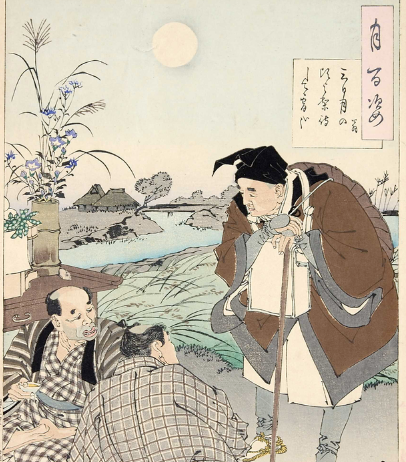
Speaking of poetry, the master of haiku poetry, Matsuo Bashō, went on a journey in his 40s with Tsuboi Tokoku, rumored to be a good-looking former rice dealer who was 13 years his junior. It’s difficult to determine whether their relationship was romantic, but Bashō composed many poems about his apprentice.
He sent a letter when Tokoku lost touch with him after ending their travels. When Bashō learned Tokoku died in his 30s, he later journaled about his experience of waking up in tears from the loss.

Samurai Warriors Were Open to Homosexuality
If you think samurai were entirely devoted to stoic acts of violence, you’ll be surprised to learn that many legendary warriors were openly bisexual.
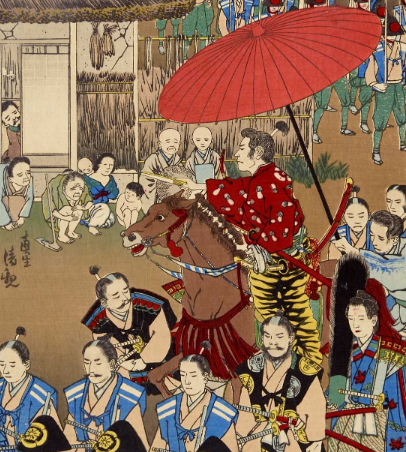
In fact, one of the most iconic samurai, Oda Nobunaga, who conquered the major cities in Japan in 1573, was known for his intimate relationship with his subordinate, Maeda Toshiie.
Toshiie started his career as a pageboy, working for Nobunaga from the age of 14. They both had wives and children, but bringing women to battlefields wasn’t allowed at that time to keep spies at bay.
For this reason, having a trustworthy swain was common, and Nobunaga and Toshiie were no exception to the rule. Surprisingly, they were also relatives. Nobunaga’s daughter was married to Toshiie’s son.
Later in his life, Nobunaga was said to have had a romance with another young pageboy called Mori Ranmaru, but there is nothing in the record to substantiate the rumors of an intimate relationship between the two. However, the partnership of Nobunaga and Toshiie was publicly known.
According to the document Asou Kouon Yawa (亜相公御夜話), Nobunaga joked about their relationship when he was sake-ing and dining his close vassals:
信長公御傍に寝臥なされ、御秘蔵にて候 (Nobunaga-kou osoba ni shinga nasare gohizou nite sourou) He used to sleep with Nobunaga and he was Nobunaga’s favorite.
If that happened today, Toshiie would have talked to HR to file a claim for Nobunaga’s harassment. But in the 16th century, men who were attending the party were envious of their intimate relationship. That’s partly because having a sexual connection with their boss was one of the ways to show their faith and climb the ladder to be successful as a samurai.
Today, some people believe it was just bromance, but many experts hold they were bisexual because it was common at that time; other famous samurai like Takeda Shingen and Date Masamune were also said to be bisexual. They both left love letters to male subordinates.

When the Catholic missionary Francis Xavier visited Japan in 1549, he wrote in his report, “They don’t think it’s critical, so young men and their male partners are proud of themselves, talking about them publicly instead of hiding it.”
In the city of Edo in the 17th century, demographics were significantly skewed toward males. In 1721, among 500,000 residents, 320,000 were men with only 180,000 women. Sons of farmers moved to Edo to find a job, and samurai regularly had to leave their families in their hometowns to visit their big boss shogun in Edo. Experts say these backgrounds explain why gay culture flourished without obstacles in old Japan.
After opening up the country, Westerners imported the culture of shame toward same-sex relations. Then, the political leaders rapidly marginalized homosexual couples in the 19th-century Meiji era.
However, people’s sexuality doesn’t change. Fast forward to today, 8.9% of Japanese consider themselves LGBTQ+, which makes around one in ten people unable to legally marry their partners.
Perhaps forgetting our history and ancestors’ stance on same-sex relations has caused some of the modern problems we’re facing today. Of course, the era of samurai and this modern age are not directly comparable.
Still, it is a historical fact that famous samurai and poets, as well as all the nameless people, have shaped Japanese culture and an inclusive form of family irrespective of gender and sexual orientation.
If you enjoyed this article, discover other works of the author at Japonica.
Follow Yuko for more stories about cross-cultural topics, travel, business, parenting, and equality. You can also subscribe from the referral link, which Medium uses a portion from followers for author support without any additional cost. Mediumの購読は、こちらのリンクからどうぞ。