
Former PM Abe’s Assassination Unveils the Dangerous Self-Censorship of Japanese Media
How the Unification Church gained political influence in Japan

After the shocking death of former Prime Minister Shinzo Abe, unanswered questions have plagued a traumatized Japan. Yet, domestic media outlets continue disappointing Japanese citizens by not addressing them.
Japanese media’s self-censorship has been a serious problem for a long time. Many anchors and journalists left the public broadcasting corporation, NHK, over the past decades due to suspected conflicts with the Liberal Democratic Party (LDP). No matter what problems the LDP caused, it was difficult for journalists to blame the ruling party outright.
Some of these journalists have been ringing alarm bells about the overly-close relationship between the Japanese media and every cabinet. Yet again, Abe’s assassination shed light on the poor quality of journalism in Japan.
Media Silence. An Election Without Critical Information
On July 9, the day after Abe’s murder, all five major newspapers in Japan ran exactly the same headline: “Former PM Abe Shot and Dead.” None used the words “assassination” or “murder.”
It’s hard to tell how this complete alignment happened, but their intention to limit the impact of this incident just before the Upper House election the following day was palpable, with or without political pressure.
Most politicians, starting with current PM Fumio Kishida, declared the shooting a challenge to democracy and freedom of speech. But was democracy at stake, or just the politicians and party agenda?
The evidence doesn’t add up. Not long after being arrested, the accused gunman — Tetsuya Yamagami, confessed that he had no political grudge.
Major media outlets reported that the shooter murdered Abe because he mistakenly thought Abe had a connection with “a religious organization” to which Yamagami’s mother donated approximately $724,000 (¥100 million).
Overseas media such as Le Figaro listed the name of the organization immediately—the Unification Church (UC, often referred to as the Moonies from founder Sun Myung Moon). But the first Japanese article that revealed the name came out only near midnight, 12 hours after Le Figaro. And after campaigning for the following day’s election was almost finished.
Maybe the police didn’t disclose the name. There’s no way to determine what caused this slow coverage on the most important story, which led to LDP politicians’ solidarity before the election and their huge win.
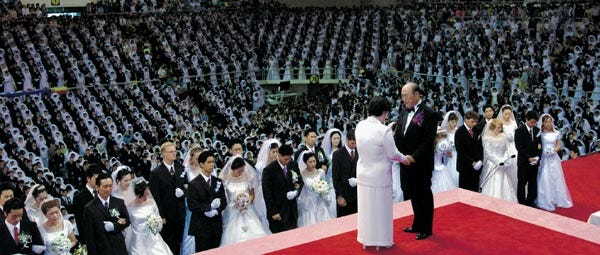
Media Manipulation: TV and Newspapers Work for the LDP
Even after the votes were counted, Japanese media held back from providing details about Abe’s long relationship with the Moonies.
That didn’t last long as word spread. More and more people discovered that Abe had repeatedly appeared on the cover of a magazine published by “Family Federation for World Peace and Unification” — the church’s new name.
In 2015, during Abe’s second reign, the UC changed its name. People have squashed rumors surrounding the name change and Hakubun Shimomura, the then Minister of Education, has defended the move, stating that the head of the Agency for Cultural Affairs had followed the rule and processed the request accordingly.
However, journalists confirmed that since the 1990s, previous ministers had denied the name change request due to the UC’s malicious religious business. They demanded a further explanation from Shimomura, but he hasn’t commented on the sudden policy change.
Added to this were the screenshots shared on social media of Abe expressing his respect for Hak Ja Han — the leader of the UC — in a video message back in 2019.
Still, TV news programs repeatedly claimed that linking Abe to the UC would only spread the gunman’s delusion as if Abe was partly responsible for the shooting. It was obvious Abe had a connection with the UC, but his supporters persistently highlighted the danger of focusing on the suspect’s thoughts.
How Abe Nurtured the Moonies Without Media’s Intervention
Japanese media is still trying to protect Abe’s reputation—which directly leads to LDP’s credibility—and to minimize people’s sympathy toward the gunman, Yamagami, who lost his father and brother to suicide in addition to the financial troubles caused by his mother.
Just before the shooting, Yamagami sent a letter to a journalist and blog owner who had been criticizing the UC. When the journalist noticed the letter and reported it, media sources initially publicized the bulk of the letter on July 17.
A few hours later, however, those articles suddenly disappeared from their websites. People now share screenshots of the letter along with Yamagami’s previous tweets on social media, though his Twitter account was suspended on July 19.
For the time being, the most trustworthy news sources in Japan about this incident seem to be lawyers and freelance journalists who have been fighting against the cult.
Yoshifu Arita, a journalist and member of the Upper House, explained that he gave a lecture about the UC for police executives back in 1995 when they were preparing an investigation. However, the police never conducted an official investigation. 10 years later, Arita asked two of the police executives why they couldn’t raid the UC. Their reply was “political power.”
National Network of Lawyers Against Spiritual Sales also repeatedly accused Abe and other politicians of connection to the UC since the cult used political figures for their promotion and fundraising. According to them, many young politicians started attending UC’s events publicly during Abe’s administration because they recognized that building a relationship with the Moonies was the fastest way at that time to climb the ladder in the LDP.
In fact, Abe’s ex-secretary Yoshiyuki Inoue won the election on July 10 with the support of the UC. He publicly announced that he became a supporting member of the UC at their event on July 6, two days before Abe’s assassination. Later, both the UC and Inoue admitted that the Moonies supported Inoue to win this Upper House election. Inoue almost doubled his votes from 87,946 in 2019 to 165,062 in 2022 after becoming a “Family Federation for World Peace and Unification” (UC) supporting member.
He’s openly against same-sex marriage and separate surnames for married couples, aligning with the UC’s dogma. The Moonies are said to have educated many members of the Diet—mainly those in the LDP—through the influence of Abe and volunteer parliamentary assistants trained and sent to multiple political parties.
Parliamentary assistants of Diet members are either government-paid or private. They attend events on behalf of Diet members, support election campaigns, and manage paperwork. The UC has an assistant training school, and graduates work as both government-paid and private staffers.
On July 12, the group of lawyers against spiritual businesses commented at a press conference that when they investigated 20 years ago, there were over 100 Moonies secretaries and they closely communicated with each other to instill their beliefs.
Even the former, and the current chairperson of the National Public Safety Commission are now being scrutinized for their connections with the UC.
Journalism on Social Media
Today, Japanese people flock to social media to seek hidden stories and information on politicians’ backgrounds. Of course, information on Twitter and other platforms needs fact-checking in this technologically advanced age.
However, it is also true that journalistic news sources exist on social media while corrupted mega-media outlets always adjust their tone to avoid conflict with the ruling parties.
Abe’s shooting undoubtedly opened a Pandora’s box that was an open secret for a very long time—dysfunctional Japanese media and collusion between religious groups and ruling parties. As long as Japanese media works for the authorities instead of the people, none of these problems will be addressed.
If you enjoyed this article, discover other works of the author at Japonica.
Follow Yuko for more stories about cross-cultural topics, travel, business, parenting, and equality. You can also subscribe from the referral link, which Medium uses a portion from followers for author support without any additional cost. Mediumの購読は、こちらのリンクからどうぞ。


