avatarYuko Tamura

Free AI web copilot to create summaries, insights and extended knowledge, download it at here

3175

Abstract

ga (7) yu/me/no/a/to (5)</p><p id="24f4">The seasonal word in this poem is summer grass, which symbolizes summer, and <i>ya</i> makes the accent of <i>kireji</i>.</p><p id="e20d">Does it still sound difficult to compose on your own? You can start with English haiku, which is more contemporary and flexible than the original Japanese version.</p><figure id="98af"><img src="https://cdn-images-1.readmedium.com/v2/resize:fit:800/0*uB8L4WPJfk2l7Pqn"><figcaption>Haiku post in Matsuya, Ehime. Matsuyama city office announces winners with a prize every three months. Photo from <a href="https://commons.wikimedia.org/wiki/File:%E4%BF%B3%E5%8F%A5%E3%83%9D%E3%82%B9%E3%83%88.jpg">Wikimedia Commons</a>.</figcaption></figure><h1 id="8066">How to Write Haiku in English</h1><p id="ccfa">According to an expert <a href="https://st.japantimes.co.jp/st_haiku_howto.htm">Toru Kiuchi</a>, the followings are the keys worth considering when you compose haiku in English.</p><ul><li>Write with three lines and make each line 5, 7, 5 syllables or fewer.</li><li>Try to add seasonal words. They don’t necessarily have to be <i>kigo</i>.</li><li>Use nouns, dashes, and colons instead of Japanese <i>kireji</i> words.</li><li>Use present tense and minimize the number of verbs and adjectives.</li></ul><p id="0bd5">It is more important to start writing haiku than to worry too much about techniques because Matsuo Bashō said:</p><blockquote id="d717"><p>物の見えたる光、いまだ心に消えざる中にいひとむべし<i>*</i> mono no mietaru hikari, imada kokoro ni kiezaru uchi ni iitomu beshi</p></blockquote><blockquote id="ef63"><p><i>Translation by the author: When you find something critical glitters in front of you, you should compose haiku before your impression fades away.</i></p></blockquote><p id="007b">If you want to see examples of English haiku, you can find other haiku lovers’ poems in the below link and start writing your own!</p><div id="cc96" class="link-block"> <a href="https://www.asahi.com/ajw/special/haiku/"> <div> <div> <h2>Asahi Haikuist Network | The Asahi Shimbun</h2> <div><h3>Welcome to the Asahi Haikuist Network, a selection of seasonal haiku from poets living around the world. </h3></div> <div><p>www.asahi.com</p></div> </div> <div> <div style="background-image: url(https://miro.readmedium.com/v2/resize:fit:320/0*PitVpLYVm82VjIo6)"></div> </div> </div> </a> </div><figure id="81ff"><img src="https://cdn-images-1.readmedium.com/v2/resize:fit:800/1*3vEDz2xlBMKRuvIqLdW9nA.png"><figcaption>Haiku on green tea bottles. Photo by Author.</figcaption></figure><h1 id="7323">How Can I Refine My Haiku?</h1><p id="89c8">If you want to make your haiku good, here are some points Japanese haiku poets pay attention to writing profound pieces. After finishing your work, going through these will help you polish yours even if it’s in English.</p><ul><li><b>Avoid <i>jiamari</i> and <i>jitarazu</i>:</b> <i>Jiamari</i> (字余り) means extra syllables and <i>jitarazu </i>(字足らず) is too few syllables. Japanese haiku sticks to 5, 7, 5

Options

syllables, and teachers recommend switching words and omitting unnecessary words to adhere to this rule. But English haiku is often much shorter than Japanese ones, so you can relax a little if you compose in English!</li><li><b>Avoid <i>kigasanari</i></b><i> </i>(季重なり): <i>kigasanari</i> means using multiple seasonal words in one haiku. Focus is vital in this poetry, and often it’s all about seasons. So if you pick two or more words that describe one season—or mix two seasons, like cherry blossoms (spring) and rainbow (summer)—readers get confused.</li><li><b>Be specific</b>: Since the number of syllables is strictly limited, using many nouns makes haiku sharp and rich in context. Pick a noun that you want to highlight—it doesn’t need to be a seasonal word—and choose other words that make it shine.</li></ul><h1 id="99e1">How Can I Enjoy Haiku More?</h1><p id="192b">The easiest way is to share your pieces on social media with #haiku and interact with other haikuists. If you want to participate in contests, <a href="https://www.asahi.com/ajw/special/haiku/">Asahi Shimbun’s curation</a> and <a href="https://itoen-shinhaiku.jp/en/">the annual contest by Itoen</a> are great challenges. They accept English haiku and submissions from outside Japan.</p><p id="6b08">August 19 is haiku day in Japan (because you can read 819 as haiku!), and high schoolers compete at the national <a href="https://haikukoushien.com/">Haiku Koushien</a> around this time in Matsuyama city, which claims to be the capital of haiku.</p><p id="1a17">Writing haiku is similar to jotting down gratitude journals because it turns your everyday experience into artwork. Why don’t you start writing haiku just like journaling? Your haiku might be featured in a Japanese newspaper someday!</p><p id="6981"><i>*</i>Reference: 辻桃子・安部元気. (2018). イチからの俳句入門. 主婦の友社. p.80.</p><p id="4031"><i>If you enjoyed this article, discover other works of the author at <a href="https://medium.com/japonica-publication">Japonica</a>.</i></p><div id="4928" class="link-block"> <a href="https://readmedium.com/why-you-should-listen-to-hip-hop-to-master-the-japanese-language-6ea1e2625309"> <div> <div> <h2>Why You Should Listen to Hip-Hop to Master the Japanese Language</h2> <div><h3>Learn Japanese rhyming. You’ll appreciate skillful rappers and Nikkei headlines.</h3></div> <div><p>medium.com</p></div> </div> <div> <div style="background-image: url(https://miro.readmedium.com/v2/resize:fit:320/1*GdeaXF_vz8bLSN9bV_q8lA.jpeg)"></div> </div> </div> </a> </div><p id="7818"><a href="https://medium.com/@yutranslates"><i>Follow Yuko</i></a> <i>for more stories about cross-cultural topics, travel, business, parenting, and equality. You can also subscribe from the <a href="https://medium.com/@yutranslates/membership">referral link, </a>which Medium uses a portion from followers for author support without any additional cost. Mediumの購読は、<a href="https://medium.com/@yutranslates/membership">こちらのリンク</a>からどうぞ。</i></p></article></body>

All You Need to Know to Start Writing Haiku Today

Describing what you see makes everyday life more mindful

Photo from Adobe Stock.

It has been 330 years since Matsuo Bashō established the style of short-form poetry called haiku. He was the most renowned haiku poet in the 17th century in Japan. Today, almost every Japanese student learns his masterworks at school.

Over the past decade, a quiet haiku boom has been running across Japan. A TV show discovered Itsuki Natsui and viewers loved her outspoken comments on haiku guests submitted. This weekly program cultivated new fans irrespective of gender and age since popular actors and comedians passionately learned haiku techniques from Natsui.

What Is Haiku?

In general, haiku consists of three elements:

  1. 17 phonetic units that make a 5-7-5 rhythm. Each Japanese hiragana character is one count. For instance, Nihon (Japan) is written in hiragana with 3 characters, にほん, so counts as three phonetic units. If you write in English, syllable counter tools are helpful.
  2. Kigo (季語): Words and phrases that symbolize a season. For example, thunder, waterfall, and ice cream represent summer. All in all, there are approximately 5,000 kigo words, and the list of kigo, saijiki (歳時記, almanac of seasonal words), defines and updates them regularly.
  3. Kireji (切れ字): Cutting Japanese words ya (や), kana (かな), keri (けり) to name a few. These words usually bring an exclamatory effect. Without kireji, haiku becomes more like prose. Changing scenes and connecting different things are the basic form of haiku.

Now, let me explain these components in one of the most famous works by Matsuo Bashō.

夏草や 兵どもが 夢の跡 natsukusa ya tsuwamono domo ga yume no ato

Translation by the author: Now there is only overgrown summer grass, but once this place was the battlefield where samurai warriors fought in dreams of glory.

This piece is exactly 17 syllables in Japanese: na/tsu/ku/sa/ya (5) tsu/wa/mo/no/do/mo/ga (7) yu/me/no/a/to (5)

The seasonal word in this poem is summer grass, which symbolizes summer, and ya makes the accent of kireji.

Does it still sound difficult to compose on your own? You can start with English haiku, which is more contemporary and flexible than the original Japanese version.
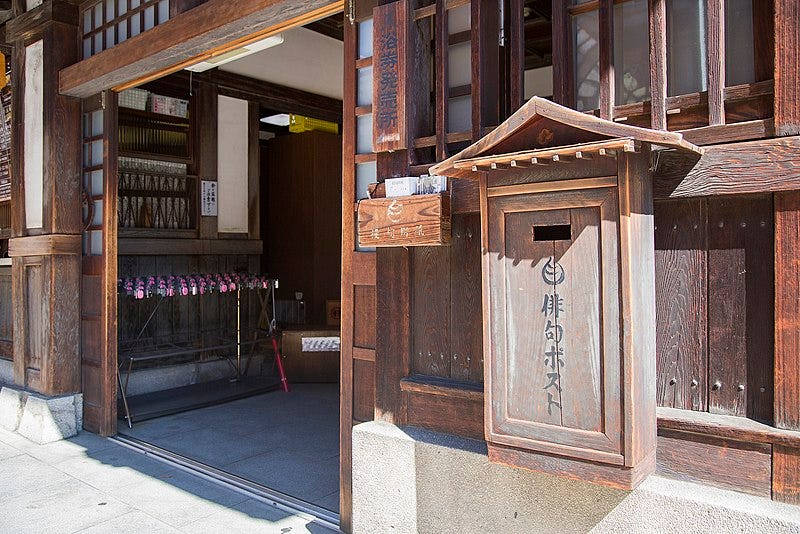
Haiku post in Matsuya, Ehime. Matsuyama city office announces winners with a prize every three months. Photo from Wikimedia Commons.

How to Write Haiku in English

According to an expert Toru Kiuchi, the followings are the keys worth considering when you compose haiku in English.

  • Write with three lines and make each line 5, 7, 5 syllables or fewer.
  • Try to add seasonal words. They don’t necessarily have to be kigo.
  • Use nouns, dashes, and colons instead of Japanese kireji words.
  • Use present tense and minimize the number of verbs and adjectives.

It is more important to start writing haiku than to worry too much about techniques because Matsuo Bashō said:

物の見えたる光、いまだ心に消えざる中にいひとむべし* mono no mietaru hikari, imada kokoro ni kiezaru uchi ni iitomu beshi

Translation by the author: When you find something critical glitters in front of you, you should compose haiku before your impression fades away.

If you want to see examples of English haiku, you can find other haiku lovers’ poems in the below link and start writing your own!
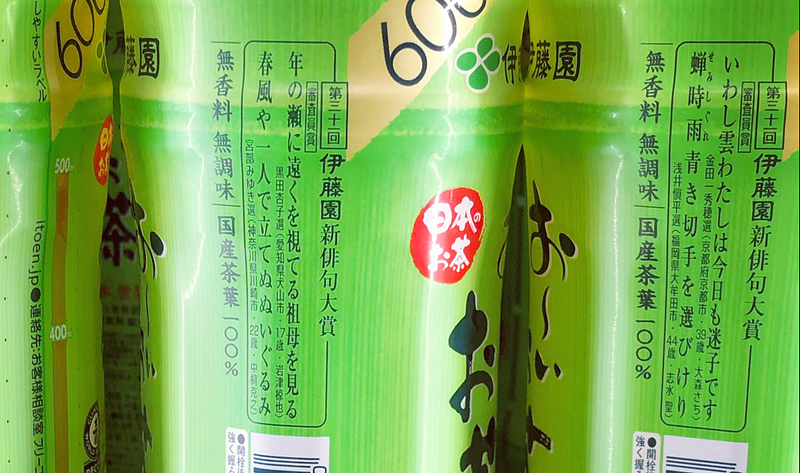
Haiku on green tea bottles. Photo by Author.

How Can I Refine My Haiku?

If you want to make your haiku good, here are some points Japanese haiku poets pay attention to writing profound pieces. After finishing your work, going through these will help you polish yours even if it’s in English.

  • Avoid jiamari and jitarazu: Jiamari (字余り) means extra syllables and jitarazu (字足らず) is too few syllables. Japanese haiku sticks to 5, 7, 5 syllables, and teachers recommend switching words and omitting unnecessary words to adhere to this rule. But English haiku is often much shorter than Japanese ones, so you can relax a little if you compose in English!
  • Avoid kigasanari (季重なり): kigasanari means using multiple seasonal words in one haiku. Focus is vital in this poetry, and often it’s all about seasons. So if you pick two or more words that describe one season—or mix two seasons, like cherry blossoms (spring) and rainbow (summer)—readers get confused.
  • Be specific: Since the number of syllables is strictly limited, using many nouns makes haiku sharp and rich in context. Pick a noun that you want to highlight—it doesn’t need to be a seasonal word—and choose other words that make it shine.

How Can I Enjoy Haiku More?

The easiest way is to share your pieces on social media with #haiku and interact with other haikuists. If you want to participate in contests, Asahi Shimbun’s curation and the annual contest by Itoen are great challenges. They accept English haiku and submissions from outside Japan.

August 19 is haiku day in Japan (because you can read 819 as haiku!), and high schoolers compete at the national Haiku Koushien around this time in Matsuyama city, which claims to be the capital of haiku.

Writing haiku is similar to jotting down gratitude journals because it turns your everyday experience into artwork. Why don’t you start writing haiku just like journaling? Your haiku might be featured in a Japanese newspaper someday!

*Reference: 辻桃子・安部元気. (2018). イチからの俳句入門. 主婦の友社. p.80.

If you enjoyed this article, discover other works of the author at Japonica.

Follow Yuko for more stories about cross-cultural topics, travel, business, parenting, and equality. You can also subscribe from the referral link, which Medium uses a portion from followers for author support without any additional cost. Mediumの購読は、こちらのリンクからどうぞ。

Haiku
Japanese
Travel
Education
Social Media
Recommended from ReadMedium