
GARDEN MEDITATION
Zen and the Art of Pea Vine Maintenance
Have you thanked your pea vines lately?
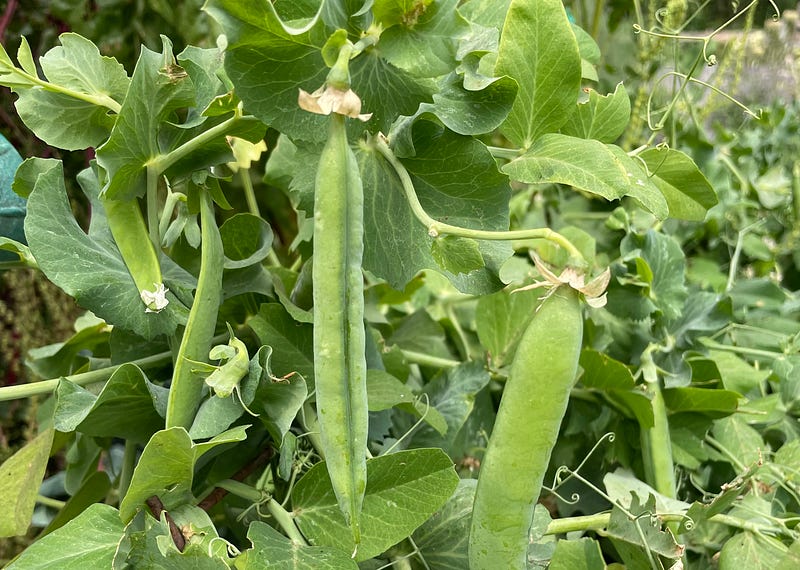
It has been a good summer for veggies. It’s already August and the harvest has been underway since June—weeks of berry-picking followed by potato digging, tomato plucking, cucumbers, zucchinis, artichokes, and all sorts of greens (lettuces, cilantro, parsley, Swiss chard, kale), and the squash and pumpkins are getting fat.
Today I pulled all the pea vines, dry and brown and barely clinging to life. I had planted them mainly for my partner, who enjoys a mid-afternoon pause in the garden for a sweet snack of fresh baby peas straight off the vine. Sadly for him, now it’s time to collect the dry brown pods for seed for next year’s crop.
It hasn’t been an easy year for this gardener. Normally in the Pacific Northwest, there’s plenty of rain, and I’ve only needed to water the raised beds occasionally, usually during the month of August.
This year, however, there has been no rain since early June and I can hear my garden crying out in thirst in my dreams every night.
Although my garden is completely fenced to keep pests out, especially our neighborhood deer who walk right up to the back deck, unafraid and seemingly arrogant in their bravado, the fence doesn’t stop birds, mice, shrews, or those disgusting Norwegian rats, the size of overfed house cats.
Over time, though, I’ve learned that these little “pests” don’t take all that much from us, and I will make it a point to plant a little extra, just in case, to share with my feathered and furred denizens.
However, this year, for the first time, something was destroying my beans—pole beans, bush beans, and soybeans—as soon as they sprouted. Each morning I would find tiny green stumps where seedlings had been the night before.
Bad, bad bunny bean bandit
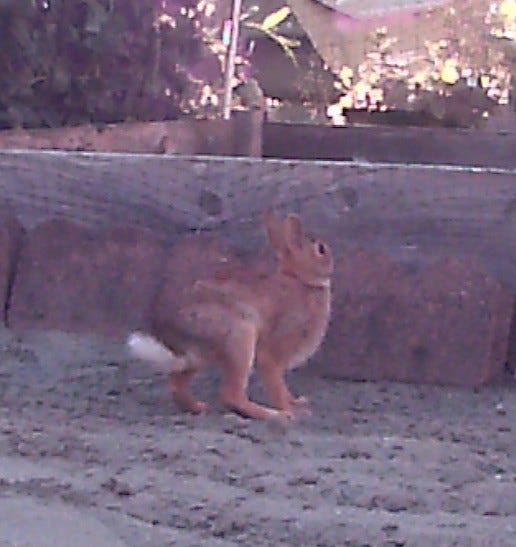
The average temperature here has been increasing over the past decade, apparently enough to encourage an explosion in the population of bunnies.
Eventually my crittercam caught a pair of tiny bunny invaders so small they could leap through the wire fence without ruffling their fur.
The little guy on the left was surprised by the bird netting protecting my newly sprouted soybeans… in their fourth planting.
Once again, all hands on deck to search for holes in the fence, adding more bird netting, more chicken wire, more blocking up holes with anything handy.
The next day, my bean sprouts had survived a night uneaten. And another night. Finally I could exhale and attend to the rest of the garden.
Sundays in August are devoted to cleaning up, harvesting cucumbers and zucchinis, beating back rapacious pumpkin vines, trimming tomato vines, and thinking about next year’s crops—what to plant, where to plant, collecting seeds.
Today was pea vine day.
A tangled, tortured mass of green and brown cried out to be relieved from summer heat, begging to be laid to rest in compost bins, returning all its nutrients to future generations, its seeds to give rise to next year’s crop.
- These vines had fed us delicious snacks all summer, in addition to a freezer full of baby peas to enjoy through the cold season.
- These vines had fed rabbits and mice, and provided shelter for the fledgling sparrows and robins that frequent the garden.
- These vines had fed the earth, their roots pulling in nitrogen from the atmosphere, converting it into fertilizer deep underground for future plants.
- These vines had made me smile each morning, offering sweet pods and happy greenness all summer, even during the darkest times.
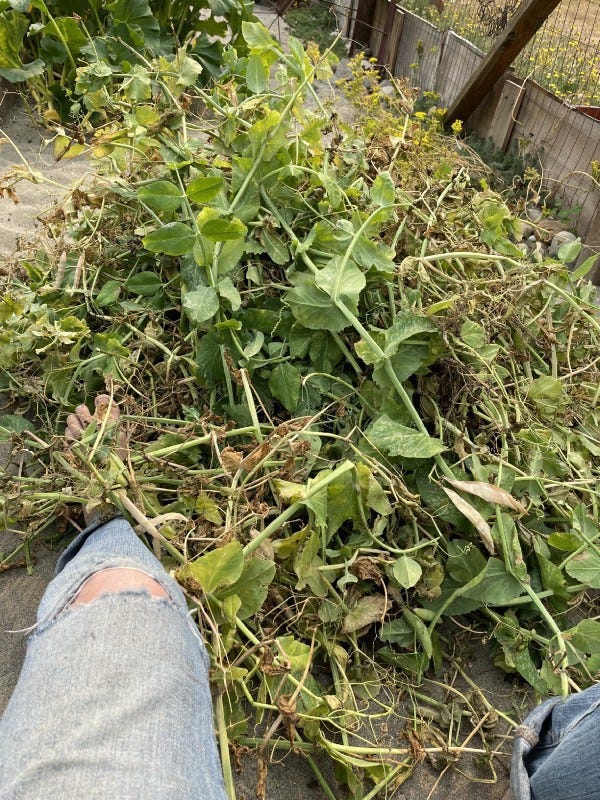
As I ripped them from the earth, piling the dead and dying vines on the sand, the life force remaining inside them continued to speak to me.
I held a vine close to my face and whispered my deep gratitude for them having given so generously while asking nothing in return but for me to sow its seed in the spring.
I pulled up my garden stool, and set to work inspecting each vine for dried pods, filling a bucket of seed for next spring and a compost bin of nutrient-rich leaves and stems for next fall’s mulch.
Time passes, the pile shrinks, the bucket fills, my mind wanders, in peace, among peas.
So many tasks, so little time
Quieted by my pea vine task, my thoughts drift to the pumpkins, whose vines are about to overtake the tomato patch, to the tomatoes crying out for their bottom leaves to be trimmed, to the zucchinis threatening to eat the farm. Seed heads on lovage, fennel, cilantro, spinach, onions, and chard beg to be collected before they drop to the ground.
Everything cries for more water. A tiny feather floats in the half-evaporated bird bath.
I shake my head remembering the person I once was before I retired to this beautiful farm. As a corporate executive, an entrepreneur, world-traveler, big spender, privileged white woman with a PhD in physical organic chemistry, I was unstoppable.
Yet, here I sit, barefoot and grimy, up to my apex in dead pea vines, and I’ve never been happier nor more fulfilled.
The pea vines taught me to slow down, appreciate, show gratitude, and just sit quietly in the garden from time to time and let the plants speak to me.
I wonder how many people in this country have no idea whatsoever about where their food comes from, how it grows, is harvested, packaged, transported. Will they ever know the bliss of sitting on a stool in a vegetable garden, collecting dried pea pods, or shelling beans, or picking strawberries?
A fertile garden feeds a fertile mind. There’s no greater high than this.
With thanks to Robert Pirsig, author of Zen and the Art of Motorcycle Maintenance for the inspiration for the title to this piece! I don’t feel guilty for stealing his idea because apparently he borrowed it from Eugen Herrigel’s Zen in the Art of Archery. :D
And thanks for reading! And as always, a special thanks to ScienceDuuude and the welcoming WotWU wordworkers!