
Zazen
Meditation is good for nothing!

Today’s New York Times Spelling Bee letters:
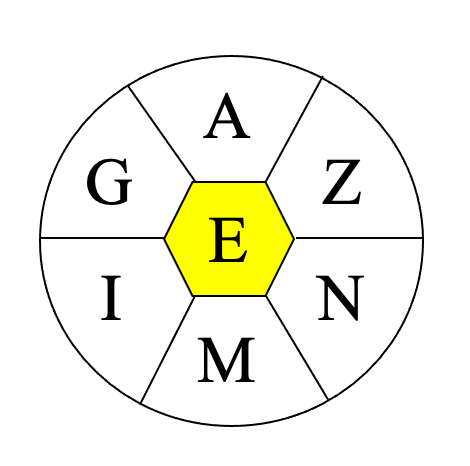
A, G, I, M, N, Z, and center E (all words must include E)
Merriam-Webster says…
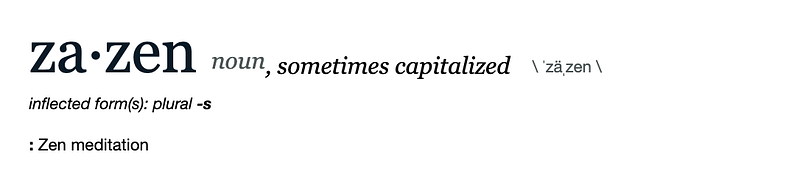
Silly little dictionary! Don’t you know zazen can’t possibly be a word if the New York Times says it ain’t?
For further fascinating facts, check out the Spelling Bee Master.
What’s your favorite dord* from today’s puzzle?
My Two Cents
Before all you meditation fans start yelling at me––softly, because that’s how meditation fans tend to yell––for my supposedly disparaging remark below the title of today’s article, I just want to say one thing: Have you ever read my column?!?
Well, if you stop yelling softly and keep reading it will all make sense in the end. Just remember to scroll down slowly so I can earn my 13 cents.
Sit!
To be honest, I’m a bit disappointed by Merriam-Webster’s definition. It’s missing a key component of zazen. They got the “zen” part right, but whiffed on the “za”. And za is key, because although zen is what you do, za is how you do it.
In other words, and to quote every mom that ever had a teenager: “You just sit there doing nothing!”
The dictionary explains that zazen comes from the Japanese words za, meaning “seat”, and zen, meaning, well… Zen . So literally, “seated meditation”. In Japanese script it’s written like this: 座禅 (Just make sure to copy this correctly when you decide to tattoo it on your arm so that you don’t end up exhibiting an embarrassing mistake.)
The Zen Mountain Monastery explains the following:
“Zazen, a form of seated meditation, is at the very heart of Zen practice. In fact, Zen is known as the “meditation school” of Buddhism. Zazen is the study of the self. Master Dogen said, “To study the Buddha Way is to study the self, to study the self is to forget the self, and to forget the self is to be enlightened by the ten thousand things.” To be enlightened by the ten thousand things is to recognize the unity of the self and all things.”
As you’ve probably concluded, zazen should be done while sitting. Otherwise you’re just enacting the dictionary’s incomplete definition. And although the most common positions for zazen are the cross-legged ones––Burmese, Full Lotus and Half Lotus––you may also kneel (known as Seiza) or even use a chair if any of the previous positions are too strenuous for you. In this case, no pain is a gain.
Your back should be straight; avoid leaning to one side or slouching. This will help you breathing become relaxed, deep, and natural. Don’t try to control or manipulate your breathing; it should feel effortless.
Schools of thinking… about nothing
In the quote I mentioned in the previous section, Master Dogen refers to Dōgen Zenji, also known as Dōgen Kigen, Eihei Dōgen, Kōso Jōyō Daishi, or Busshō Dentō Kokushi. He lived from 1200 to 1253 C.E. and is considered the founder of the Sōtō school of Zen, the largest of the three Japanese schools of Buddhism.
The other two are Rinzai, founded earlier than Soto, and Obaku, which started much, much later sort of as an offshoot of Rinzai combined with Chinese Buddhism.
The Rinzai school is known for using koans as part of the meditation. As the dictionary explains, koans are “a paradox to be meditated upon that is used to train Zen Buddhist monks to abandon ultimate dependence on reason and to force them into gaining sudden intuitive enlightenment”.
I’m not going to get into this subject too much today because last time I checked the word koan was verboten by the Spelling Bee, which means one day I can write a separate article about these paradoxes. And then link that article to this one, so my readers can scroll down slowly twice in one afternoon and help me earn 26 cents instead of my usual 13!
But I will share one of my favorite koans, one that you may have heard before. It was authored by Zen Master Hakuin Ekaku:
Two hands clap and there is a sound. What is the sound of one hand?
Back to Master Dogen… Steven Heine sums up the man’s life by explaining that he “is one of the most influential Buddhist teachers of all time. Although Dogen’s writings have reached wide prominence among contemporary Buddhists and philosophers, there is much that remains enigmatic about his life and writings.”
I assume that’s Heine’s way of convincing you to buy his book on Dogen. Touché, Mr. Heine! There’s something very zennish about this, although what exactly I can’t put my finger on.
Dogen started as a monk in the Tendai school of Buddhism. One of the tenets of Tendai was the idea of original enlightenment (本覚 hongaku), which stated that all humans are already enlightened by nature. This meant that it made no sense to try to achieve enlightenment through practice.
But Dogen saw a logical flaw in this. Why did the Buddhas himself (surely and enlightened being if there ever was one) seek enlightenment and engage in spiritual practice to do so?
Since the Tendai could not answer this seeming paradox to Dogen’s satisfaction, he went on a lifelong quest, which took him all the way to China and back. When he returned to Japan, he wrote the Fukan Zazengi, or “Universally Recommended Instructions for Zazen”. In this short text, he explained the importance of zazen and outlined the basic method.
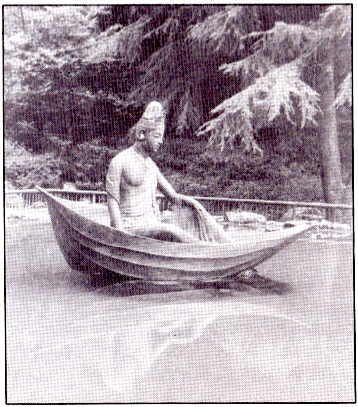
The above photo shows a statue that memorializes Dogen’s vision of Avalokiteshvara, the earthly manifestation of the compassionate Buddha. This happened during Dogen’s return trip from China, when the ship he was on was caught in a severe storm. Dogen led the crew in reciting prayers for Avalokiteshvara, during which the vision appeared before them. The storm calm down after that.
There are other miraculous events written about Dogen’s life. What’s certain is that he became very well-known in Japan for his teachings, especially his emphasis on zazen.
And to quote from Dogen’s treatise on meditation:
Do not think “good” or “bad.” Do not judge true or false. Give up the operations of mind, intellect, and consciousness; stop measuring with thoughts, ideas, and views.
In other words, think nothing. Or at least try to. Better yet, don’t even try.
And if you still don’t believe me that meditation is good for nothing, don’t take my word for it! Watch this short video by a Buddhist master who says so himself.
(If you can’t watch the whole thing, the first couple of minutes are very interesting.)
And yet, despite everything we’ve learned today… the editors of the Spelling Bee decided that the word zazen is a dord*.
You can check out my previous entry on another dord* here:
*What the heck is a dord, you ask? Here’s the answer: