
Zambo
Race as a social construct in Latin America
Today’s New York Times Spelling Bee letters:
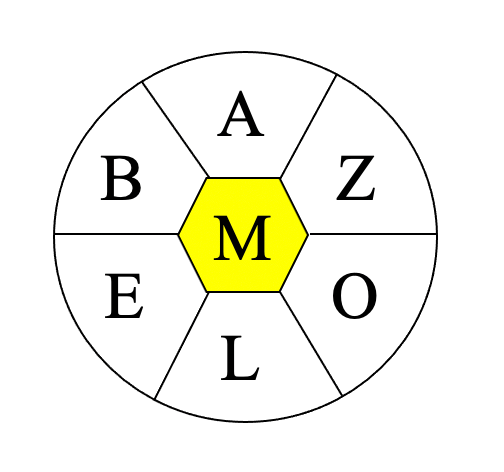
A, B, E, L, O, Z, and center M (all words must include M)
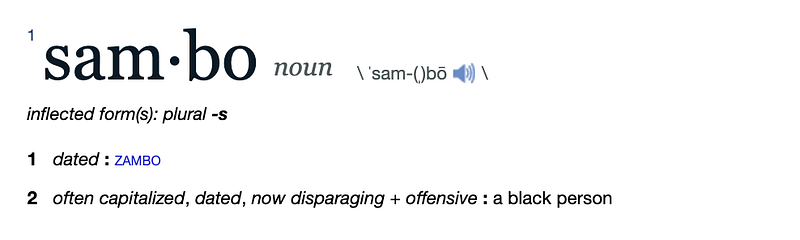
Merriam-Webster says…

Silly little dictionary! Don’t you know zambo can’t possibly be a word if the New York Times says it ain’t?
For further fascinating facts, check out the Spelling Bee Master.
What’s your favorite dord* from today’s puzzle?
My Two Cents
If the word zambo sounds familiar but misspelled at the same time, that’s because you’re probably thinking of the word sambo, which archaically meant the same thing. However, after the American Civil War sambo became a derogatory term used against Black, especially in the Jim Crow South.
The term became a stereotypical name for Black characters in literature. In Uncle Tom’s Cabin by Harriet Beecher Stowe, Sambo is the name of one of the overseers who works for slave owner Simon Legree. And in the 1899 children’s book Little Black Sambo, the eponymous character is a South India boy. Although the plot itself is not prejudiced, the name and illustrations were controversial. Thanks in large part to the efforts of American poet and activist Langston Hughes ––who criticized Little Black Sambo as a typical “pickaninny” storybook which was hurtful to Blacks–– its popularity as a children’s book waned over the next few decades.
Today in the U.S. and Britain, sambo is considered a racial slur perhaps second only to the infamous n-word. However, in Latin America the term zambo has been reclaimed as the first name of a superhero who fights against colonization and racial oppression: Zambo Dendé.
Once upon a time in Latin America
Eighteenth-century Swedish botanist and zoologist Carl Linnaeus is known as “The Father of Taxonomy,” because he invented binomial nomenclature, the formal two-name system that is still used today to classify living things. He was the first naturalist to include humans as part of the animal kingdom, a gutsy move at the time. And although he never actually used the term “race”, he did split us homo sapiens into four varieties, which also corresponded to the four land masses known at the time:
- Europaeus albus: European white
- Americanus rubescens: American reddish
- Asiaticus fuscus: Asian tawny
- Africanus niger: African black
At first Linnaeus posited that skin-color — his main distinction employed in classification — was mostly due to climate and geography, and therefore variable like other “accidental” bodily characteristics of humans, such as height or weight. However, around the 1750s, he began ascribing physical and moral attributes to both geography and skin color. Thus, the 1758 10th edition of Linnaeus’s Systema naturae eventually became the basis for scientific racism.
This is not just my opinion or that of progressive or leftist revisionists. The Linnean Society of London explicitly says that “One of the origins of scientific racism can be traced to Linnaeus’ work on the classification of man, which had devastating and far-reaching consequences for humanity.” And in her brilliant article “How Scientific Taxonomy Constructed the Myth of Race”, Brittany Kenyon-Flatt analyzes the changing history of Linnaeus’s descriptions of humans and concludes with this:
While it is true, as many scholars argue, that Linnaeus did not promote the idea of distinct human species, his concepts of human classification paved the way for pseudoscientific ideas about human biological diversity — the horrific consequences of which are still felt today.
Although the actual term “race” was not commonly used before the 19th century, bias, prejudice, and racism did exist in the form of discrimination against people of different origins. Across the Americas, the first people to suffer the invasion of the Europeans where the indigenous people. They were mistreated, enslaved, and massacred. Their territories were encroached upon and land was stolen from them.
Slave trade to the West began not too long after its conquest by Europe. African people were shipped not only to the American colonies, but also up and down Latin America. Unlike the U.S., the mixing of colonial whites, indigenous people and enslaved African was relatively common and open in Spanish- and Portuguese-speaking nations. This created an odd duality in 17th- and 18th-century Latin American countries. On the one hand it was not censored as in the United States. In fact, there was widespread marriage between the three peoples from the very beginning. But it also ended up creating a very detailed classification system based upon a person’s genealogy.
The first basic terms were mestizo (the child of a white European and an indigenous person), mulato (the child of a white European and an African), and zambo (the child of an African and an indigenous person). The English dictionary explains that the origin of this last term is “perhaps from Kongo nzambu, meaning “monkey”. Which is horrible, I know. However, in Spanish the main definition of zambo is “knock-kneed” (a condition in which the legs curve inward at the knees). And its etymology according to Spanish sources is rooted in the Greek strabos, meaning “squint-eyed”, related to the Greek streblos, meaning “twisted”. Exactly why zambo was chosen as a term of lineage is unclear, but what is clear is there were no good intentions behind it.
As the offspring of these three categories mixed with whites, natives, or Blacks ––or amongst themselves–– more terms were created to describe their descendants. Below is an 18-century painting showing sixteen “racial” groupings. Mestizo and mulato are on either side of the top row. Note that this artwork is from Mexico, so some terms differ from the ones used in South America. The fourth depiction in the second row from the top, which says “lobo” (wolf), is somewhat equivalent to the zambo.
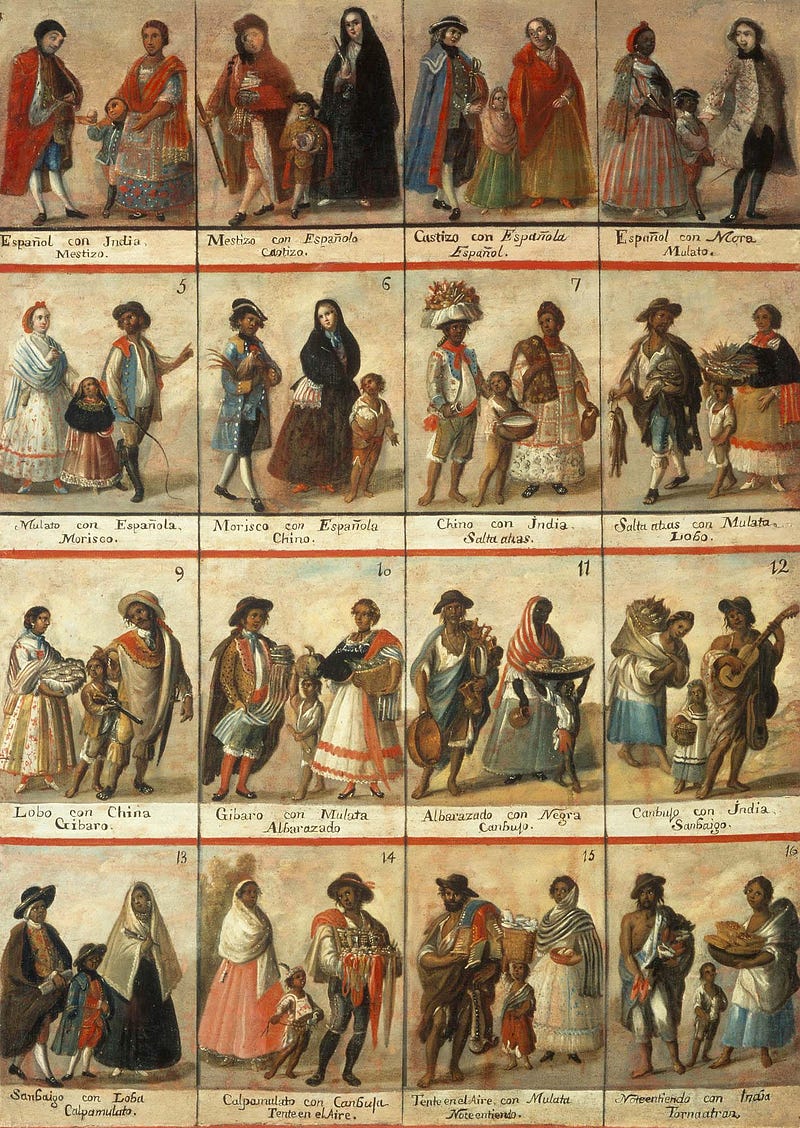
I am not an expert, but it’s apparent to me that the further down you are classified in this picture, the lower your stature in society.
What is true about these categories is that they had more to do with lineage and ancestry than race. (For example, there was a distinct term for whites born in the colonies: criollo.) Much has been discussed about the ironclad caste system in the Spanish colonies of the Americas, a theory first developed by historians Ángel Rosenblat and Gonzalo Aguirre Beltrán in the 1940s. Both men popularized the idea that racial status was the key organizing principle of Spanish colonial rule, a theory that has been challenged over the last decade or so by reputable academics such as Pilar Gonzalbo and Joanne Rappaport.
These recent counterclaims, supported by archival research, is that there was no fixed system of classification for individuals: colonial societies in Latin America were much more fluid than their North American counterparts. Sometimes a person was identified by different categories simultaneously or over time. There were usually no significant impediments in daily life for people of different ethnic origins and mixes.
As I mentioned earlier, the concept of race became more prevalent in the 19th century, coinciding with the end of Spanish colonial rule. It was then that the idea of black or indigenous ancestry as a “stain” began to develop, in tune with the biological racism that emerged throughout the western world.
Darwin’s early ideas about the different varieties of humans and their temperaments were further developed in the 1800s by some eugenicists. Among them was Ernst Haeckel, a German biologist who categorized humans into 12 hierarchical species and 36 races. According to him, the “Indo-Germanians” ranked highest and the indigenous peoples in Africa and Oceania ranked the lowest, based on the “evolution” of their physical traits, culture, societal norms, and language. It’s believed that Haeckel’s ideas may have greatly influenced some of the ideas of Nazi founders in the 1920s and 30s.
Indeed, by the 20th century the modern yet artificial concept of race had taken hold of our global collective unconscious. Most of us born in the previous millennium were imprinted at an early age with the idea that humans can be subdivided into meaningful groups based on visible characteristics, and that those physical traits reflect an underlying genetic code that determines culture, behavior, intelligence, and even criminal tendencies. That’s how we got the controversial 1994 book The Bell Curve, which purported to show a correlation between race and intelligence. Despite analyses that clearly show that the methodology and conclusions reached by authors Richard J. Herrnstein and Charles Murray are flawed, The Bell Curve is still referenced almost thirty years after its release.
The history of the colonial Americas ––both North and South–– is, on its own, strong enough evidence that we forged the concepts of race and racism to excuse, justify, and support our personal and collective biases, prejudices, xenophobic tendencies, and unending thirst for power. After all, it’s easier for a society or collective to feel powerful if there is another group of people that has been rendered powerless.
Ironically, as the concept of race grew firmly embedded in people’s minds as a scientific theory, science itself worked to dismiss this idea. The work of Rosalind Franklin, Francis Crick, and James D. Watson jump-started the analysis of DNA in the 1950s; four decades later we were on our way to sequencing the entire human genome, a project that was fully completed just this past May (2021).
Ancestry tests based on DNA became more and more popular at the beginning of our current century, as evidenced by the fact that by 2019 more than 26 million consumers had tested theirs. This growing trend has helped prove two key things about “race”: (1) the great majority of human beings are a living, breathing melting pot of ethnicities, and (2) the science of racial makeup doesn’t really exist. As journalist Jack Herrera explains that…
…ancestry and physical appearance (or phenotypic traits) don’t directly overlap. Characteristics like skin color, hair texture, and eye shape are controlled by thousands of different genes — separate from the ones scientists look at when composing an ancestry profile. As a result, someone with a high estimate of West African ancestry might not look or even identify as black. Similarly, an individual whose tests come back with a very low estimate of West African ancestry might actually be black.
For more about the myth of DNA and race, please read this very interesting article suggested by William F. Pray, from which the above quote is taken.
The peacock song
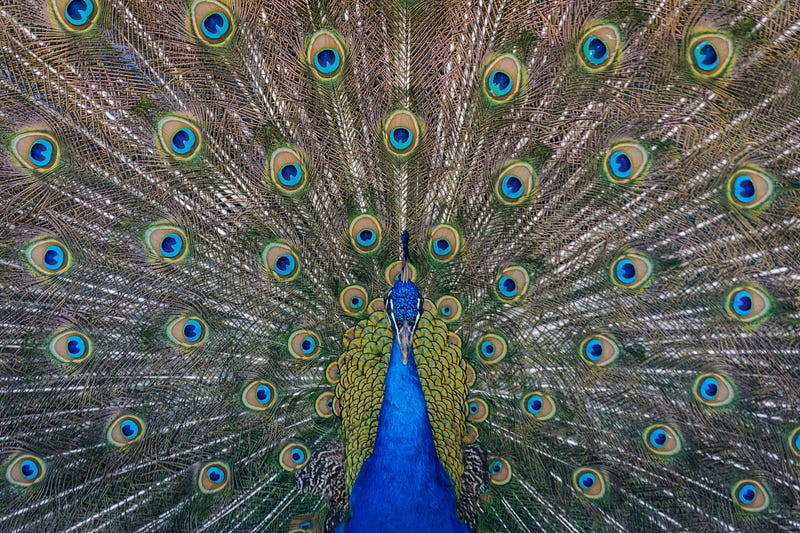
What does the photo of a peacock at the top of today’s column have to do with anything we’ve discussed so far? Well, discussions about race always bring to mind a song in Spanish called “Pavo Real” (peacock). This is a song from Venezuela ––where I grew up–– composed in 1949 by César del Ávila. The best known version is a pop one recorded in 1979 by Venezuelan singer and actor José Luis Rodriguez, known as “El Puma” (the puma).
Towards the end, the song recommends racial intermarriage in very blunt terms. Here are the last verses in Spanish, with my English translation (and I realize the lyrics may come across as offensive to some):
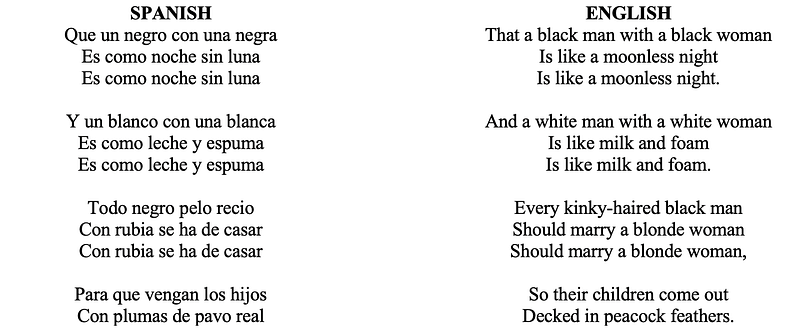
I was a kid when I first heard this song and knew nothing about poetic language. I was imagining boys and girls literally with feathers on their bodies. My parents explained to me that this was a metaphor for the multicultural, multicolored Venezuelan society, a result of the mixing of European, Native American, African, and Asian peoples over centuries.
This idea of multiculturalism was burned into my consciousness forever. It was a beautiful concept expressed earlier in the lyrics: “que combine los colores, que la raza es natural” (we should combine our colors because race is a natural thing). Here I should note that the phrase “race is a natural thing” means the exact opposite of what it may sound like to some.
In other words, all the “races” are naturally one race: the human one.
That is what I learned as a child. Now as an adult, I make every effort to see my fellow homo sapiens in those terms.
Here is a video of José Luís Rodríguez singing “Pavo Real” live in Chile in 1981.
One would think that, given the importance of the word zambo in the discussion of race and the history of racism, the editors of the Spelling Bee should not have decided that zambo is a dord*.
You can check out my previous entry on another dord* here:
What the heck is a dord, you ask? Here’s the answer: