
Octroi
This word can be a little bit taxing
Today’s New York Times Spelling Bee letters:
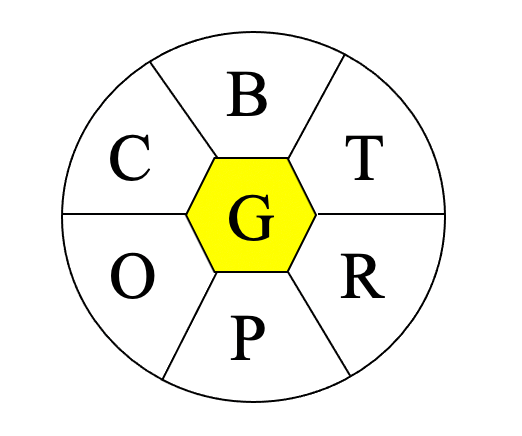
B, C, O, P, R, T, and center I (all words must include I)
Merriam-Webster says…
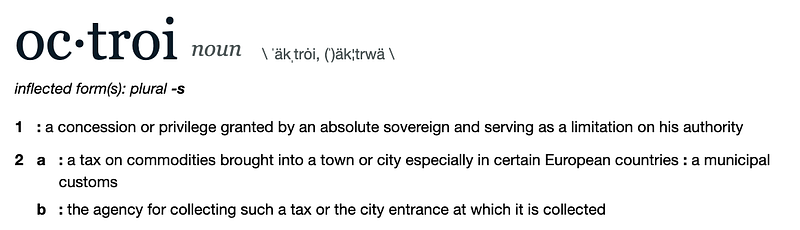
Silly little dictionary! Don’t you know octroi can’t possibly be a word if the New York Times says it ain’t?
For further fascinating facts, check out the Spelling Bee Master.
What’s your favorite dord* from today’s puzzle?
My Two Cents
Urgent warning! Some spoilers ahead, in the form of a few answers in today’s Spelling Bee, for those of you who play the game and haven’t finished by now. Skip to the first subheader if you’d like. Just remember to scroll slowly.
Octroi is an odd word. It sounds like it could be one of those irregular plurals some people love to flaunt in order to appear sophisticated as phuck. And because today’s puzzle has “I” as its center letter, there are a few of them (irregular plurals, that is, not sophisticated phucks).
For example, croci (the plural of crocus), octopi (the plural of octopus), and tori (the plural of torus). It might therefore be logical for one to think that octroi is the plural of octrus. Logical, perhaps, but still very wrong. Mainly because octrus isn’t a word.
French twist
Our friends at Merriam-Webster explain that octroi came to the English language from French octroyer, itself from Middle and Old French octroyer, meaning “to grant” or “to authorize”. I looked up the origin of that word (so you, my dear reader, wouldn’t have to) and found that the spelling of the word in Old French was probably otreier, from the popular Latin auctoridiare, itself from the classical Latin auctor, meaning “grant” or “authorize”)
The again, when I checked the etymology of the word author in the dictionary, it gave me this: “Middle English auctour, from Anglo-French auctor, autor, from Latin auctor promoter, originator, author, from augēre to increase”. Same auctor, slightly different meaning. You can draw your own conclusions. Or not, if you’re not a very good draftsperson.
Octroi was already being used in ancient Rome, where it was known as vectigalia. This was a collective concept, as there were several types. Among them was a tax on the entry or departure to the provinces, one levied at the entrance to towns, and a type of sales tax in markets. Cities weren’t allowed to keep all the profits from these taxes, however, and had to share them with the Roman public treasury.
There is even a theory that the apostle Matthew collected “the octroi levied on the fish, fruit, and other produce that made up the exports and imports of Capernaum” (near the Sea of Galilee).
It was the Romans who brought the vectigalia into the area where France, Belgium, and Luxembourg sit today. The feudal lords had control over this this tax until around the 12th or 13th century, when towns became more independent and obtained the right to not only establish their own taxes but also have total control of the monies. However, as it usually does, the high royal power was not happy about this and changed the rules. To quote Mel Brooks: “It’s good to be the king”.
Thus, permission to levy local taxes needed to be obtained from the king, who would then issue charters granting (octroyer) French towns the right to apply tax themselves. There you have the convoluted origin of the English word, and also definition 1 in the dictionary.
Death of taxes
The 1911 edition of the Encyclopedia Britannica explains this:
French octroi duties are collected either by the (1) régie simple, i.e. by special officers under the direction of the maire; (2) by the bail à ferme, i.e. farming, the contractor paying yearly a certain agreed upon sum calculated on the estimated amount; (3) the régie interessé, a variation of the preceding method, the contractor sharing the profits with the municipality when they reach a given sum; and (4) the abonnement avec la régie des contributions indirectes, under which a department of the treasury undertakes to collect the duties.
Notice something interesting? (Hint, it’s in bold font.) The verb used is in present tense. That’s because the ancient and annoying octroi was still being levied when the eleventh edition of the Britannica was published more than 100 years ago.
As the encyclopedia further explains, there were many unsuccessful attempts at abolishing it during the late nineteenth and early twentieth centuries. Belgium put an end to it in 1870, apparently. But in France it was giving too much money to very powerful people. By 1911, when the eleventh edition of the Britannica came out, the octroi was still in place in “Italy, Spain, Portugal and in some of the towns of Austria”.
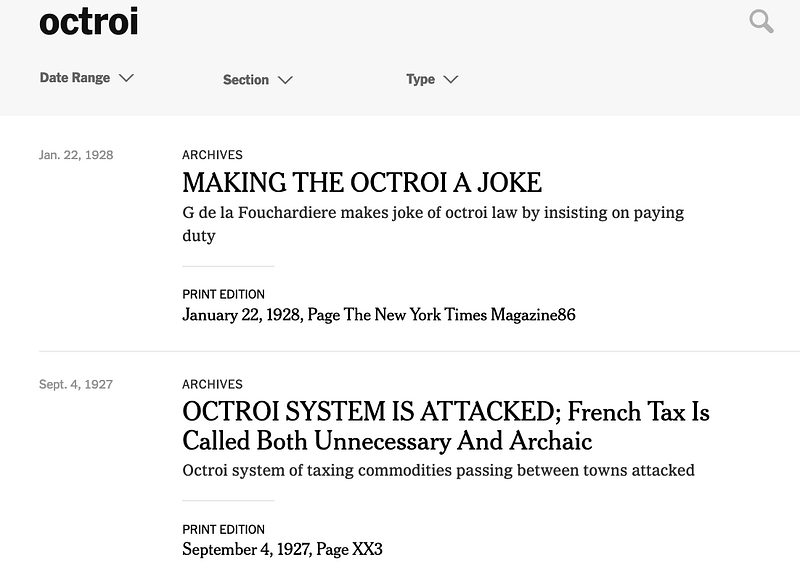
I did a search for the term octroi in the archives of the New York Times.
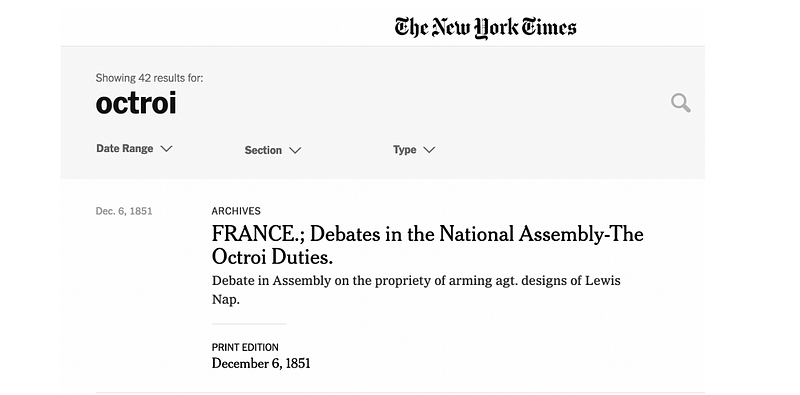
Look at that date! All 19th century-ish and stuff. This tells you two things: (1) The Gray Lady has been around a long, long time, and (2) they certainly know about the existence of the word octroi… which raises the question as to why it was expelled from today’s list of acceptable answers in the Spelling Bee.
Further searches confirm the debate in France throughout the first few decades of the previous century.
and…
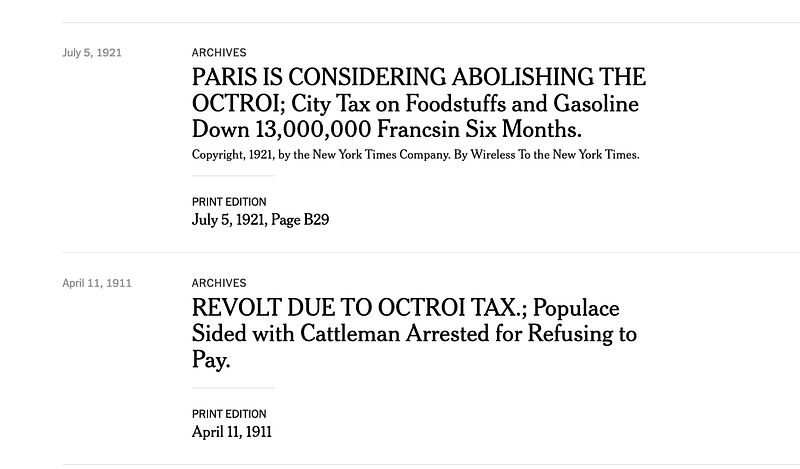
There was a revolt! People actually sided with a cattleman! That never happens! Goes to show you how bad things were.
It took until 1948––yes, after World War II–-for the hated octroi to finally die in France.
But wait, there’s more! (as they say on TV)
The octroi was still around in Pakistan until it was abolished in 1997… but it was still charged for certain commodities until at least a decade later. Both in Pakistan and in India, where it was still an issue a few years ago, the hated tax was imported from Great Britain during medieval times. So even after these two nations gained independence mid-20th century, the octroi survived. It’s like the dreaded Covid that won’t go away! According to some sources, the octroi was abolished in 2017, but here is a 2019 New York Times article that mentions its existence:
Three years ago! Doesn’t this prove the word is not as obscure as the Spelling Bee would like us to believe?
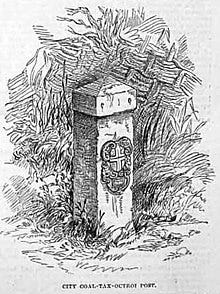
Okay, I’ve typed a lot of words today and haven’t even offered my dear readers a break in the form of a picture, so here is an illustration of a city coal tax octroi post in London, England:
You may be wondering what the photo at the top of today’s article has to do with the word octroi. I am also wondering that. I just picked it because it seemed prettier than the choices I got when I searched for photos related to taxes.
I’m happy with the PSA I’ve performed today. Next time a sophisticated phuck uses the word octroi as an irregular plural, you can smack them over the head with an 1851 edition of the New York Times (or Volume 19 of the 1911 Encyclopedia Britannica, if you can find it) and explain that this word is in its singular form… despite the fact that the editors of the Spelling Bee decided that octroi is a dord*.
You can check out my previous entry on another dord* here:
*What the heck is a dord, you ask? Here’s the answer: