
Gurnard
Those magnificent oceans with their flying fish
Today’s New York Times Spelling Bee letters:
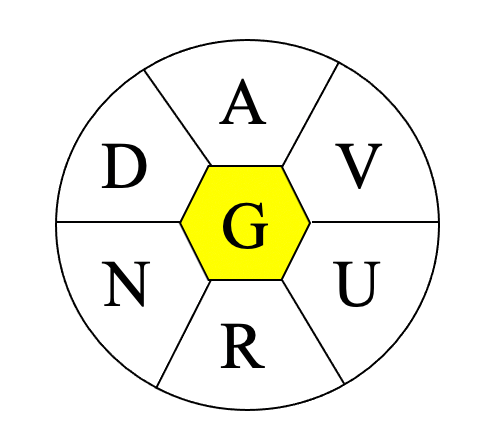
A, D, N, R, U, V, and center G (all words must include G)
Merriam-Webster says…
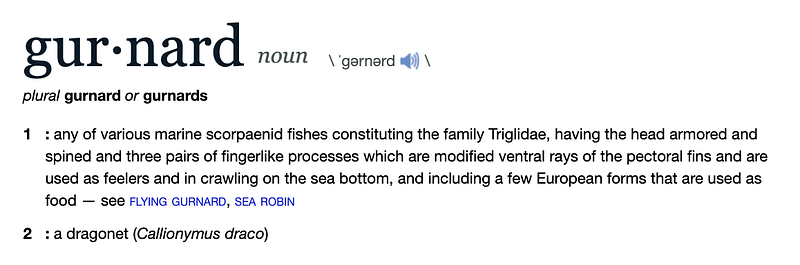
Silly little dictionary! Don’t you know gurnard can’t possibly be a word if the New York Times says it ain’t?
For further fascinating facts, check out the Spelling Bee Master.
What’s your favorite dord* from today’s puzzle?
My Two Cents
The phrase under the title of today’s column is a reference to a 1965 movie with the very long title of Those Magnificent Men in their Flying Machines; Or, How I Flew from London to Paris in 25 Hours and 11 Minutes –– although most people know it by its not-much-shorter title of Those Magnificent Men in their Flying Machines. The film is set in 1910, only a few years after the Wright brother’s first flight. The plot revolves around air race from London to Paris, sponsored by a British newspaper magnate. The ensemble cast of mostly British actors does include Americans Red Skelton and Stuart Whitman, and German Gert Fröbe, best known as the villainous Goldfinger in the James Bond film, um, Goldfinger.
What does this have to do with today’s “ghost word”? Well, to be honest… I kinda forgot.
Fly me to the moon
According to our friends at Merriam-Webster, the word gurnard comes to us from Middle English, from Middle French gornart, an irregular form of grogner, grognier, meaning “to grunt”, “grumble” (from Latin grunnire to grunt). So maybe the first person to discover this fish caught them right in a moment of heated sex?
Gurnard, by the way, does not rhyme with Bernard. The pronunciation is closer to GER-nerd. The word is used to describe both the sea robin and the flying gurnards. Let’s begin with the latter.
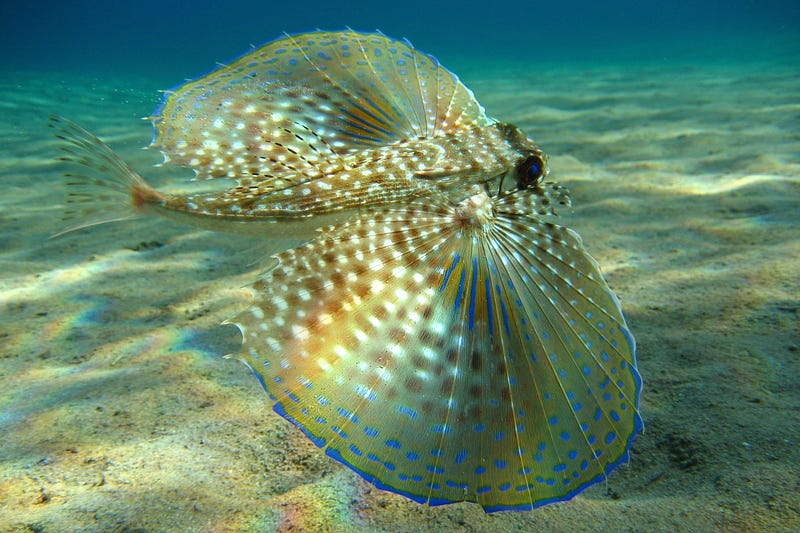
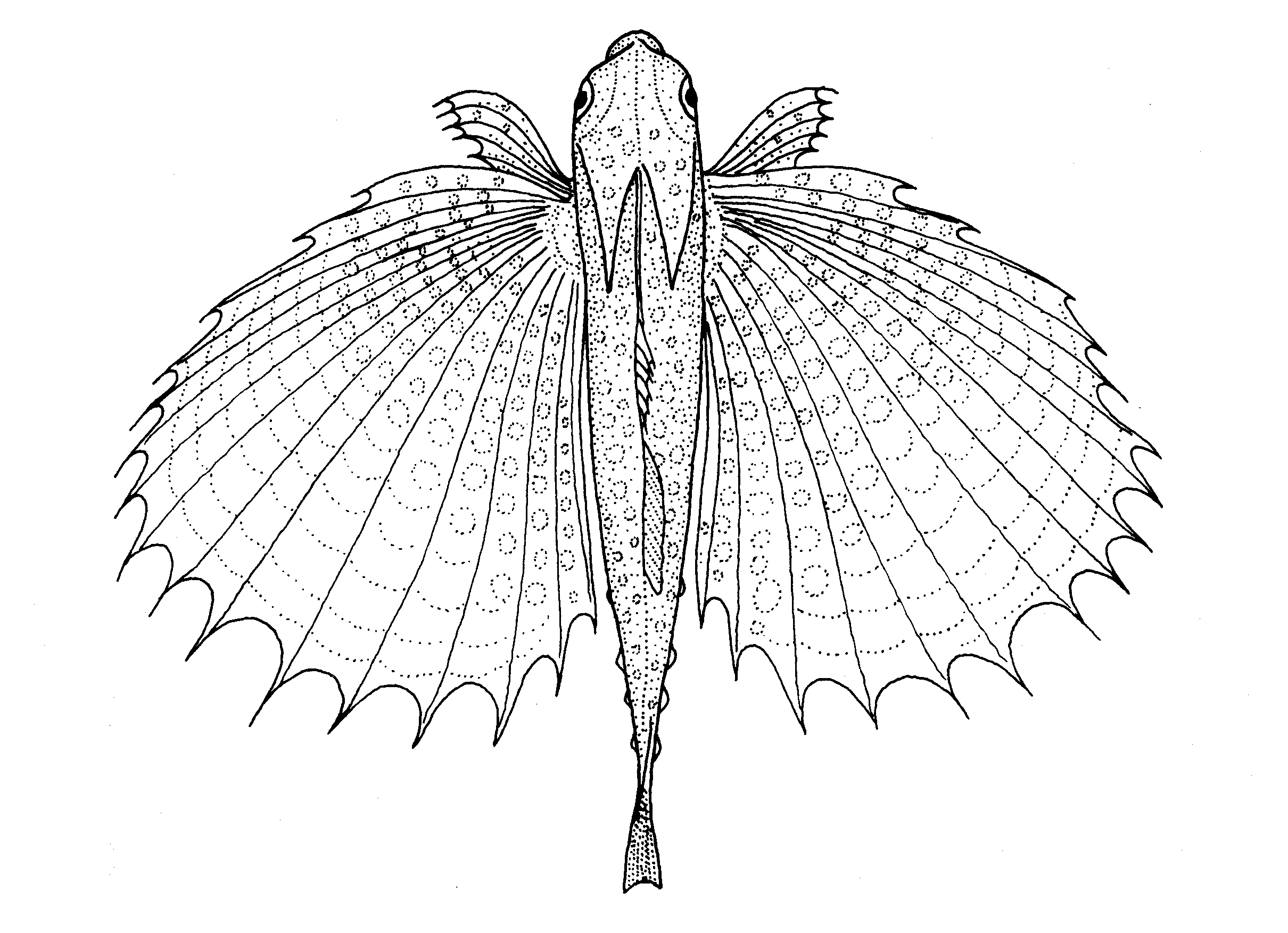
“Flying gurnard” is a misnomer. Although its huge pectoral fins look like wings (as in the picture at the top), this marine fish of the Dactylopteridae family cannot fly or even glide in the air like the actual flying fish does. That family of pisces is the Exocoetidae, and includes more than 60 species. Here is a video of real flying fish, complete with triumphant orchestral music and the inimitable voice of (I think) Sir David Attenborough:
And here is a flying gurnard, well, um… not flying. Poor thing is just trying to get away from the camera. Also, there’s no inspiring music or British narrator.
The pectoral fin is the one closest to a fish’s neck, if fish actually had necks. That corresponds to number 1 in the illustration below.
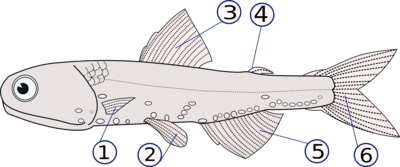
Number 2 is the pelvic fin, while number 5 has the unfortunate name of “anal fin”.
In the flying gurnard, that pectoral fin is on steroids, and fans open like a peacock’s tail when the fish wants to just swim around… or get away from the camera. Compare the fin in the above illustration to these:
Flying gurnards have a swim bladder that helps it control its buoyancy, and a “drumming muscle” that can beat against that swim bladder to produce sounds. Perhaps that is the grunting heard by the person who named the fish.
These fish may be related to the trumpetfish and the flutemouths; together, the three of them could perform as a modern jazz trio.
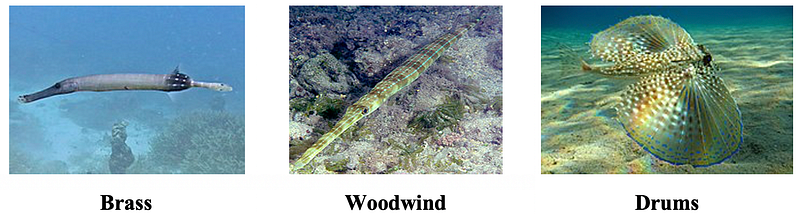
Now that’s a band I’d pay to see perform!
Baltimore sea robins
The “real” gurnard belongs to the Triglidae family, which consists of many bottom feeders from the order Scorpaeniformes. If you think the first half of that word looks similar to “scorpion”, you’re right. Gurnards, or sea robins, belong to the suborder Platycephaloidei, while the poisonous scorpion fish and lionfish belong to the Scorpaenoidei suborder.
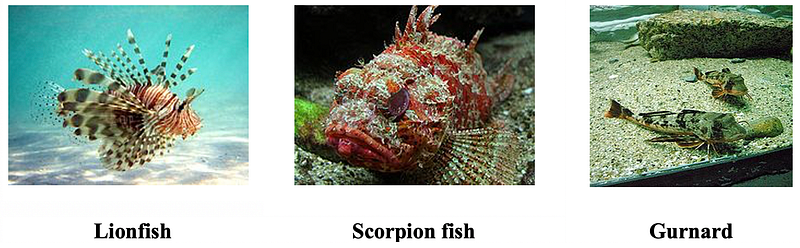
According to some experts (especially those who write for Wikipedia), the gurnard got the nickname “sea robin” thanks to the orange color that American species have on their belly, and from the fact that they also have large pectoral fins that resemble a bird’s wings. Those fins are not as big as the flying gurnard’s, as you can see here:
That wasn’t some tricky Tiktok video you just saw. The gurnard is scurrying around on what seem to be the legs of a crab he may have swallowed whole.
As the Journal of Experimental Biology explains, gunards belong to the category of ray-finned fish, in which their fins are “composed of paired and segmented flexible structures… that help support and change the shape of the fins to affect water flow.” However, sea robins have separate rays that have adapted to be used as walking appendages. Those are the “crab legs” you saw in the video.
The gurnard used to be discarded as bycatch during fishing. But over the last decade or so, it has become more popular in American and European fish markets. Supposedly the sea robin is one of the ingredients in French bouillabaisse. Some chefs extol the fish’s taste and virtues, while others simply prefer to use it as bait for lobster.
Oh, and it turns out these gurnards (not the flying ones) are the ones that make a croaking sound when they are caught, which explains the origin of their name.
Now you know: if you’re ever in the ocean and see an animal that swims like a fish, walks like a crab, and sounds like a frog… you may think you’ve run into a gurnard. It’s likely your mind must be playing tricks on you, however, because the editors of the Spelling Bee decided that gurnard is a dord*.
You can check out my previous entry on another dord* here:
*What the heck is a dord, you ask? Here’s the answer: