avatarAvi Kotzer

Free AI web copilot to create summaries, insights and extended knowledge, download it at here

4234

Abstract

.</p><p id="f3de">In <i>nim</i>, when there is only one group left with at least two objects, the player whose turn is next can easily win. If a player leaves an even number of non-zero groups, that player takes last and either wins or loses, depending on the version of the game agreed upon. However, if the player leaves an odd number of groups, then the other player will be the last to take away.</p><p id="d52f">The game of <i>nim</i> gave rise to the <a href="https://en.wikipedia.org/wiki/Nimber"><b>nimbers</b></a>, a mathematical concept defined as the values of heaps or groups in the game <i>nim</i>. These are used in <a href="https://www.britannica.com/science/combinatorics">combinatorial theory</a>, a fascinating branch of math.</p><p id="80c7">You can read all about nimbers <a href="https://en.wikipedia.org/wiki/Nimber">here</a>, or you can instead enjoy yourself by playing the nim game, below:</p><div id="7f9d" class="link-block"> <a href="https://www.archimedes-lab.org/game_nim/play_nim_game.html"> <div> <div> <h2>Play nim game online</h2> <div><h3>Play Nim against your computer! </h3></div> <div><p>www.archimedes-lab.org</p></div> </div> <div> <div style="background-image: url(https://miro.readmedium.com/v2/resize:fit:320/)"></div> </div> </div> </a> </div><h2 id="f7db">The computer wore a suit and tie</h2><p id="9349">The 1939 New York World’s Fair was a long one. It was held from April to October of 1939, which was logical… and then again from April to October of 1940. Why? Who knows… but it gave Westinghouse Electric Corporation, one of the exhibitors, an excuse to add new exhibits for that second season.</p><p id="337f">Enter Edward Condon, an Associate Director of Research at Westinghouse. He was also a nuclear physicist and pioneer of quantum mechanics, and a man interested in the game of <i>nim</i>. So he proposed to the higher-ups that the company make a machine that could play the game.</p><p id="8f04">Here is Condon, smiling politely for the 150th time after someone asks him “Condon… like the rubber?”</p><figure id="2eb2"><img src="https://cdn-images-1.readmedium.com/v2/resize:fit:800/0*387zd2pMt2nUXuOR.jpg"><figcaption>Photo: National Institute of Standards and Technology</figcaption></figure><p id="ad4a">Thus was born the <b>Nimatron</b>, designed and constructed by Gerald L. Tawney and Willard A. Derr, Westinghouse employees. The machine was built with electro-mechanical relays , which allowed it to “make decisions” in the game on mere milliseconds. However, the designers felt the Nimatron’s speed could frustrate opposing players, so they added a delay relay of a couple seconds to make it appear that the machine was “thinking” about the move during its turning instead of responding instantly. Westinghouse filed a patent on behalf of Condon, Tawney, and Derr; the illustration at the top of today’s column is taken from that patent filing.</p><p id="1909">The visuals were in the form of four columns of seven lights; human players would pick a column from which to turn off the lights, make their choice of the number of lights to turn off by pressing buttons, and then pressed a different button to give the machine a turn.</p><figure id="63e7"><img src="https://cdn-images-1.readmedium.com/v2/resize:fit:800/0*hygRzpeF0GVmTTUZ.jpg"><figcaption>Credit: Westinghouse Electric Corporation</figcaption></figure><p id="a1cb">The lights were displayed on the front of the machine, as well as on four sides of a cube above the machine, as shown in the above photo. This allowed spectators to follow the game. As you can also see from the picture, the Nimatron was huge. It measured about three feet wide, eight feet in height, and weighed close to a metric ton.</p><p id="484b">If the player beat the machine (only 10% of the time, apparently), out popped a token with the inscription “Nim Champ”.</p><p id="14a8">The Nimatron was the first computing device invented solely for gaming purposes. As Condon explained in an article for <i>The American Mathematical Monthly</i> in 1942:</p><blockqu

Options

ote id="b519"><p>“The Nimatron serves no other useful purpose than to entertain, unless it be to illustrate how a set of electrical relays can be made to make a ‘decision’ in accordance with a fairly simple mathematical procedure.”</p></blockquote><p id="11ca">Despite the success of the Nimatron at the World’s Fair, Condon later said he thought the machine was a failure <i>because</i> he had seen it only as something to entertain with, having no practical uses. However, other people did see tons of potential in this machine, and a few years later fully-programmable digital computers began to emerge left and right, created by other companies and groups using many of the same principles Condon’s team had pioneered.</p><p id="9591">One of these computers was very similarly-named <b>Nimrod</b>, which made its public debut at the 1951 Festival of Britain. Can you guess what game it was running? Why, <b>Halo</b>, of course… not! It was <i>nim </i>and, not surprisingly, it also used lightbulbs.</p><p id="40d9">Here is a replica of the Nimrod at a museum exhibit in Berlin.</p><figure id="1885"><img src="https://cdn-images-1.readmedium.com/v2/resize:fit:800/0*SKmgY0YBydaNFspu.jpg"><figcaption>Photo by Chuck SMITH</figcaption></figure><p id="b6d8">The Nimrod is considered by some experts as one of the first video games, possibly the second ever invented. The debate about this stands on the fact that, although the Nimrod had a game running on a computer, it did not include an electronic screen. Which side of the argument do you stand on?</p><p id="eecf">Oh, yeah, I almost forgot (not really). The phrase at the top of today’s column is said by the computer WOPR, nicknamed Joshua, in the 1983 movie <a href="https://catalog.afi.com/Catalog/moviedetails/67139"><i>WarGames</i></a>, starring Matthew Broderick and Ally Sheedy. Here is the first instance:</p> <figure id="251c"> <div> <div> <img class="ratio" src="http://placehold.it/16x9"> <iframe class="" src="https://cdn.embedly.com/widgets/media.html?src=https%3A%2F%2Fwww.youtube.com%2Fembed%2F-1F7vaNP9w0%3Ffeature%3Doembed&amp;display_name=YouTube&amp;url=https%3A%2F%2Fwww.youtube.com%2Fwatch%3Fv%3D-1F7vaNP9w0&amp;image=https%3A%2F%2Fi.ytimg.com%2Fvi%2F-1F7vaNP9w0%2Fhqdefault.jpg&amp;key=a19fcc184b9711e1b4764040d3dc5c07&amp;type=text%2Fhtml&amp;schema=youtube" allowfullscreen="" frameborder="0" height="480" width="640"> </div> </div> </figure></iframe></div></div></figure><p id="0ad1">If you’re young enough ––35 or under–– and want a peek at how computers <i>used</i> to be, check out this flick.</p><p id="59a5">I hope you enjoyed today’s column and didn’t mind me <i>nimming</i> a bit of your time today… even though the editors of the Spelling Bee decided that <i>nimming</i> is a dord*.</p><p id="3a38">You can check out my previous entry on another <b>dord* </b>here:</p><div id="c3ea" class="link-block"> <a href="https://readmedium.com/bitt-50428e6bc53c"> <div> <div> <h2>Bitt</h2> <div><h3>There’s a bit more to this word than just an extra “t”</h3></div> <div><p>medium.com</p></div> </div> <div> <div style="background-image: url(https://miro.readmedium.com/v2/resize:fit:320/0*eKxGxEsnUpByJBhX)"></div> </div> </div> </a> </div><p id="4ad8">*What the heck is a <b>dord, </b>you ask? Here’s the answer:</p><div id="59b2" class="link-block"> <a href="https://www.merriam-webster.com/words-at-play/dord-a-ghost-word"> <div> <div> <h2>'Dord': A Ghost Word</h2> <div><h3>One of the questions people like to ask lexicographers is this: Can you sneak something into the dictionary? Can you…</h3></div> <div><p>www.merriam-webster.com</p></div> </div> <div> <div style="background-image: url(https://miro.readmedium.com/v2/resize:fit:320/0*52y-GN0QRvmPzBOQ)"></div> </div> </div> </a> </div></article></body>

Nimming

Shall we play a game?
Today’s New York Times Spelling Bee letters:
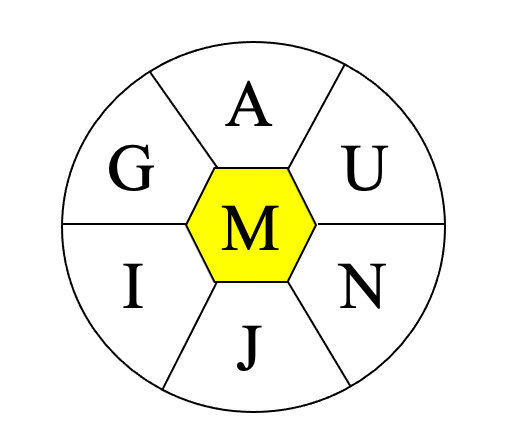
Art: Iva Reztok

A, G, I, J, N, U, and center M (all words must include M)

Merriam-Webster says…

Credit: merriam-webster.com

Silly little dictionary! Don’t you know nimming can’t possibly be a word if the New York Times says it ain’t?

For further fascinating facts, check out the Spelling Bee Master.

What’s your favorite dord* from today’s puzzle?

My Two Cents

Can you identify who says the quote at the top of today’s column (right under the title)? Hint: it’s from a 1980s movie. You’ll find the answer towards the end of the article. Yeah, I know, it’s a way to get you to scroll down, hopefully slowly. I can be sneaky that way sometimes.

Steal this word!

The definition of nimming as “the present participle of nim” isn’t very helpful if you don’t know what nim means. Which I freely admit I didn’t.
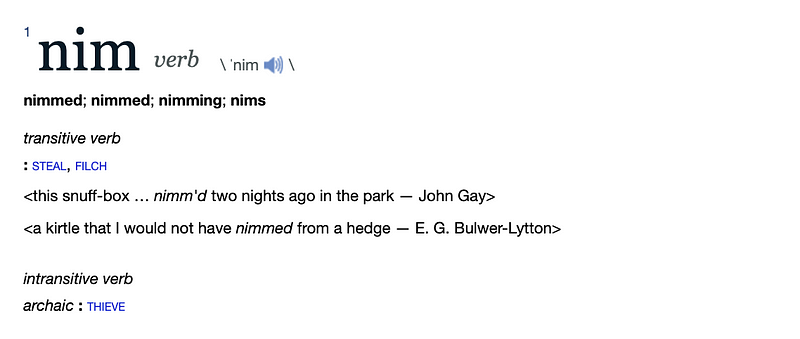
Credit: merriam-webster.com

All three words in blue are synonyms. Specifically, the connotation of filch is to “steal furtively” or “pilfer”. And pilfer means “to steal little by little or by taking articles of small value : commit or practice petty theft”.

Now, nim itself would not be an acceptable word in today’s Spelling Bee because answers need to have at least four letters (one of which must be the center letter) to be valid. But since the puzzle includes the i-n-g combination, savvy players know they can add the suffix -ing to any two- or three-letter word to get a valid answer. For example, aiming.

Now, nim is not just a verb, but also a noun. A very interesting one that is likely intimately connected with the meanings of the verb form, especially “pilfer”.

Nim is a game of strategy based on math. Two players take turns removing (or “nimming”) objects from several piles or groups. On each turn, a player must select one group or pile and take away at least one object from it––although they can also remove the entire pile if they wish to do so. The classic version of the game says the loser is the one left with the last object, but this rule can be reversed so that the last object belongs to the winner.
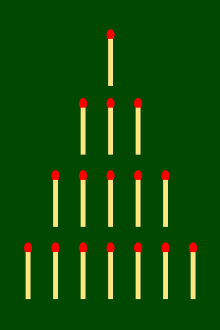
Image by Uncopy

So, for example, in the above layout, a simple classic game could consist of the two players removing each row starting from the bottom one. Player 1 would remove the bottom row and Player 2 would remove the third row. Next, Player 1 would remove the second row, leaving only the top match for Player 2, who would lose. I’m presenting a basic explanation; the game itself is complex and interesting.

Nim may have come from in China — it resembles the Chinese game of jiǎn-shízi, or “picking stones”. The earliest European references to nim are from the 16th century, but its current name was coined by Charles L. Bouton, who in 1902 published the complete theory of the game in Annals of Mathematics.

In nim, when there is only one group left with at least two objects, the player whose turn is next can easily win. If a player leaves an even number of non-zero groups, that player takes last and either wins or loses, depending on the version of the game agreed upon. However, if the player leaves an odd number of groups, then the other player will be the last to take away.

The game of nim gave rise to the nimbers, a mathematical concept defined as the values of heaps or groups in the game nim. These are used in combinatorial theory, a fascinating branch of math.

You can read all about nimbers here, or you can instead enjoy yourself by playing the nim game, below:

The computer wore a suit and tie

The 1939 New York World’s Fair was a long one. It was held from April to October of 1939, which was logical… and then again from April to October of 1940. Why? Who knows… but it gave Westinghouse Electric Corporation, one of the exhibitors, an excuse to add new exhibits for that second season.

Enter Edward Condon, an Associate Director of Research at Westinghouse. He was also a nuclear physicist and pioneer of quantum mechanics, and a man interested in the game of nim. So he proposed to the higher-ups that the company make a machine that could play the game.

Here is Condon, smiling politely for the 150th time after someone asks him “Condon… like the rubber?”
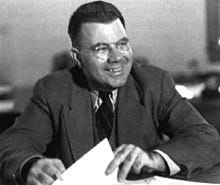
Photo: National Institute of Standards and Technology

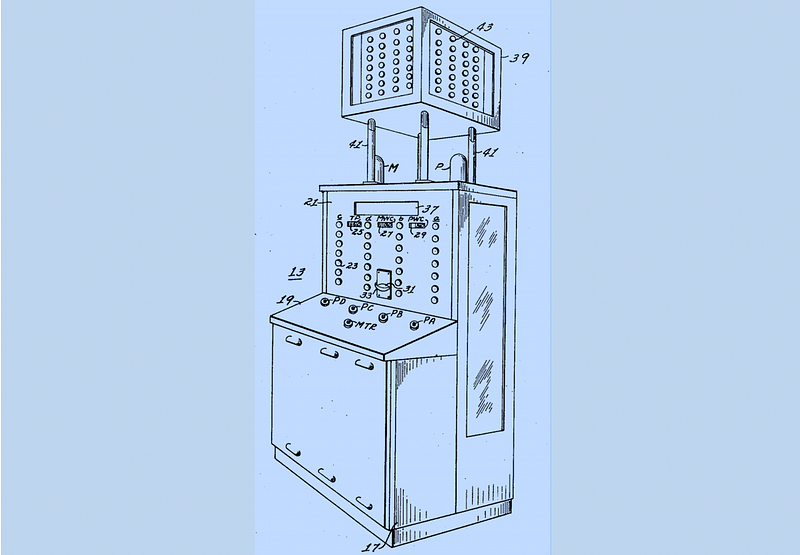
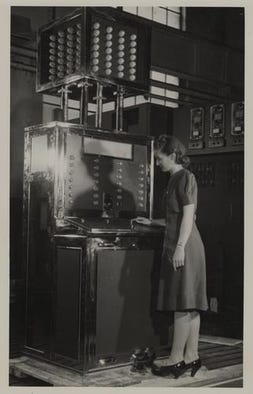
Thus was born the Nimatron, designed and constructed by Gerald L. Tawney and Willard A. Derr, Westinghouse employees. The machine was built with electro-mechanical relays , which allowed it to “make decisions” in the game on mere milliseconds. However, the designers felt the Nimatron’s speed could frustrate opposing players, so they added a delay relay of a couple seconds to make it appear that the machine was “thinking” about the move during its turning instead of responding instantly. Westinghouse filed a patent on behalf of Condon, Tawney, and Derr; the illustration at the top of today’s column is taken from that patent filing.

The visuals were in the form of four columns of seven lights; human players would pick a column from which to turn off the lights, make their choice of the number of lights to turn off by pressing buttons, and then pressed a different button to give the machine a turn.
Credit: Westinghouse Electric Corporation

The lights were displayed on the front of the machine, as well as on four sides of a cube above the machine, as shown in the above photo. This allowed spectators to follow the game. As you can also see from the picture, the Nimatron was huge. It measured about three feet wide, eight feet in height, and weighed close to a metric ton.

If the player beat the machine (only 10% of the time, apparently), out popped a token with the inscription “Nim Champ”.

The Nimatron was the first computing device invented solely for gaming purposes. As Condon explained in an article for The American Mathematical Monthly in 1942:

“The Nimatron serves no other useful purpose than to entertain, unless it be to illustrate how a set of electrical relays can be made to make a ‘decision’ in accordance with a fairly simple mathematical procedure.”

Despite the success of the Nimatron at the World’s Fair, Condon later said he thought the machine was a failure because he had seen it only as something to entertain with, having no practical uses. However, other people did see tons of potential in this machine, and a few years later fully-programmable digital computers began to emerge left and right, created by other companies and groups using many of the same principles Condon’s team had pioneered.

One of these computers was very similarly-named Nimrod, which made its public debut at the 1951 Festival of Britain. Can you guess what game it was running? Why, Halo, of course… not! It was nim and, not surprisingly, it also used lightbulbs.

Here is a replica of the Nimrod at a museum exhibit in Berlin.
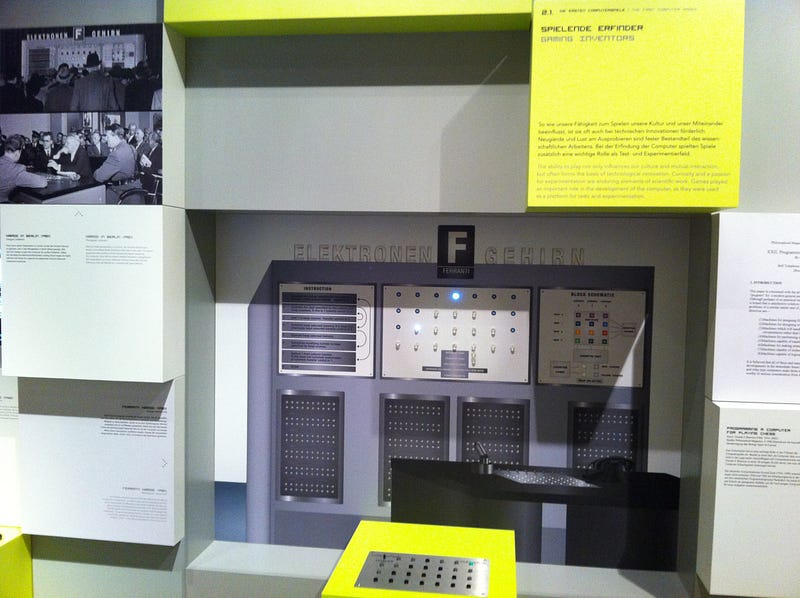
Photo by Chuck SMITH

The Nimrod is considered by some experts as one of the first video games, possibly the second ever invented. The debate about this stands on the fact that, although the Nimrod had a game running on a computer, it did not include an electronic screen. Which side of the argument do you stand on?

Oh, yeah, I almost forgot (not really). The phrase at the top of today’s column is said by the computer WOPR, nicknamed Joshua, in the 1983 movie WarGames, starring Matthew Broderick and Ally Sheedy. Here is the first instance:

If you’re young enough ––35 or under–– and want a peek at how computers used to be, check out this flick.

I hope you enjoyed today’s column and didn’t mind me nimming a bit of your time today… even though the editors of the Spelling Bee decided that nimming is a dord*.

You can check out my previous entry on another dord* here:

*What the heck is a dord, you ask? Here’s the answer:

Spelling Bee
Language
Computers
Math
Games
Recommended from ReadMedium