THOUGHTS
You’re Allowed to Be Racist
Just keep your prejudice away from me
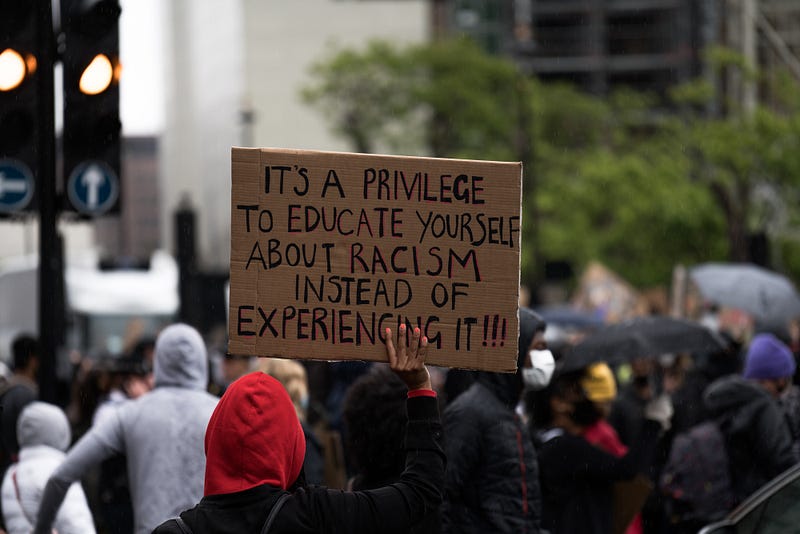
Another Black man is dead at a police officer’s hands, and what can I say that hasn’t already been said — more eloquently, thoughtfully, and with links to data? I don’t want to be another voice clamoring yet saying nothing. I don’t want to be another mad Black woman if my anger is shallow, just for show, or uniformed. I don’t want to be too angry to think, listen, act, or see clearly. I already know (and have written that) racism is easy. I don’t want to repeat myself. It’s exhausting.
I could very easily become a pessimist. It’s not hard to look at the world with cynical eyes. I could also try to live in denial, striving for ignorant bliss. But it’s not even a matter of whether the glass of racial reconciliation and civil rights progress is half empty or half full. It’s the fact that, at any moment, someone might knock that glass over, so I’d better carry a mop and a sponge.
What recent events (and social media trends) have helped me to realize is not that racism still exists (I already knew that), but how different each person’s experience of racism can be. I have been lucky, though perhaps being fortunate has kept me naïve. I grew up in a tough neighborhood, but I was rarely afraid there. The people on my block (even the alleged criminals) were kind and looked out for everyone.
I went to one of the best private schools in the country. And even though I was the only Black girl in my class until the sixth grade, I never felt “less than” or discriminated against. If anything made me feel inadequate, it was my lack of corpulent wealth, not my color. I was too young to understand the subtler (or sinister) implications, complications, and consequences of being the only blackbird in a flock of doves. I felt special — and lucky. I’m still grateful and happy that I attended that school. My perspective is different now. I can see it for what it is and was — the imperfections and good intentions — the progress and the flaws. That’s how I look at America. I love it without pretending it’s perfect or incapable of wrong.
Racism has touched my life, but it has not scarred my body. I have not had a racially charged experience that I couldn’t walk away from. My encounters with racism (with a few exceptions) have primarily been the kind that folks love to explain away: The type that sounds like a compliment until I realize they’re impressed because they expected less of someone “like me.” The biased act that I can’t prove beyond a shadow of a doubt has anything to do with race (though it always almost does). Perhaps that man was mean to me because I’m Black. Maybe he’s racist; maybe he’s a jerk; maybe he’s having a bad day; or maybe all of the above.
Talking to my siblings, however, showed me how differently members of the same family (even if born less than a decade apart) can experience the world. I have never been called a nigger (to my face). Both my brother and sister (who are seven and eight years younger than me) have been. My brother was called a coon as well. It broke my heart to hear that.
And here we are again with a tragic situation that some are reluctant to classify as racist. Personally, I don’t think you can call anything an “innocent mistake” if it costs a life. Only the woman who pulled the trigger knows what thoughts were going through her head at the time. But the thing about racism is that it doesn’t always operate on a conscious level. Who can say if she would have reacted the same way had the suspect been white or female?
I hope that everyone who criticized Colin Kaepernick for being unpatriotic and disrespectful of our troops was livid when they saw a lieutenant in the US Army getting pepper-sprayed and kicked by police officers despite the fact that he was calm, respectful, and wearing his uniform — oh, and had done nothing wrong. If a Black man in his American military uniform can have such a demeaning, violent, and dehumanizing encounter with police officers, I must assume that racism trumps patriotism and that “support our troops” isn’t unconditional.
Historically, folks have loved to use patriotism (and nationalism) as masks for their racism. Just look at the rise in violence against Asians and Pacific Islanders. It is beyond alarming; it’s appalling. I find it sad and sickening that a person’s ethnicity alone could provoke someone else to spit, slash, kick, or insult them. And even as all this is happening, folks are vehemently asserting that they aren’t racist. (But it’s coming from somewhere, isn’t it?)
Some folks love to say they aren’t racist. Yet some of those same folks are the ones who affirm that all lives matter but have trouble saying Black lives do. They are the ones who found humor in or repeated Trump’s racism-infused slurs for Covid-19, but can’t figure out why “stop Asian hate” is trending. They are the ones so frenzied with patriotism they’ve lost sight of the people — whether it’s someone who’s Asian, Black, or undocumented. They are the ones who act as though you’re can’t be for both police officers and Black people. They seem to think critiques are unpatriotic or disloyal instead of an attempt to make a country or organization better. They are the ones who use the term “American” to mean people who look and think like they do.
The neighborhood and churches I grew up in were predominately Black. The classrooms I learned in (through college) were primarily white. Since preschool, I’ve had to straddle both sides. I can identify with both (even if I only resemble one). My family tree is Black. My husband and in-laws are white. There was a time when I worried speaking up would be a betrayal of someone — or would alienate or disappoint. But now the stakes are too high. We’re in a fight for our liberty and lives. It’s okay if shining a light on the problem makes some (white) people cry.
Sometimes I hold my tongue because I recognize that I have a lot to learn — and not just from textbooks, but personal stories as well. As I said before, my brother, sister, and I have all had very different experiences being Black. They’re significantly younger than me. They’ve had racial slurs thrown at them much more than I have. I needed to hear their stories to better understand their feelings and perspectives on racial matters.
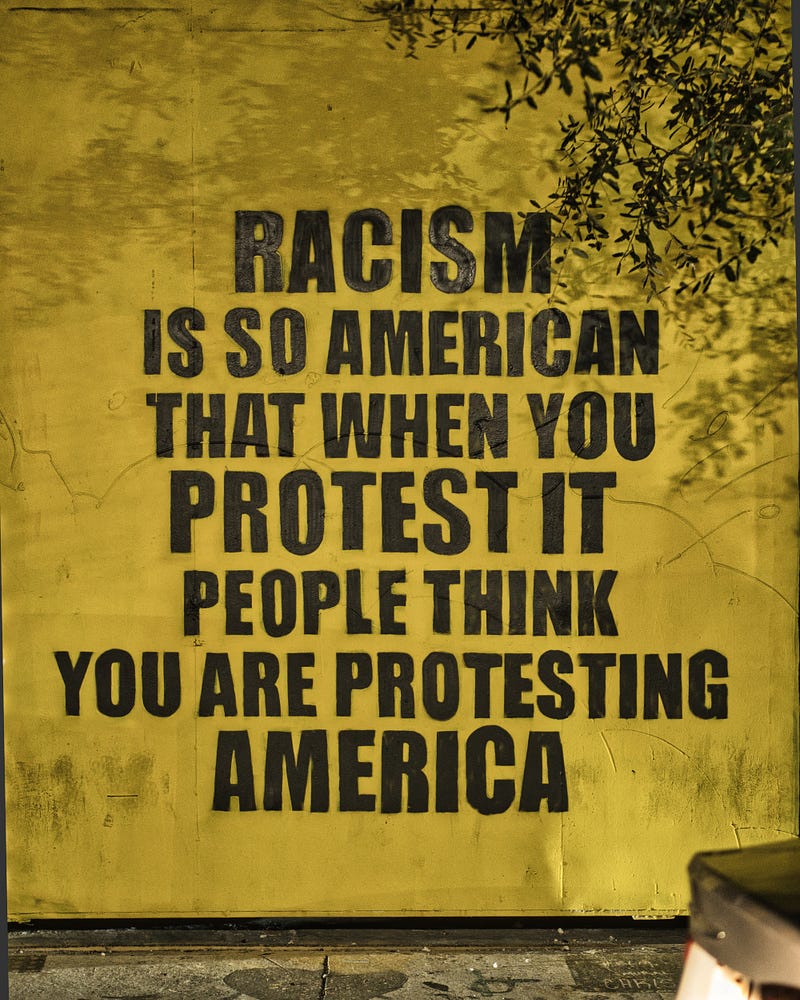
That’s the sticky thing about America. It’s not the same country, experientially, for everyone. My experience walking down the street, entering a store, trying to get a job (or a cab), or dating (when I was single) isn’t the same as that of every other person, every Black person, or even every Black woman — not in America, and not in New York City. I have been lucky — no one has hurt me (or stopped and frisked me) because I’m Black. But others have experienced being Black differently. It’s important that I don’t dismiss their stories — their reality.
The same is true of my Asian friends. Not all of them have been physically hurt, but they are still traumatized by the exponential increase in anti-AAPI violence. When someone who looks like you gets kicked like an animal. When they are attacked and witnesses actively refuse to come to their aid, how can that not make you fearful, angry, or both?
My world used to be very black and white, but it is more diverse now. I have friends from different cultures and countries — and of every color. Some are genuinely trying to understand the “black lives matter” and “stop Asian hate” movements from as many perspectives as they can. Others are standing firm wherever they woke up that morning and are unwilling to consider another position. I can’t tell if they don’t know their history or know it and still want to see Confederate champions and other hallmarks of racism remain on a pedestal while America’s internment camps get minimized or excluded in textbooks.
Reluctantly, I admit that’s their right. This is a free country, isn’t it? We live in a nation where you’re allowed to be racist, sexist, ageist, homophobic, shortsighted, incendiary, or uniformed. Free speech allows for the propagation of truth, spin, love, and propaganda. Just keep your prejudice away from me, and make sure your biases don’t trample on any laws.
What I really wish, is that everyone who swears they don’t have a racist bone in their body but still has trouble saying “Black lives matter” or has said “Kung Flu” could see how hurtful that disconnect is. I wish that everyone who thinks Black people are overreacting or need to learn how to deliver their message in a more calm and orderly way would stop seeing just this moment in time and take the long view of how Blacks have been treated in this country. Some people will ignore facts in the face of feelings. Others can’t see the forest because they’re so bent on inspecting the trees. Some should know better. Others are still learning.
The thought that has been running through my mind most this week is this: “The love of money is a root of all kinds of evil” (1 Timothy 6:10). I believe that. Racism is a disease as well as a symptom. I don’t want to minimize the actions of the benevolent and generous, but we are a country with a history of loving, lusting after, and idolizing money — where “greed is good.” We serve profit margins like kings. We chase after wealth as if it’s the oxygen we need to breathe. Generations upon generations of Americans have crushed one ethnic group or another for land, resources, or currency. The whole idea that this country can’t accommodate more immigrants (or those immigrants in particular) is fed by a lie rooted in greed. It isn’t true that it’s us versus them, but that’s what both the xenophobes and the greedy want us to think.
Yes, we are a country of innovators, philanthropists, and industrial titans. But we also took advantage, benefiting from cheap, free, or forced labor — helping the poor with one hand while pushing them down with another. We built on the backs of the disenfranchised, abused the voiceless, hurled fists and insults at immigrants. We acted like we owned the place and all the “others” were intruders coming to steal our wealth (quickly forgetting that only the Native Americans are native to this country — that everyone else is an alien or descended from an alien’s progeny).
Current events are eliciting an emotional spectrum within me. I feel blessed to have made it this far into my life without being the victim of violent racism. I feel guilty for being spared — and sad on behalf of those (who like some of my friends and siblings) haven’t been. I am disappointed by the venom that human beings are throwing at each other — the lack of respect for differing views, experiences, and opinions. I have been encouraged by those who empathize, who hope to be part of the solution, and who are able to converse respectfully — even with those who disagree with them. I have been humbled and inspired by the words of those who are adding their thoughtful, fact-based, opinions to the dialogue — illuminating what often goes unseen and unconsidered.
It’s true. Not everyone is being productive. Some are making it worse. Some are identifying and trying to solve the problem. They are screaming, “no justice, no peace” or “don’t shoot!” But others are throwing fuel onto the flames. Some are trying to hear and help the victim. Others are denying (or minimizing) the victim’s experience.
Even though I have a short temper, I used to think less of the looters or the ones throwing objects at police officers. But then I started to think of it this way: It’s not too unlike a toddler’s temper tantrum. No, the behavior can’t be rewarded, encouraged, or reinforced. It’s wrong. We teach children who throw tantrums to channel their emotions in more productive (and socially acceptable) ways — to politely ask for what they want — to use their words. But that also presupposes that they’ll be heard — that they have the tools to pursue their dreams, meet their needs, and enjoy their freedom — equal to everyone. It’s hard to remain calm and composed when there’s an emergency but no one is listening. When due process and polite discourse keep failing your community, I can understand the urge to break something.
This is why attempts to impugn a victim are distractions. Even the guilty are entitled to humanity. A victim doesn’t become any less of a victim just because he or she isn’t (or hasn’t always been) a perfect, law-abiding citizen. Not everything is black and white — or black against white. Revenge isn’t justice. Anger isn’t a crime.
Too often we want a pure hero and a perfect villain. But that’s not reality. Human beings are complex — everyone is part bad, part good, and part all things in between. Sometimes the truth isn’t comfortable. Sometimes it’s obvious; sometimes it’s inscrutable. My being Black doesn’t make my opinion more valid. Your being white doesn’t mean you “don’t get it.” Facts and opinions are not the same thing. Just because you haven’t seen it on the news, doesn’t mean it isn’t happening.
We may not agree on everything, but can we at least agree that every life is worth the same thing. That being Black, Asian, American, undocumented, innocent, or guilty doesn’t mean you are less entitled to humane treatment? I hope the day comes when we won’t demean, discredit, or discount someone for being different — when we’re not less bothered by someone’s death because we don’t consider them “like us.”
To move forward — for real change, we need thoughts and love and laws and actions. Clearly there’s still work to be done. Change can be hard and slow, but it can’t be stopped. Some people need to speak; everyone needs to listen. Those with an audience or followers would be wise to keep testing the truth — as well as their own integrity and wisdom.
We’re not all experiencing the same America — even when we have the same color skin, but especially when we don’t. It takes many perspectives to see the full picture. What I’ve learned and lived doesn’t encompass everything. So, I’ll keep watching, writing, and listening.