
Scars Are Inevitable: Learning to Like My Imperfections
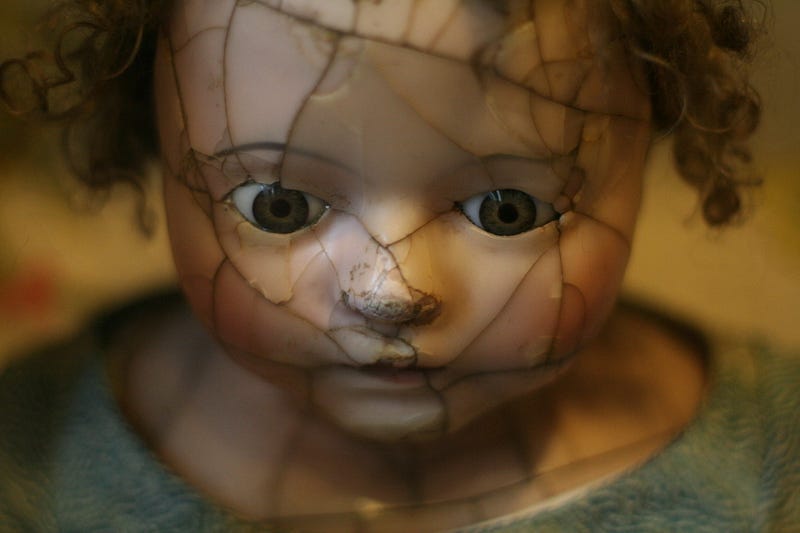
Perhaps I watched too many soap operas as a child with my grandmother, but I used to look forward to ending a relationship dramatically. I pined for the opportunity to fling my napkin down defiantly or (and better) throw my drink in someone’s face and stomp away completely justified in my indignation.
I’ve never done it. Even though I have a short temper, I’m not confrontational by nature. I grew up in a tough neighborhood, but I lived a very sheltered life — one full of ballet lessons, devoid of profanity, and wrapped in obligatory utterances of please and thank you. So despite the fact that I used to get a thrill out of watching soap opera divas slam doors and slap faces, despite my active love of hand-to-hand combat action movies, I’ve never allowed my dramatic and aggressive inclinations into my reality.
I suppose I should emphasize that I enjoy dramatic violence, and by dramatic I mean theatrical, staged, make-believe. I can only enjoy a well-executed fight scene in a show or film because it is not real. I might be able to fantasize about defeating someone physically, but I also know that hurting someone else opens the door to being hurt personally. In real fights, both the winner and the loser limp away (if such designations can even be made). And even though most pain is temporary, getting hurt often leaves a scar — a permanent marking.
As a (recovering) perfectionist, it’s very difficult for me to come to terms with acquiring a new scar. Before I give myself permission to feel the pain, I spend time berating myself for being careless — or wishing I could go back in time to not do the thing I did that will now leave a permanent blemish on my body.
In addition to being aesthetically unpalatable, scars are reminders of mistakes I’ve made — a chasm I shouldn’t have tried to jump across, something hot I should have been more mindful of, a detrimental lapse in care and caution. It’s one thing to make a mistake; it’s another for my skin to carry the consequences of my blunder.
Much to my chagrin, I have had to accept that scars are inevitable. Apparently even my ethnicity is a factor, as I was once told by a blunt plastic surgeon while he was tending to one of my wounds (and I paraphrase), “Black don’t crack, but is sure does scar easily.” It also didn’t help that my childhood self found picking scabs utterly irresistible.
I used to be ashamed of my scars. I wore them as badges of dishonor. I saw each one as a testament to my gross imperfection — further proof that I could fall or fail. But the older I got, and the more bodies I saw, the more I realized that we’re all imperfect and scarred. Whether subtly or violently, whether by our own hand or someone else’s, all of us have been wounded. Making it through life unblemished (as was my short-lived goal) is impossible. Even the careful get cut. Life is a gift, but it isn’t innocuous.
And so, to counter all the past efforts I’ve made to avoid or hide them, and all the time I’ve spent regretting or resenting them, I now share my personal catalog of permanent blemishes:
On my forehead I carry the chicken pox scar I’ve had since nursery school. I was diagnosed on the first day of Christmas vacation and deemed no longer contagious the day before my school reopened. [This would turn out to be a repeated motif in my life. For as long as I remained in academia (be it as a student or a teacher), I would only get sick on weekends and vacations.] I also succeeded in giving the chicken pox to a visiting relative I wasn’t fond of. I took pride in this at the time — paying it forward with chicken pox. Apparently “misery loves company” applies to the acutely itchy as well.
On my upper left arm, near my shoulder, I can just barely make out the triangular scar from an iron I accidentally pressed into. I was in the fifth or sixth grade, and my photography class was making T-shirts with iron-on versions of our snapshots. This is one of the few scars I didn’t mind getting at the time, as it meant attentive sympathy (or guilt) from my photography teacher, and I had a serious crush on him.
I have a small scar on each hand — each in the space between my index finger knuckle and thumb. The wound on my right hand I got while in college. I was at my ophthalmologist’s office and mindlessly held on to the bathroom door for so long that it closed on my hand. My pupils had just been dilated, so I couldn’t clearly see the blood, but I could feel it dripping. I received exactly one stitch (which was administered by the plastic surgeon I mentioned earlier). I found it irritating that I couldn’t properly say I’d gotten stitches, as nothing about my solitary suture merited the plural. The similarly shaped (but smaller) scar on my left hand (which went without stitches — or a stitch, for that matter) I inflicted on myself with a pair of scissors while trying to cut out my hair extensions.
I have one scar on each shin. The more prominent one is on my left leg. I was young and playing with my cousins in Grenada, running circles around their house, when I lost my footing trying to cross their cement gutter. I remember thinking I’d cut myself down to the bone because all I saw at first was white where my brown skin had been. It’s the biggest scar I’ve ever gotten. At the time (I was significantly shorter then) it was about a third of the length of my shin. It’s only half the length of my pinky finger now. The scar on my right leg is significantly smaller. It came from a floor burn I got during a volleyball tournament in high school. It probably wouldn’t have left a mark at all if I’d thought to disinfect it sooner and then not picked at the scab like an addict. It’s the reason I still only play indoor volleyball with knee-high socks on.
I assume I have a blemish that is invisible to me (and most), as it is located near the middle of my scalp. Back in grade school, when I still got my kinky hair relaxed, I suffered a chemical burn from the corrosive process. I was never able to see it, but a portion of my scalp became painfully raw and scabbed over, and then a chunk of my hair fell out. I remember my mother trying to hide my bald spot with askew and asymmetrical ponytails. Of all my wounds, this one took the longest time to heal and was the hardest hit to my vanity. Even now (more than two decades later), the hair in that region still grows shorter and weaker than the hair everywhere else.
My most recent scar is a thin, jagged crescent on the inside of my right forearm. I was riding the subway and absentmindedly trying to scratch an itch under a tight sleeve. I must have pressed a bit too hard, and my nail must have been just the right degree of sharp. Suddenly I felt a pang of heat, and when I pulled my hand away I saw a lot of gunk under my fingernail. Upon inspecting my arm, I realized I had scratched enough of my own skin away to draw blood. Now it looks like an open parentheses — the mouth part of an emoji smile.
Another recent blemish is a burn that is very well camouflaged now. I was rushing to take something unwieldy out of the stove, and let it push my wrist bone into the interior of the oven door. Just a few seconds against the heat, so brief I didn’t think much of it at first, but then I could feel the burning sensation intensify as it moved through deeper layers of my dermis. Before long I had a blister. A brief act of thoughtless carelessness and I suffered the third most memorable burn of my life.
And isn’t that how most scars come to pass? A momentary error in judgment, a fleeting lapse in attention — the injury might take just a second to inflict, but its claim to our skin can last a lifetime.
Versions of this piece appeared on Write Away and The Body Is Not an Apology.


