
Your Next Mountain May Not Be a Mountain
How to embrace new landscapes when life changes direction
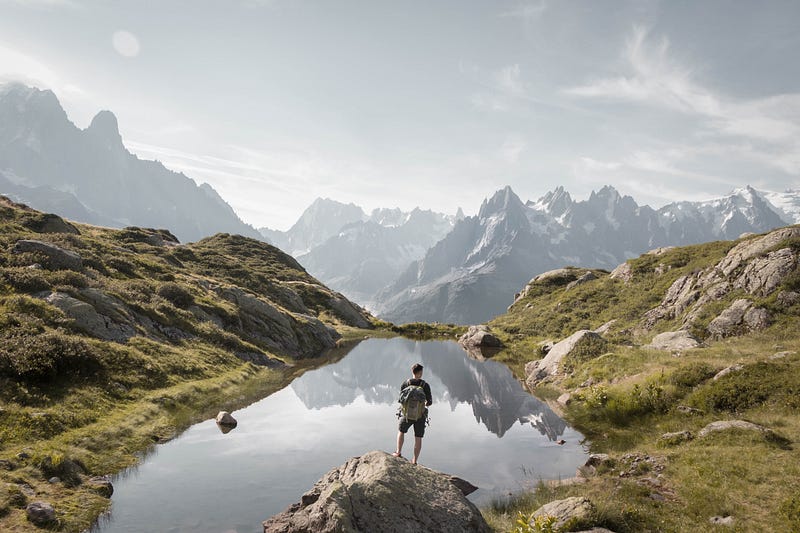
I recently collapsed at the foot of an eight-year mountain. It was a job I entered with passion, thinking its summit was the one I had been looking for all this time. There were early signs the mountain wasn’t right for me, but I continued anyway. Such is the power of the mind to concoct illusions.
The summit always seemed to be obscured by clouds. Tales of what people thought was up there convinced us, lonely climbers, to continue. Maybe I too could enjoy the summit’s glories. I wasn’t even sure what the summit would look like. It was a mountain few had climbed before, and of those who had reached the summit, few seemed to return being able to relate to others.
It was a tough slog for the most part, although I had good support along the way. But it came to the point where I knew I was on the wrong mountain. And as devastating it was to not reach my destination, I decided to find myself a new one.
In his book, The Second Mountain, David Brookes uses the metaphor of two mountains to talk about that point in one’s life or career when you realize what you were working towards no longer matters to you. You were climbing the wrong mountain. The first mountain is depicted as somewhat selfish — climbed for personal gain.
By contrast, the second mountain represents one of vocation. A life that will bring greater fulfillment. This article by Laurence McCahill provides a better overview than what I am sharing here. But in short, despite its title, the book isn’t about mountain climbing. It’s about living a moral life. David Brookes explores themes such as family, philosophy, and community.
David Brookes’s perspective frankly doesn’t always resonate with me, although soon we’ll discover some themes that are harmonious with his. But I did want to acknowledge his work. It points to the idea that mountains dominate how we view life and career. And that other landscapes could offer a better way to consider life’s journey.
The three big problems with mountains
Mountains dominate the way we think of success. There are three big problems with this:
- When one doesn't summit a mountain, the experience is often failure.
- From a narrow mountain perspective, it’s easy to miss the gift in other landscapes.
- There are other ways of thinking of success
When you fail to reach the summit
I introduced a friend to mountain climbing at age fourteen and he was hooked. Mountain climbing can be addictive — there’s a rush of achieving a summit. He went on to climb several smaller mountains before tackling Everest Basecamp as a way of working up to higher peaks.
His first big mountain was going to be Aconcagua in Argentina, the highest peak in the Americas standing at 6,961 meters (22,838 ft). Stephen paid a handsome sum to join a group with an experienced guide. He forked out even more money on the right equipment and clothing, and he trained intensely for six months to be fit and ready to climb.
He was progressing well during the early stages of the climb but began to struggle the higher they got. As a safety protocol, the expedition leader tracked the climbers’ vitals as they gain altitude. Summiting a mountain of this height can be dangerous. When it came to summit day, the leader refused to let him continue with the group. Instead, he had to remain back at camp while the others continued to the top.
He was naturally devastated. The loss of time, money and investment was part of it, but even more, he didn’t reach the peak he held in his mind for months. He had defined success by the narrow terms of the summit.
Most people aren’t into climbing high mountains, so this example might seem unrelatable on the surface. But, in fields such as entrepreneurship, the arts, sports, and spirituality, this “sense of failure” is remarkably common. We don’t always reach the summit we aim for.
The gift of other landscapes
When I found myself at the bottom of my eight-year mountain, it was tempting to look around for the next mountain to climb. That’s why books like The Second Mountain exist — because there are people like me who look for the next one to climb.
Instead, I found myself in a different landscape altogether. I was somehow lost in a desert, and it wasn’t until could move through that I could even contemplate a mountain at all.
What I found in the desert was something far greater than any mountain could provide. For one, it was healing. But in the realm of success, it helped me to redefine what the goal was.
I’ve long been curious about the power of landscapes in shaping our thinking. And my earliest experiences came through leading Outward Bound expeditions and seeing the change of energy come when an expedition shifted from climbing a mountain to paddling a river.
Unlike mountains, rivers don’t require perseverance. The necessary quality is surrender. The direction and destination are already set for you. There aren’t any uphill battles. Instead, it is about working with the natural flow of the water — or dare I say, the universe — to take you to your destination.
It doesn't mean that rivers are effortless, as rivers can often be more unpredictable and dangerous than mountains. The sheer volume of water and energy propelling you forward requires a different kind of skill to navigate. But once you can handle the current and obstacles, it is an entirely different kind of journey.
The point here is not to unpack the finer points of rivers versus mountains or deserts. It is to recognize that life contains many more landscapes and journeys than our western mountain-dominant world would have us believe.
How to think of success
Regardless of which landscape one pursues, the idea of a destination as the determinant of success is very limiting. Instead, as any outdoor adventurer would attest, it is the inner and interpersonal qualities of perseverance, compassion, skill, and more that determine the quality of a journey. Climbing and paddling are both individual and team endeavors.
While we are taught from a young age to think of a career as a solo pursuit, in reality, it is almost always the opposite. Even in what appears on the surface as an introverted professional like writing, we are interacting with people every day. Our life experiences shape the content we write about, and we interact with editors and publishers to produce our work.
You could think of almost any profession and see that invariably they require the development of all sorts of hidden qualities. Yes, it can be motivating to have individual goals, but the greater determinant of success is often the qualities we carry within us as we relate to those around us.
I have had several distinct jobs and journeys throughout my adult life. I don’t even like to call it a career. Yes, I have set goals and experienced failure at times. But, every “failure” connected me more closely to who I am.
I opened this article by talking about finding myself at the bottom of an eight-year mountain. But it turns out that, perhaps, I wasn’t climbing a mountain at all. When viewed through the lens of making my way through life’s many and varied landscapes, I see myself simply moving through new territory adjusting to life around me. From this new perspective, I no longer see myself at the bottom feeling I have failed.
While life’s grand adventure may include any number of journeys, there’s also gratitude for the landscape I am in right now. Yesterday I went for a hike in a forest. Today I went to the beach and listened to the waves. Tonight, I sit in my cave writing this article.
Life is miraculous in all its forms. I hope I can continue to recognize its opportunities and not limit myself to society’s need for me to always climb a mountain. And in its rightful timing, when my next mountain appears, may I be ready to approach it with the necessary vigor and detachment that any good mountain requires.


