
When There’s No End in Sight
What to do when you‘re lost in the desert
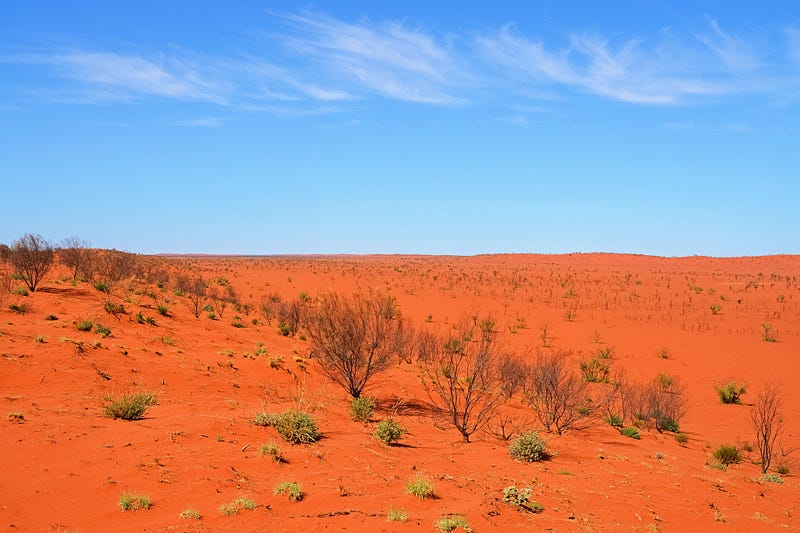
We’d been driving west of Alice Springs for two hours when we stopped suddenly. I felt like I was in the classic film The Adventures of Priscilla, Queen of the Desert, sans the drag. Just like the moment when Bernadette slams on the breaks, we fell out of the bus, awed by the vastness of the landscape ahead of us. I was Bernadette.
I was thirty-five when I made my first trip to the centre of Australia. It was like visiting a missing part of me. Life had taken me through every other possible landscape, and eventually the desert caught up with me.
There wasn’t any reason to stop on the road west of Alice; none of us needed to pee. We were driven by a silent inner force. I soon found myself wandering north across the red earth, magnetically pulled into the landscape. I wasn’t walking toward or away from anything. I was walking into something. After a time, I turned and looked back to see our truck was only a spec on the horizon.
I’d been living in the inner west of Sydney on the same street Priscilla started. My work as a nonprofit executive left me exhausted and out of balance. I desperately needed to escape the all-consuming nature of life. The grind, the noise, and the pressure.
Our modern work lives are the antithesis of deserts. We are raised to look at the career landscape as a series of mountains to be climbed. Sometimes we choose the right mountain, other times we don’t. But in many cases the view from the mountain is sufficiently clouded in, making one question whether it was worth climbing at all.
The mountain had been instilled in me since I climbed my first one at age ten. Don’t get me wrong, I love mountains and the feeling of reaching a summit. But I wonder what my life would have been like if I learned the wisdom of the desert earlier. Would I be able to better handle life’s harder times? Would I live differently if I didn’t have a fixed horizon?
My first sojourn to the desert turned out to be more than a peaceful escape. When I returned to the city, the jarring energetic contrast led me to leave my job. It marked what became a season of soul searching. I entered a period where I no longer had a mountain in front of me or a fixed point on my horizon.
Deserts teach us what no other landscape can. They force us to face ourselves. With a constantly moving horizon, we are left to turn inward to our own strength and resilience for survival. Like the wells of water that lay beneath the surface of a desert landscape, we too possess an inner life force waiting to be tapped within us.
Earlier this year I again walked away from a job of eight years. I knew in my heart it was the right move, but I felt lost. I drove with a friend southwest from Minnesota to New Mexico, our bodies on autopilot for White Sands National Park. We knew what we needed — the desert silence.
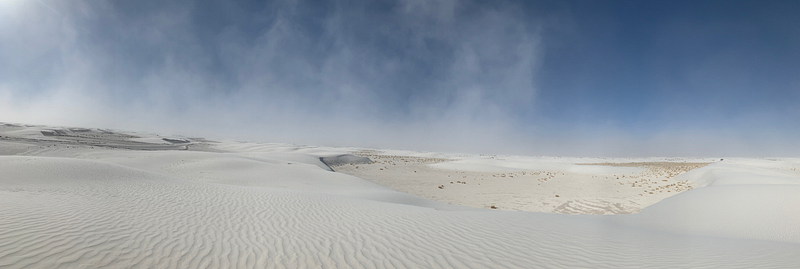
As I lay on the chalky sand with endless dunes surrounding us, I could feel the pure white wind changing me. Part of me wanted to stay there forever. Indeed, part of me did.
I eventually walked out of the desert coated with a thin film of sand. A coat I still energetically wear. I didn’t realise at the time, although should have seen it coming, that this was going to be more than a weekend visit to a national park. I had once again invoked the desert in my own life.
The pandemic forced many of us into a desert season. Where the shifting horizon isn’t just about place, but also about time. It’s easy to wander aimlessly each day, not knowing where you are or when the destination will reveal itself. A week feels like a year. The endless promises are a mirage, and a moment’s expectation gives way to disappointment.
Perhaps it’s because, as a society, we haven’t learned the secrets of the desert. How, in the silence and apparent desolation, there’s a new kind of growth waiting to be discovered.
It was apropos that the opening scene of Priscilla had Mitzi singing, “I’ve been to paradise but I’ve never been to me,” an anthem to the deep inner yearning to find oneself. The desert was the only place that could happen. The story wouldn’t have worked as Priscilla, Queen of the Mountains or Queen of the Streets. The harsh emptiness of the desert stripped away life as they knew it. The desert was a mirror that allowed them to see their inherent resilience.
As almost every plan evaporated from my own life, I was forced to look in my own mirror; to tap into my own well. I have found myself writing stories from my life. Forgotten treasures of the past have been pulled to the surface to give me strength.
It’s been surprising, even shocking, what I’ve found. And while the writing journey is pursued alone, I have encountered other writers out here in the desert. Each of us sharing our stories as a way of tapping into the hidden wisdom of our hearts.
The desert archetype is present when there’s nothing but a shifting horizon as far as the eye can see. When there’s no end in sight, and yet there’s no going back. The end point a mirage that preys on hope; an illusory goal that never satisfies our thirst for a little certainty.
The edge of the desert sneaks up as an almost imperceptible surprise, more gradual than abrupt. By the time we get there we no longer seek answers outside ourselves.
The desert can be empowering when we know its wisdom. We only need to take our eyes off the horizon and look to the deep well within us. When the time comes, we emerge to find ourselves in a new landscape; stronger, and ready for the next part of our journey. We may not want to go back there quickly, yet are grateful for who we’ve have become through it.
Dedicated to Melinda, who can survive any mountain or desert.


