
Your Mental Indebtedness Is What Keeps You In Debt
Release yourself from your false obligations
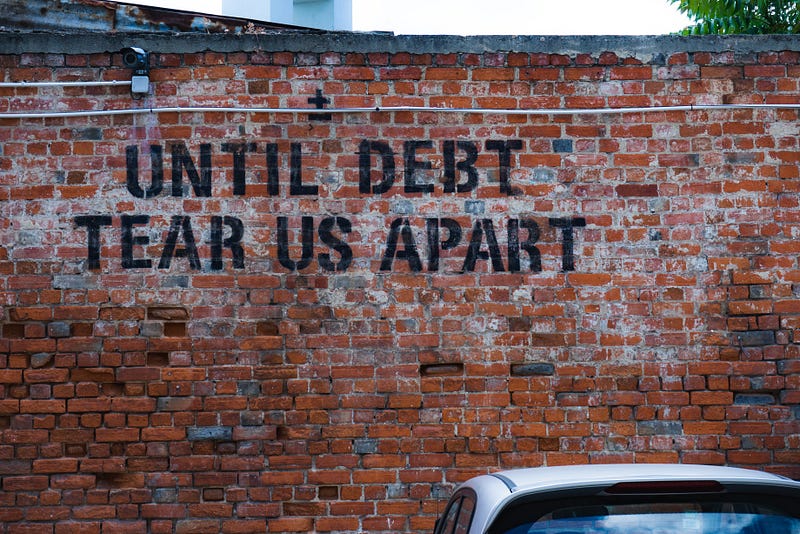
How much debt do you have?
Credit cards? Student and consumer loans? Car loans? Mortgages?
According to Experian’s 2019 Consumer Debt Study, total consumer debt in the US sits at $14 trillion, with Americans carrying on average around $90,000 worth of personal debt, a new record since 2009. The average credit card balance reached close to $6,200 in 2019. A quarter of Americans expect to die in debt.
At this point, with the abundance of information out there on financial literacy and how costly a credit card balance of even $4,000 can be, it seems astonishing that people keep living beyond their means.
Or is it?
You see, debt is not so simple. Of course, a part of it has to do with people having trouble delaying gratification and going on buying sprees to get the dopamine highs from the act of getting a new thing in their possession; it’s about filling an emotional void.
However, on a more fundamental level, incurring debt has its own philosophy. You incur debt because you are used to being indebted.
Now, when we think of debt, we immediately think of money. But there are a lot more ways for you to be indebted other than in monetary terms, and this mindset has been so deeply ingrained into your entire being by the society you live in that you don’t even realize it.
Any debt is about obligations. For most of you, your whole life is one big obligation; it has been since you were born, and you accept it.
Well, you are trained to accept it.
Intrigued? Let’s take a closer look.
Your First Creditors By Birth
You were born, and just like that, you already owe something to someone.
Your first “creditor” is none other than your parents — and, if you are growing up in a toxic family, they will make sure you are aware of it.
They will go out of their way to remind you of the sacrifice they made for you — the life they gave you, the food they put on your table, the clothes they got you, the tuition they paid for you. They will keep telling you how much they have done for you, so now you’d be expected to reciprocate that.
You’d be expected to repay your debt.
Maybe not in the monetary form, at first — you are still young, after all, and aren’t making your own money. Besides, it’s not like you could put a price tag on human life.
And your parents know that.
Make no mistake: they know the buttons they need to push to make you comply. They know perfectly well that you are dependent on them financially, so they can use that lever to ensure you remain in this inferior, indebted mental state.
Chronically indebted people — the same as chronically guilty people — are much easier to control.
Not all parents are like that, of course. But, unfortunately, way too many of them are. Some are less toxic than others, but many parents out there view their children as an extension of themselves and force them on a path to conformity the way they themselves once were. They believe that because you are their child, they have a say in what you do with your life.
And just like that, you’ve been first introduced to the mental and emotional state of indebtedness.
So how can you repay your parents if you don’t have any money?
By being a good kid. By making them proud. By doing what they say, pursuing the type of life they see for you. Because they know better, right? You have to keep them happy — get good grades, play a musical instrument, go to college, pursue a career they find acceptable, land a prestigious job that they can brag about to their friends.
And if you try to resist, they will remind you that you have an obligation to your family. After all, they have done so much for you, haven’t they? This is the least you can do in return.
Your parents instill in you the belief that you need to be successful so that they could save face in front of the neighbors. And as you grow older, this belief becomes internalized and turns into a conviction of your own. You now believe you have to possess conventional attributes of success in the form of wealth, social status, and social prestige to be well-regarded in society.
You end up going to college. It doesn’t matter that college isn’t really about learning anymore and is not necessarily required to obtain the skills and knowledge you need for a fulfilling professional occupation. You go anyway because you’ve been told it’s the only way to succeed and end up either taking on a bunch of student loan debt or have your parents fund the bill.
If you come from a family where your parents engage in guilt trips, gaslighting, and manipulations to control your life, the latter option entails just as much indebtedness as the former one, albeit not necessarily in monetary terms.
You will graduate and enter the rat race. And then… Well, you know the drill.
Keep working, get promotions, get planned vacations once or twice a year. Car loan, later on, a mortgage. You have to keep up with the Joneses.
You will spend a lifetime (literally) working a job you don’t like for a wage to sustain yourself, only so you could continue going to work.

The Philosophy of Debt
To be clear, I am not trying to demonize going to college or striving to achieve the proverbial American Dream in which you work a cushy stable job and own a house in the suburbia where you live happily ever after as a perfect nuclear family. Everyone chooses for themselves what happiness looks like.
However, the image of the proverbial American Dream is misleading in more ways than one, deceptive even. It rests on the idea of being forced into obligations you often don’t want to have but end up carrying out anyway because you’ve been told your whole life that’s how it has to be. You are indoctrinated with a sense of obligation, which ends up guiding your decision-making in life. Driven by these externally inflicted ideals, you believe you ought to be a certain way to be successful and earn your place in society.
And this mental indebtedness then entails you to incur monetary debt to fund the life you’ve been told you should have.
The worst part about it, the moment you’re in the rat race, it’s hard to escape. You see, the system perpetuates itself: the more mental debt you take on, the more monetary debt you take on, and the more money you owe, the harder it is to bail out. You can’t just quit that 9–5 job you hate if you have bills coming due each month. So you are now obligated to keep it.
The system was designed to recruit you and retain you inside.
At its core, your debt is not just the money you owe to the bank; indebtedness is a state of mind.
On the conventional path to conformity, debt is the glue that keeps society together.

The Path To Freedom
Freedom doesn’t begin in your wallet — it begins in your mind.
There is plenty of information available on the best strategies to repay your debts. However, while this is obviously very important, you will not solve your debt problem until you first release yourself from your mental indebtedness.
You need to recognize the aspects of your life where you feel the burden of obligations, that is, where you often engage in activities you don’t want to do but do them because you feel you must. Sure, some of them may be legitimate and need to be maintained — I am not talking about basic obligations mandated by law, such as paying taxes.
However, many of them are likely self-imposed in a sense that you don’t actually have to continue carrying them but do it anyway under the influence of social inertia. These can manifest themselves in a variety of ways, such as:
- staying in a job/career you hate because of the fear of losing stability and social image
- staying in toxic, codependent relationships with people that hurt you but where you feel you are obligated to support and help them
- catering to your parents and making life decisions on the basis of their approval
- setting life goals not in accordance with what you want, but based on social or family expectations
- making any sacrifices you don’t feel comfortable making
You have to release yourself from all of the false obligations you have taken upon yourself. You are allowed to live your life how you want — but you are the only one who can give yourself that permission.
When you realize that, your debts will go away. Not that they will magically disappear, but one way or another, you will eventually find a way to take care of them and never be bothered by the debt problem again. For proof of that, go no further than pretty much every successful self-improvement writer: many of them have stories of building themselves up from scratch and paying off tens of thousands in debt, all of which began with their embarking on a path to self-discovery and away from social conformation.
But before you get there, you need to understand that you don’t owe anything to anyone. Even to your parents.
Because at the end of the day, it’s all about personal responsibility. You didn’t make the decision to be born; your parents did. It would make no difference if they made this life choice because they sincerely wanted to bring a new human being into this world or because they had an underlying selfish motive of using you as a tool for satisfying their own emotional and financial needs. It was their decision, not yours. You don’t have to be responsible for it.
And this principle applies in general to everything in your life: your career, your living arrangements, the lifestyle you are striving to maintain. If you don’t want to do it, you don’t have to do it. You always have a choice.
Let go of the narratives. Take a close look at your life, pick every aspect of it — your relationships, your job, your way of living — and ask yourself: Is this in my life because I deliberately chose for it to be? Or because someone else expected me to have it and I complied?
You will be surprised to find out that you won’t always be able to answer these questions definitively, at least not right away. Because of the social conditioning, we often lose track of our true inner desires, so you may have to spend some time untangling this. It will require developing a new level of self-awareness that you may haven’t had before. It may lead you to some profound realizations that might be uncomfortable to acknowledge. It may lead you to make some difficult decisions, but after you admit to yourself the truth, you will never want to go back.
You will not want to be a function you perform mindlessly every day out of obligation to pay the bills, instead of doing something you really enjoy.
You will not want to be in toxic, one-sided relationships.
You will not want to do things because others expect you to do them.
And you will no longer want to drive yourself into debt because you will hate feeling indebted.
You will want to be free — of expectations, of obligations, and of debt.
Financial freedom isn’t just about financial discipline, saving 50% of your income, and not buying vanilla lattes and avocado toasts every day. Financial freedom is inseparable from your inner freedom as an individual.
Realizing this is the first step on the path to joining the quarter of Americans that is currently debt-free.