
Your Honor, I Call Humanity to The Stand
In Praise of Star Trek’s Courtroom Episodes
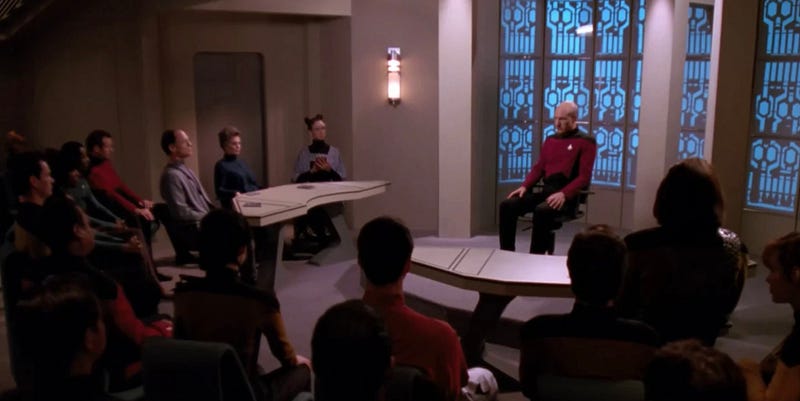
Let’s be honest: as sci-fi, Star Trek shouldn’t work. It’s just too outlandish. Sci-fi, in general, is very forgiving. It will allow alternate universes, babel fish, wormholes, and time travel. But there’s one speculative line that good sci-fi generally doesn’t dare cross: sustained utopia. Paradise doesn’t make for good reading unless it’s Paradise Lost. And yet, Star Trek, perhaps the most influential sci-fi franchise of all time, revolves around a utopian vision.
Why does it succeed here where others fail? Like the best fiction, it succeeds not because it’s a window into weird and wonderful worlds but because it’s a mirror in which we can see ourselves. We want to believe we’re better than what we see doomscrolling our social feeds. We want to believe that there’s something noble waiting to rise out of the ash of our many conspicuous faults. And Star Trek gives us just that. It offers a sustained picture of the altruism and nobility that we know, deep down, we are capable of.
In a sense, all our fictional visions and stories are a sort of trial. Humanity is on trial, and the verdict is, all too often, “guilty.” In truth, this is tiresome. We want to win–at least sometimes. We want the jury to see the truth behind all the messiness of our lives and pronounce our innocence–and that’s what we get from Star Trek. It should come as no surprise, then, that many of the most popular episodes of the Star Trek canon are not filled with explosions, romantic intrigue, or extended CGI sequences. Instead, many of the most beloved episodes take place in the courtroom. In a sense, the courtroom drama is the soul of Star Trek.
A careful observer of the many episodes of courtroom drama will notice that a few themes predominate. We might call these the sacred rights of the individual, the exploration of justice, and the challenge of cross-cultural tolerance. The rest of this article will focus on the sacred rights of the individual through an overview of two TNG episodes. A list (that I hope is comprehensive) of 29 courtroom episodes is included at the end.
The Sacred Rights of the Individual
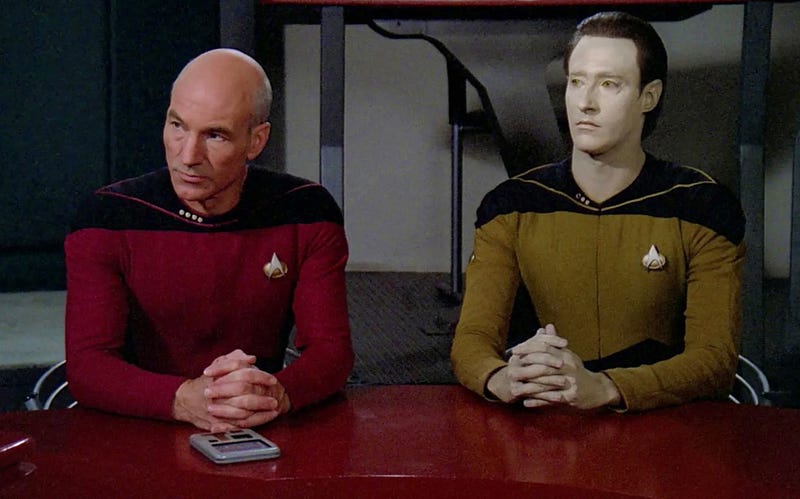
Data and the Right to Be
“Your honor,” a passionate Picard pleads, “Starfleet was founded to seek out new life. Well, there it sits!” Data sits silently, awaiting the verdict of the judge. Is he property or person? Does he have a right to choose his own fate? The judge rules in favor of Data (an android and artificial intelligence), stating that he deserves the same rights and privileges as any other Federation citizen.
The TNG episode “The Measure of a Man” is a favorite of many Star Trek fans. It delves into deep philosophical and ethical waters and returns with pearls of wisdom. The trial teaches us that the rights we enjoy are not our privileges alone. They belong to all sentient beings, however different they may be. Our histories are rife with images of savage cruelty to those who are different. Not only other forms of life but even those like us who differ in the realms of religion, ancestry, race, and preference. This episode shows us how far the Federation has come and how high our potential for enlightenment is. We find ourselves empathizing with a person who could not be more different than us: an artificial lifeform incapable of emotion. If we can watch Data’s plight with empathy and rejoice at his victory, surely we can do the same for our fellow humans.
Soren and the Right to Choose
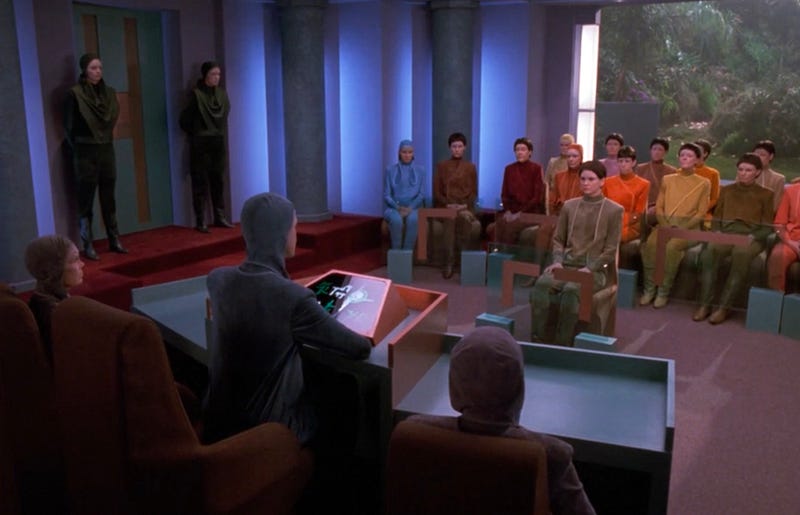
Soren, a member of the androgynous J’naii race, declares, “I am tired of lies.” Though most J’naii are androgynous, a few, like Soren, are born with a distinct gender. Those discovered to be gendered face persecution and are compelled to undergo a procedure to erase that gender. Born female, Soren stands wearied but unwavering in the civic chamber of her people, asserting, “I am female. I was born that way. I’ve felt this way, had these longings, my entire life. It’s not unnatural. I’m not sick for feeling this way.”
The episode aired in 1992 and deals with topics, like sexual preference and gender identity, rarely addressed at the time. Anyone who lived through the 90’s knows that these were often unsafe topics of discussion. Much of the LGBTQ+ community remained closeted, often for their own safety. By flipping the script, Star Trek could boldly go where the rest of popular television dared not. As Kenny Minker said in a recent review of this episode, “In this world, male-female love is the ‘other.’ Therefore, straight, cisgender viewers are forced to imagine how it might feel to not be in the accepted majority.” For many at the time, issues of gender identity and sexual preference were too inflammatory to discuss. Using an alien lens, Star Trek compellingly reframed the issue, forcing us to confront our darker biases.
Soren and Riker, who had fallen in love, act on their feelings and are caught by other members of the J’naii. Soren is taken into custody and placed on trial for her “perversion.” Her rights in jeopardy, she delivers one of Star Trek’s most moving monologues. It deserves to be quoted at length:
What I need, and what all of those who are like me need, is your understanding and your compassion. We have not injured you in any way. And yet, we are scorned and attacked… What we do is no different from what you do. We talk and laugh. We complain about work and we wonder about growing old. We talk about our families, and we worry about the future. And we cry with each other when things seem hopeless. All of the loving things that you do with each other, that is what we do. And for that we are called misfits and deviants and criminals.
Sadly, the J’naii are not the Federation. They're a picture of our prejudice and xenophobia. Soren’s impassioned plea falls on deaf ears, and she is tragically forced to undergo the gender erasure procedure.
In Star Trek’s vast universe, where the infinite possibilities of existence are explored, the courtroom often becomes the stage where the most profound human dramas unfold. The rights of the individual stand as a lodestar in these legal battles, pointing to the essence of better humanity. Whether it’s Data’s struggle for personhood or Soren’s fight for her identity, these courtroom confrontations remind us that the very core of a just society is its commitment to protect and honor the rights of every individual, no matter how different they appear on the surface. Though set against the backdrop of interstellar jurisprudence, the challenges these characters face are profoundly human and resonate with our shared quest for recognition, respect, and dignity. Star Trek doesn’t merely present a utopia; it sets a course for us, steering towards a future where the rights of the individual are both the journey and the destination, often adjudicated in the most unexpected of arenas.
Humanity on Trial
Throughout history, humanity has been on trial, its actions, mistakes, and triumphs constantly under scrutiny. This trial began ages ago, in the annals of our earliest stories and myths, and persists to this day. Every step forward, every societal advance or regression, serves as evidence presented before the grand jury of time. Our collective narrative — filled with tales of discovery, conflict, cruelty, and redemption — continually challenges and defines our place in the universe. It’s a theme explored in many literary masterpieces, and perhaps one of the most poignant representations can be found in the pages of John Milton’s Paradise Lost.
The title of that work has always felt inconsistently negative to me. When Paradise is lost, and Adam and Eve are forced to leave it behind forever, it doesn’t appear as devastating as you may expect. Milton imbues the scene with hope and optimism. Leaving Paradise behind is not a guilty verdict; it is the trial’s commencement.
Some natural tears they dropt, but wiped them soon; The world was all before them, where to choose Their place of rest, and Providence their guide: They, hand in hand, with wandering steps and slow, Through Eden took their solitary way.
With wandering steps and slow, we, too, encounter a world laid out before us — a world shaped by our choices.
The poetic symmetry is not lost on Star Trek fans. After all, TNG begins and ends with humanity on trial under the scrutinizing gaze of the omnipotent Q. Star Trek underscores our agency in determining our final verdict. If lost Paradise is ever found — be it in the form of the Federation or another vision — it will be erected upon the bedrock of our better selves.
Is it any wonder, then, that courtroom episodes resonate so deeply with Star Trek enthusiasts? The franchise earns its adoration not just for its futuristic visions but for revealing a more enlightened reflection of humanity. This vision shines brightest amidst the legal dramas of the Trek universe.
List of Courtroom Episodes
TOS
- “Court Martial” (Season 1, Episode 20)
- “The Menagerie, Part I” (Season 1, Episode 11) and “The Menagerie, Part II” (Season 1, Episode 12)
- “Wolf in the Fold” (Season 2, Episode 14)
- “Turnabout Intruder” (Season 3, Episode 24)
TNG
- “Encounter at Farpoint” (Season 1, Episodes 1 & 2)
- “Justice” (Season 1, Episode 8)
- “The Measure of a Man” (Season 2, Episode 9)
- “A Matter of Perspective” (Season 3, Episode 14)
- “The Drumhead” (Season 4, Episode 21)
- “Devil’s Due” (Season 4, Episode 13)
- “The Outcast” (Season 5, Episode 17)
- “The First Duty” (Season 5, Episode 19)
- “The Pegasus” (Season 7, Episode 12)
- All Good Things…” (Season 7, Episodes 25 & 26)
DS9
- “Dax” (Season 1, Episode 8)
- “Tribunal” (Season 2, Episode 25)
- “Rules of Engagement” (Season 4, Episode 17)
- “Inquisition” (Season 6, Episode 18)
Enterprise
- “Judgment” (Season 2, Episode 19)
- “The Expanse” (Season 2, Episode 26)
- “The Forge” (Season 4, Episode 7), “Awakening” (Season 4, Episode 8), & “Kir’Shara” (Season 4, Episode 9)
- “Demons” (Season 4, Episode 20) & “Terra Prime” (Season 4, Episode 21)
Voyager
- “Ex Post Facto” (Season 1, Episode 8)
- “Death Wish” (Season 2, Episode 18)
- “Distant Origin” (Season 3, Episode 23)
- “Random Thoughts” (Season 4, Episode 10)
- “Author, Author” (Season 7, Episode 20)
Strange New Worlds
- “Ad Astra per Aspera” (Season 2, Episode 2)
Lower Decks
- “Veritas” (Season 1, Episode 8)
Am I missing anything? Please let me know in the comments if a correction is needed or if you have any episodes to add.


