
Star Trek’s 1992 Episode on Gender and Sexuality
Star Trek TNG Episode Review: The Outcast
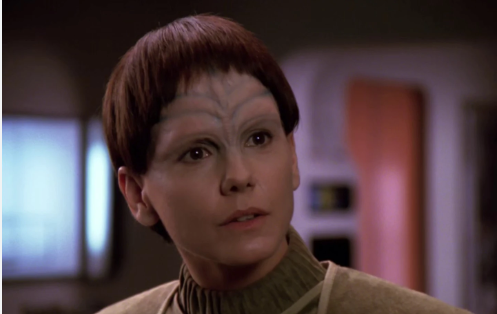
On March 16, 1992, Star Trek: The Next Generation (TNG) aired episode 17 of the show’s fifth season. The episode, titled The Outcast, concerned gender-based discrimination on an alien planet. At that point in time, The Outcast was Star Trek’s most meaningful exploration of LGBT rights and gender identity issues.
Episode Synopsis
If you’re unfamiliar with TNG, the show takes place in the 24th century and presents the adventures of Captain Jean-Luc Picard and the crew of the starship Enterprise. They travel through space, encountering new worlds and alien races.
In The Outcast, the Enterprise receives a message from the J’naii, requesting assistance to locate a missing shuttle. The J’naii (pictured above) is a humanoid alien race with no genders — every J’naii is androgynous, biologically intersex, and shares a similar outward appearance.
The Enterprise’s first officer, Riker, works closely with one of the J’naii, Soren, to locate the missing shuttle and retrieve its crew. Along the way, Riker and Soren develop romantic feelings for one another. Soren explains that some of her people do have tendencies toward identifying as male or female, but that those feelings must be kept secret. Identifying with a gender is considered a criminal perversion. Gendered individuals are forced to undergo conversion therapy that reprograms an androgynous mindset.
Powerful Social Commentary or Weak Tokenism?
In 1992, when this episode aired, there was no Will & Grace. Ellen hadn’t come out yet. Any amount of queer representation on a network show was noteworthy.
What’s bizarre about experiencing this episode, more than 30 years after it was made, is watching a story about gender identity that isn’t actually about gender identity.
On the surface, The Outcast depicts a person’s struggle to claim their true gender identity in a world that denies that freedom. However, it’s all a metaphor for gay rights (LGB, not LGBT). In 1992, we were miles away from seeing mainstream discussions on gender fluidity and transgender rights. An expansion of gay rights was closer to the visible horizon, and that’s the area that Star Trek intended to explore — even though a 2023 viewing yields a more literal, modern, and relatable story about gender identity.
As the love story between Riker and Soren develops, we learn more about J’naii society. Soren reveals that some J’naii identify as male or female and experience sexual desire for the opposite sex. Young people who show those tendencies are ostracized and eventually subjected to a brainwashing therapy that makes them more like everyone else — genderless and without any sexual desire.
In this world, male-female love is the “other.” Therefore, straight, cisgender viewers are forced to imagine how it might feel to not be in the accepted majority.
Soren and Riker’s affair is discovered, and Soren is put before a tribunal to determine if she’s violated society’s rules and requires “fixing.” Rather than lie, she argues against the system that would punish a person’s natural feelings.
“I am female. I was born that way. I have had those feelings, those longings, all of my life. It is not unnatural. I am not sick because I feel this way. I do not need to be helped. I do not need to be cured. What I need, and what all of those who are like me need, is your understanding. And your compassion… What right do you have to punish us? What right do you have to change us? What makes you think you can dictate how people love each other?”
Many reviewers are unimpressed with The Outcast. The episode is noted for its awkward dialogue about gender norms and its avoidance of any direct discussion of homosexuality.
However, there’s no doubt that many viewers at the time, and since, had their minds opened just a bit by hearing Soren’s climactic speech about the freedom to love. The episode also provided a rare moment of relatability in 1992 for young people who were struggling with feelings that society forced them to hide.
The main problem with The Outcast is its context within a Star Trek universe that, aside from these rare one-off episodes, was largely devoid of LGBT representation. Trek depicts a future human race that’s supposedly evolved past issues like sexism, racism, and capitalism — but everyone is straight. The Outcast makes viewers think about gay love, but does so using aliens, metaphors, and a male/female actor duo.
A few years later, Star Trek: Deep Space Nine (1993–1999) featured one of network TV’s first lesbian kisses in the 1995 episode Rejoined. However, Star Trek’s first openly gay series regular human characters didn’t appear until 2017 in Star Trek: Discovery.
In a 2008 interview, Trek writer Roland D. Moore admitted:
“We’ve just failed at it. It’s not been something we’ve successfully done. At Star Trek we used to have all these stock answers for why we didn’t do it. The truth is it was not really a priority for any of us on the staff so it wasn’t really something that was strong on anybody’s radar.”
Perhaps The Outcast is most noteworthy because it highlights Star Trek’s broader failures at representation. However, the episode is, in my opinion, thoughtfully made and even powerful. It also provides a fascinating glimpse into what a progressive take on gay rights looked like in 1992. I recommend the episode to anyone who’s interested in the history of LGBT representation in film and TV.
Read more on Star Trek and gender in this article by Maria Shimizu Christensen:
This story is an entry for Reviewsday Tuesday’s Monthly Theme in October:


