
Your Brain Is Wired to Avoid Success
How to unfriend your personal bully
Don’t you feel overwhelmed when thinking or talking about the brain?
I mean, we’ve got a liver doing liver things, we’ve got a heart pumping blood… but still, all those vital organs respond to their CEO, the brain.
Why are we so keen on taking care of our heart, kidneys, liver, lungs… and so careless with our brain, the organ that controls the rest?
Our brain makes us who we are, so let’s start understanding it a little bit better.
Guideline
- Why skepticism is a good thing
- Understanding how our brain works
- Understanding why our brain avoids success
- Hacking our brain with neuroplasticity
- Selective thoughts
- Successful role models
Recently, I posted this article about a Scientific Explanation For Manifesting, and I mentioned that I was learning how to do it.
Well, I want to share everything I am learning along the way, because ever since I started this journey my whole perspective of life has changed.
Skepticism
Our prefrontal cortex is the part of our brain responsible for logic and reason, and it is not fully developed until we are 8 years old.
- What does this mean?
Until the age of 8, we can only receive the direct information our parents or caregivers give us, incapable of doing anything else than believing it and praising it.
I mean, come on! It’s our parents, of course, every single thing they say it’s right, right?
We enter adulthood, with beliefs and visions of the world created by hearing, seeing, and experiencing when we were kids, with zero to no intention of changing them.
Allow me to be more direct: we live our lives the way a kid believes it’s right.
So please, get out there and be skeptical. Question this kid’s beliefs, for God’s sake!
Understanding how our brain works
Our brain can be divided like this:
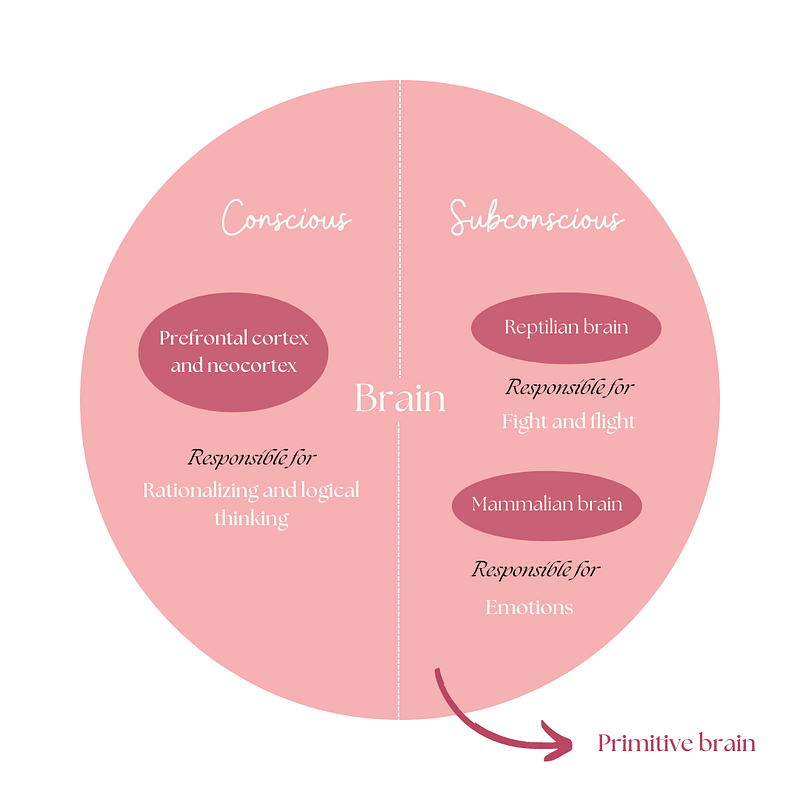
As you can see, the subconscious is the primitive part of our brain.
- And what does primitive mean?
It means that it is responsible for our survival.
While that was useful centuries ago, nowadays we don’t have to constantly worry about dying. Despite society evolving and becoming safer, our brain is still working as if we lived in the wild.
Understanding the why
Saying that your brain is manipulating you into avoiding success, may sound a bit harsh, but let me explain it so that we can all be on the same page.
This primitive brain of ours, believes safety to be those things that consume zero to no calories. Automatisms.
Every time we open TikTok or Netflix, our brain floods us with positive hormones.
But your dreams and desires are completely new and undiscovered roads.
What you believe to be your dream, your brain sees as a potential threat that could kill you, so it knows exactly what to tell you to keep you away from it and even releases stress hormones as a warning sign.
Understand this, we are more wired to avoid pain than to seek pleasure.
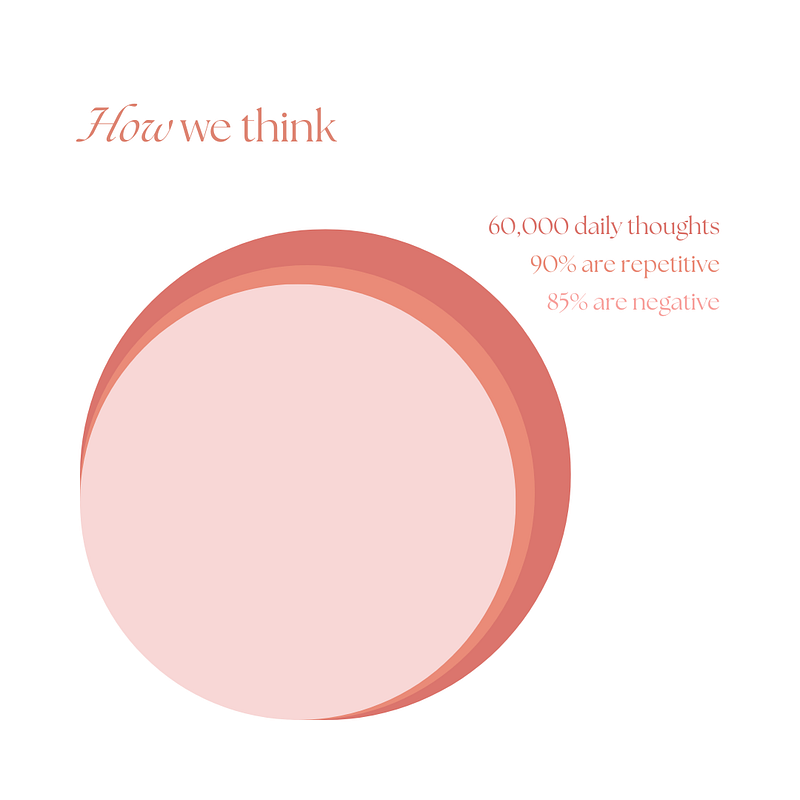
*According to research by Dr.Fred Luskin of Stanford University.
So it is safe to say that we have a huge tendency to focus on the negative.
It is more likely that you leave a negative review than a positive one. And still, it takes 4 positive reviews to neutralize 1 negative.
Now you tell, isn’t your primitive brain a bit of a bully?
Hacking our brain with neuroplasticity
Neuroplasticity was first discovered in 1964 by Marian Diamond, nowadays considered the founder of modern neuroscience.
- What is neuroplasticity?
Plastic surgery on your brain and neurons. Just kidding.
Our brain’s ability to recover, restructure, and adapt. No surgery needed!
- How can our brain do that?
By forming and reorganizing synaptic connections.
A repetitive action creates stronger synaptical connections, so the more we do something, the easier it gets.
But habits take time to form, and while repetition works wonders, we can speed up this process by associating positive emotions with them.
Selective thoughts
11 million bits of information per second, that is how much information our subconscious receives. I repeat, PER SECOND.
Now, only 40–50 bits make it to our conscious mind. That is a 0, a lot of zeros behind %.
So isn’t it crucial to know what information we want to receive?
That is why our ARA system is so important. It helps us get the information we want, our private selective detective.
When you buy a red car, you suddenly see red cars everywhere.
And that is not because you’re a trendsetter, but because your center of attention changed.
There’s always been the same number of red cars, but it is only now that you are interested in them, that the ARA system makes you aware of them.
(If you want to know more about the ARA system, I’ll leave a link to the article in which I explain in depth how fascinating it is).
Now, this book that I am reading suggests we use vision boards or visualization for our dreams and goals.
And it sounds like a pretty fun activity, but my primitive brain cannot help itself but tell me that, that is something teenagers do.
This author knew my brain would tell me that, and as a counterattack, offered a long list of successful people that use it.
Successful role models
- Sarah Blakely, founder of Spanx. A 1.2 billion dollar company.
You’ve got to visualize where you’re headed and be very clear about it. Take a Polaroid picture of where you’re going to be in a few years.
- Oprah Winfrey, I believe we all know who she is.
Create the highest, grandest vision possible for your life, because you become what you believe.
- Michael Phelps, Olympic Swimmer with 23 gold medals. He holds the record for winning the most Olympic events in history.
When I would visualize, it would be what you want it to be, what you don’t want it to be, what it could be. You are always ready for whatever comes your way.
- Michael Jordan, do I really need to explain who this basketball superstar is?
I don’t know if you’d call it visualizing or dreaming, but I’ve always done it, my whole life. Every time I feel tired while exercising and training, I close my eyes to see that picture, to see that list with my name.
- Arnold Schwarzenegger, Terminator and politian.
The model was there in my mind; I only had to grow enough to fill it. What you do is create a vision of who you want to be — and then live that picture as if it were already true.
What you think, you create.
So tell me.
What are you creating?
Thank you so much for taking the time to read this article! I am grateful that I could share my knowledge with you and truly hope it somehow helped you. If you have something you would like to add or another insight on the matter, don’t hesitate to share it with me.
Have a lovely day!


