
Music
You Need to Listen to This Song Right Now #47
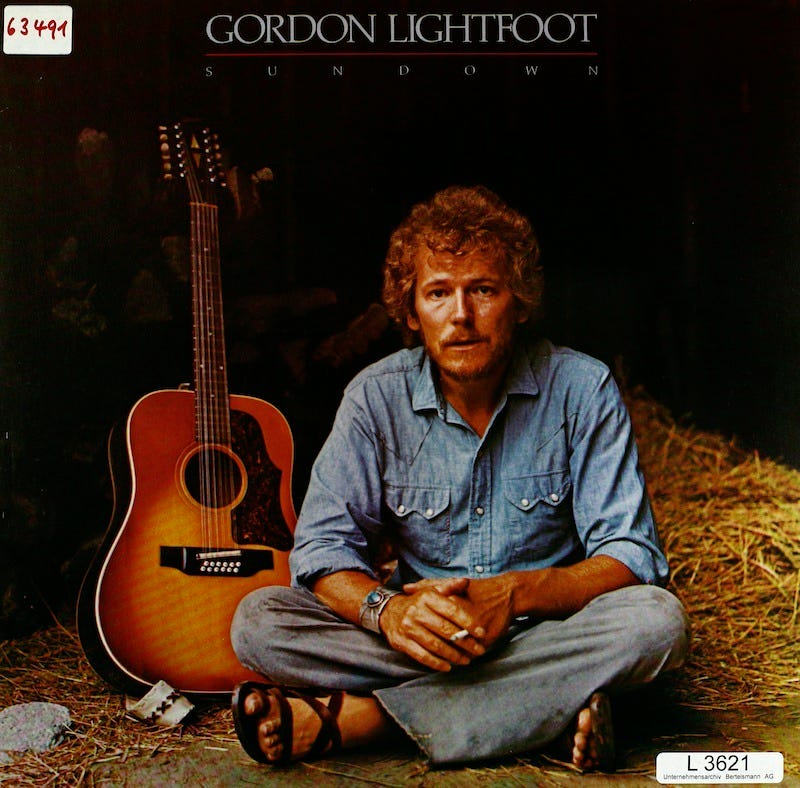
Heavy Rotation — Sundown, Gordon Lightfoot (single, 1974)
Heavy Rotation was a music industry term for songs that, one way or another, got incessant airplay. It referred to the large amount of rotations that a particular record was given on turntables at radio stations. Since, until the 1980s, this was the only way to get new music into the ears and brains of listeners, heavy rotation meant increased sales — good for record companies and artists alike.
Today, some people still put records on at home and give them a spin. Most of us don’t. However, the term still applies, just in a different way. Streaming services like Spotify sell subscriptions to listeners and then pay artists based on listens. At least, that’s the way we think it works.
For me, heavy rotation means a song that is in my head for some reason. Maybe for a moment, maybe for a day, maybe for longer. It’s a song that I come back to from time to time and still feels just as good. This series of articles is dedicated to these songs.
I aim to highlight a particular song by a particular band or singer. We should know a bit about the band, a bit about where the song fits into its history and where the song fits into what was happening in music at that time. Then there’s the song itself. Who’s playing on it, what are the lyrics getting at and why is it so good? How does it still occupy sonic space in our lives?
I’ll (try to) keep it short. It shouldn’t take you any longer to read this than the song itself. To that end, I put a Youtube clip of the original recording at the top of the article so you can listen as you read. Or not. And because a song is often much different live than in the recording studio, I stick a live clip on at the end.
What song is in your head right now? Here’s the one that won’t leave mine today:
#47 — Sundown, Gordon Lightfoot (single, 1974)
Well, ol’ Gord shuffled off this mortal coil the other day at the tender age of 84, and as a good Canadian kid, I think it’s important that his passing is marked.
The word “icon” is as overused today as “amazing,” but the word fits around here. As far as Canadian singer-songwriters who tried and succeeded to capture the vast essence of the place, he’s right up there with another Gord — Downie — of the Tragically Hip, who also left us a few years ago, having left behind an endless trail of classics of the genre.
He’s also one of the first musicians that I was introduced to at a young age by my mother, who used to sit my sister and me on the carpet, facing each other, each next to a speaker with just an album cover and liner notes between us, as she dropped Gord’s Gold onto the turntable and just let it play.
“The Wreck of the Edmund Fitzgerald,” “Carefree Highway,” “If You Could Read My Mind,” and “Rainy Day People” were always favourites. They still are, in fact. Folk music, they called it, and folk singer, they called him. I’m not so sure about either label.
But for me, Sundown most accurately captures the spirit of the times for me. And not just in his repertoire, but of mid-70s music in general, when it came to the laid-back, Sunday afternoon with the sun streaming in the feel of the recording and the lilting simplicity of putting an acoustic guitar, slide guitar, drum, and bass together.
But these belie in sharp contrast the darkness and borderline venom that is expressed in the lyrics. He knows just how to spin the light and the dark together.
It’s the tale of a woman who did Gord dirty in one way or another yet is still sniffing around without a bother on her for who she hurts. And all he wants is the strength to tell her to beat it, but he knows that his resistance will probably be futile when push comes to shove.
It is said that the woman is Cathy Smith, who gave John Belushi his last injection of heroin in 1982 at the Chateau Marmont in Los Angeles. I wonder how Gord felt when he heard that piece of news.
Things kick off with the golden strumming of his acoustic guitar, and soon the rambling bassline and low-key snare drum enter and have us settling into the groove. The easy vocal begins at 00:18:
“I can see her lyin’ back in her satin dress
In a room where you do what you don’t confess”
The chorus follows already, and it’s lead by a deliciously strummed chord, “Sundown, you better take care / If I find you’ve been creepin’ round my back stairs.” It comes across as a warning, and though she doesn’t have a chance to respond if she did, would it be along the lines of “Oh yeah? Then what?”
The second loop of the chorus elevates things with a harmony with the backing vocalist at 00:37, and then Lightfoot goes back to painting a picture of this woman,
“She’s been looking like a queen in a sailor’s dream
And she don’t always say what she really means”
She’s elusive and never lets him get too comfortable, and he knows he’s not the only one in her life and that “getting lost in her loving is (my) first mistake.”
A lovely bit of guitar noodling beginning at 1:51 leads us to the song's high point. The painting continues at 2:23, “I can see her looking fast in her faded jeans / She’s a hard lovin’ woman, got me feeling mean.”
She really did a number on him, but of course, he let it happen. If he looked a little closer, he might find that he only has himself to blame. At 2:49, he puts a final point on it with an emphatic double note on the snare drum, and I think that’s my favourite moment in this song. He’s said his piece and seems to say, “Goddamit, that’s it this time.”
A little more golden guitar takes us out, and we can get on with our lives, secure in the knowledge that though the sun blazed for a while, it has set on Sundown.
Here he is on the Midnight Special in 1974. You wouldn’t call him comfortable on stage, but the crowd doesn’t seem to mind.
If you have made it this far, it will occur to you that if this is #47 in this series, then there must be 46 previous ones. This is a correct assumption, and here I will link #46. At the bottom of it, you will find a link to #45, and at the bottom of that, you can — if you so choose — be taken to #44. This ingenious system that I thought up all by myself continues all the way to #1.
I really do hope that you like what you have just read. If you want unlimited access to thousands of writers, consider a subscription to Medium. It will set you back $5 a month, and if you use the link below, then I get a slice of that. I’m on the hunt for Gord’s Gold.