
Music
You Need to Listen to this Song Right Now #46
Heavy Rotation — Kiss and Tell, Bryan Ferry (Bête Noire, 1987)
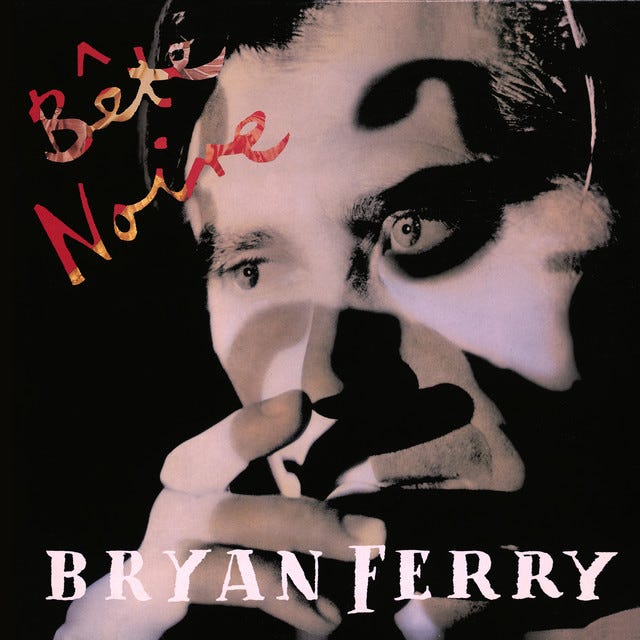
Heavy Rotation was a music industry term for songs that one way or another got incessant airplay. It referred to the large amount of rotations that a particular record was given on turntables at radio stations. Since, until the 1980s, this was the only way to get new music into the ears and brains of listeners, heavy rotation meant increased sales — good for record companies and artists alike.
Today, some people still put records on at home and give them a spin. Most of us don’t. However, the term still applies, just in a different way. Streaming services like Spotify sell subscriptions to listeners and then pay artists based on listens. At least, that’s the way we think it works.
For me, heavy rotation means a song that is in my head for some reason. Maybe for a moment, maybe for a day, maybe for longer. It’s a song that I come back to from time to time and still feels just as good. This series of articles is dedicated to these songs.
My aim is to highlight a particular song by a particular band or singer. We should know a bit about the band, a bit about where the song fits into its history and where the song fits into what was happening in music at that time. Then there’s the song itself. Who’s playing on it, what are the lyrics getting at and why is it so good? How does it still occupy sonic space in our lives?
I’ll (try to) keep it short. It shouldn’t take you any longer to read this than the song itself. To that end, I put a Youtube clip of the original recording at the top of the article so you can listen as you read. Or not. And because a song is often much different live than in the recording studio, I stick a live clip on at the end.
What song is in your head right now? Here’s the one that won’t leave mine today:
#46 — Kiss and Tell, Bryan Ferry (Bête Noire, 1987)
I saw Roxy Music at the Fujirock Music Festival in Japan in August 2010. They were on a last chance to make a few more bucks tour — though they’ve done a few more since — and I felt lucky to be able to cross paths with them.
I remember being mesmerized by the frontman, Bryan Ferry, who had perfected the louche lounge singer character to a tee, even in front of thousands of people outside in the elements, as easily as if we had been in a dark and smoky club with low ceilings. Out he came in a white tuxedo coat, bow tie untied, hair perpetually damp, all as though he was at the end of a long night or series of nights, but had time for one more martini, while singing us a few tunes.
The band swanned its way through such classics as “Love is the Drug”, “Avalon”, “More than This” and “Jealous Guy”, as well as a list of songs only serious Roxy Music fans would know.
This was a legendary band, smooth as creamed corn. But it was Bryan Ferry I was there to see.
As a male adolescent in the late 80s, the VHS tape that you wanted to get your hands on was “9 ½ Weeks” the steamy borderline softcore BDSM film starring Mickey Rourke and Kim Basinger. The actual plot of the movie was probably neither here nor there to me and my friends at the time, but I remember it partly for the soundtrack which featured the yearnful “Slave to Love”, which was also on Bryan Ferry’s “Boys and Girls” album from 1985.
It was that song that prompted me to dig into Roxy Music, who had had their heyday in the early to mid 70s, a little further.
His next album, “Bete Noire” in 1987 — his seventh of sixteen — is where I came in. I had it on cassette tape then, and I found it again on vinyl not too long ago and at $6.99, it was a no brainer and would still have been at twice the price.
I hadn’t listened to it in years, but when I got it home and put it on, I instantly thought to myself that “this is exactly what I remember music sounding like in 1988”.
It is said that Kiss and Tell, the second track on side 1 and the second single from the album, was a response to Jerry Hall’s airing of their dirty relationship laundry in a tell-all book a few years earlier. And maybe that explains why the song begins with the sound of a typewriter.
Not for long, though. At 00:08 the insistent and driving bass and drum line is established, not quitting until it’s over. It pulses the song along, creating a sense of urgency throughout. There is synthesizer colour underneath and a sinewy guitar riff over top.
At 00:24, Ferry’s distinctive vocal enters “Ten cents a dance / it’s the only price to pay / Why give ’em more / When it’s only love for sale”. Did he and Hall end on bad terms or did these come about as a result of the fact that she sold their story for money? Or maybe his beef is with Mick Jagger, who apparently stole her from under his nose, or so says Posy Churchgate - Writes & Edits Fiction.
“Just a one way street / to a faded magazine”. Ferry sees this as his opportunity to take his own shots at his erstwhile companion. He might get mean.
It obviously wasn’t his choice to make this all public, he’d like us to believe, but payment is a powerful motivator. “Kiss and tell / money talks / it never lies / Kiss and tell / Give and take / eye for an eye”.
It’s at 1:09 that Ferry’s vocal range takes the listener to the ethereal and dreamlike, going up an octave in memory of what they may have had, “fever / the heat of the night / dreamer / the stealer of sighs”.
But he quickly goes back to chiding Hall for her line of work though he probably didn’t mind it when she was on his arm, “Flash photograph / It’s the only light you see / No secret life / There’s no secret you can steal”.
I really like the guitar riff that runs alongside the vocal. There’s a sense of darkness and regret to this song and the guitar provides the feeling of an affirmation that things will be resolved, that he will move on, despite everything. “We live and learn”, he tells her at 2:09. Is he shrugging his shoulders, or letting her know that she taught him a lesson he won’t soon forget?
The guitar solo from 2:28 to 2:58 sounds like the rainy, late night, tortured walk down the street the last time he left her place. And it sounds so deliciously 80s as well.
Interestingly, from here one can hear the sound of the woodblock, a percussion instrument that has been playing all along, but is now pushed to the surface, which evokes even more energy and pace to the song. The female backing vocal is also enhanced and adds more lounge-y colour to the fade out.
In the end, it’s the sordid tale of the end of a relationship between two then-celebrities, in which each wants to have the last laugh. It wasn’t the first time this story had been told and it certainly hasn’t been the last.
Here he is in a live performance in 2014. The pace is even more insistent than on the studio track (but just half the song unfortunately)
If you have made it this far, it will occur to you if this is #46 in this series, then there must be 45 previous ones. This is a correct assumption and here I will link #45. At the bottom of it, you find a link to #44 and the bottom of that, you can — if you so choose — be taken to #43. This ingenious system that I thought up all by myself continues all the way to #1.
I really do hope that you like what you have just read. If you want unlimited access to thousands of writers, consider a subscription to Medium. It will set you back $5 a month and if you use the link below, then I get a slice of that. I’m going to get into a bit more Roxy Music / Bryan Ferry.


