
You Might Be a Perfectionist but You Don’t Have to Live Like One

I remember before I had ever heard the term “perfectionist” telling my husband (then boyfriend) that I never aim for average. Average to me was a C and only A’s were acceptable. A grade of a C was basically failing to me.
And before you are tempted to blame my striving view of life on parents who demanded perfection or overachieving, I assure you this did not come to me from anything my family modeled or expected. It was all me. I guess you could say I was born this way.
There’s always another A to reach for when you sing for your supper.
I was proud of that line of thinking and it felt good to me in my 20’s. By my late 40’s it was an exhausting mantra and standard to live by. I was learning that there was always someone smarter and better and willing and able to work harder and longer than me which made my A look like a C in comparison.
Additionally, when you’re striving for an A in an area you are not particularly gifted or working in an environment you’re not suited for, that A can start to feel unattainable and tainted. Resentment is the cost for chasing that prize and even if/when you attain it, it can feel hollow — like a huge letdown, because there’s always another A to reach for when you sing for your supper.
I still like the sound “A” over “C” and even the way an A looks over the shape and appearance of a C. I’m well trained and this grading of life is well-entrenched in me.
A=100%.
100% is perfection — is it not?
It’s whole — nothing missing, perfectly filled and rounded out. That pleases me, gives me a comfort inside that allows my nerves to settle and my heart to hum.
It should come as no surprise when I reveal to you that my number on the Sacred Enneagram is #1 The Perfectionist — which is an icky way of saying I like things whole.
I feel better when things are fixed, balanced, rounded out, and solid. I like my heart that way too.
When I decorate my home, my penchant for fullness shows up in the way I fill the nooks and crannies. I’ve always tried to fill in empty corners with plastic ficus trees or hanging lamps. I cover every blank wall, add rugs, pile on the throw pillows, and fill up empty spaces.
Emptiness makes me feel uneasy.
I’m learning to live with and appreciate empty spaces, in life and in my home.
The Cozy Home Minimalist by Myquillyn Smith challenged me to resist the urge to fill up all the space in my home. Her advice is to leave a wall here or there blank and to “quiet” a room by removing all the accessories and most of the furniture, only adding back what is necessary to make the space feel complete.
It’s a less-is-more approach to decorating without following popular minimalist rules which can feel cold to some who are used to the comfort of decorated rooms.
“Perfection is achieved, not when there is nothing more to add, but when there is nothing left to take away.” — Antoine de Saint-Exupery
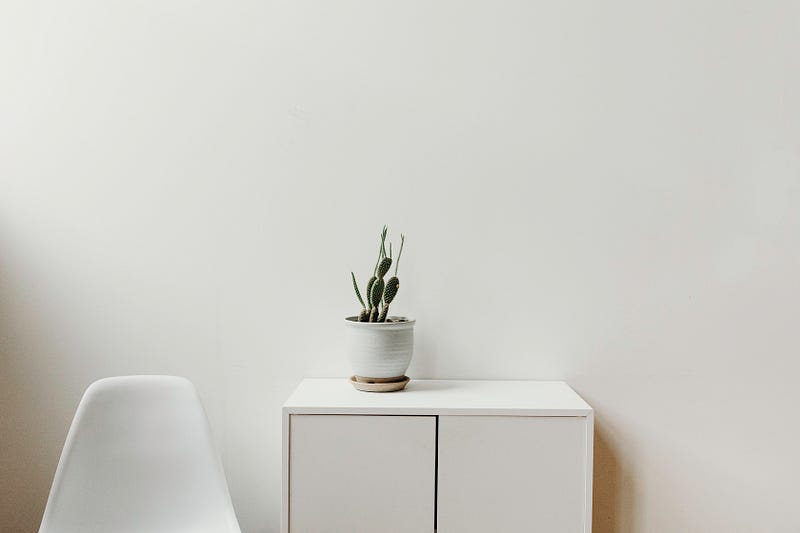
I’ve always been what Myquillyn calls a “cozifier.” A cozifier is someone who looks for ways to add to the room to make it warm and cozy but tends to overdo or clutter instead, never quite achieving the perfection they are looking for.
That was me! Always adding to my rooms and my heart in an attempt to make them feel complete. In my life, that’s looked like a lot of do-ing and striving and seeking approval in order to be full.
The reality is, I am learning, that I’ve always been full because the art of finding fulfillment is not in adding more but taking away.
This includes removing the layers of the false self that clutter up the soul as well as the pillows and knickknacks that clutter a living space. All this cozifying is my heart’s attempt to beautify my surroundings and fill my soul. But at the end of the day, it’s far less than perfect (my goal) — it’s an overdone attempt at perfection, a cluttered mess — littered with excess expectations, useless fears, and distracting props of the false self.
Less is more for your soul too
The only way to see what the soul of you was meant to be is to remove what doesn’t belong — to “quiet” the rooms of your heart and mind and let them speak to you and reveal what belongs. They’re suffocating under all the clutter of shoulds, expectations, lies, fears, and hustle.
It’s uncomfortable to sit in an empty room but it’s necessary in order to hear what it’s trying to tell us. Clarity comes when you learn that you can achieve an A with less effort when the right actions are applied.
The right tools always make a job easier and taking time to listen to your heart and soul yields better quality of effort and product than just throwing everything against the wall to see what sticks.
Hustling for perfection — racing to find what’s already there if we’d only get quiet enough to listen — takes extreme effort. Intentional listening and then acting upon what we hear is wise work. It ends in an outcome that’s achievable, sustainable, and life-enhancing.
Hustle is exhausting, unsustainable, and yields little return on investment.
The solution for the A-seeking perfectionist is to learn that the A is not the goal, the outcome is not the gold star. It’s learning to let go of the outcome in preference of the journey.
“Maybe one of these days I’ll be able to give myself a gold star for being ordinary, and maybe one of these days I’ll give myself a gold star for being extraordinary — for persisting. And maybe one day I won’t need to have a star at all.” — Sue Bender
Stuck in the Perfectionist trap? Here are some resources for you.
The Gifts of Imperfection by Brene Brown


