
You Can Retire Early
Or You Can Find Happiness at Work.

Kevin is 28 years old and lives in San Francisco. He works as a developer at a large cloud computing company, making $165k a year — enough to afford him a decent lifestyle in one of America’s most expensive cities.
However, Kevin lives far below his means. He rents a shared room in a 5-bedroom house, sleeps on an inflatable camping mat and eats beans and rice 5 nights per week. He doesn’t drive and gets around the city on a bicycle.
He also records every purchase in an Excel spreadsheet:
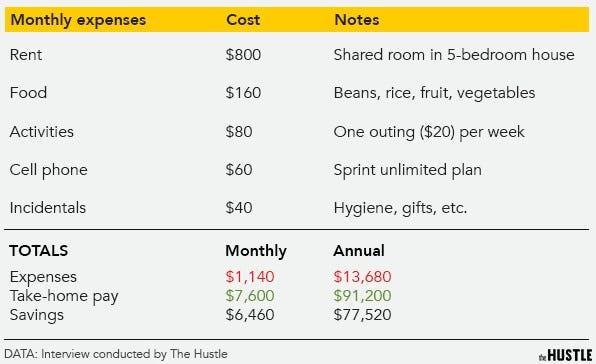
Why is he doing that?
“When I hit $800k, I’ll retire, and I’ll relocate to a cheaper city — maybe Minneapolis — and just live on the interest.”
Thanks to his frugal lifestyle, Kevin has saved around 85% of his annual income in 4 years, accumulating $380k in savings.
The FIRE Movement
Kevin is not the only one: more and more people aim at retiring early by living frugally and saving most of their annual income.
The followers of the ‘early retirement’ movement call themselves the ‘FIRE community’, where “FIRE” is short for “Financial Independence, Retire Early”.
Financial independence and early retirement aren’t new concepts, but the FIRE movement has grown in popularity over the last ten years thanks to the Internet and blogs.
Minimize spending, maximize earnings, and save enough to live off of dividends are some of the movement’s financial guidelines. According to FIRE gurus, the secret to retiring early is the “4% rule”; simply put, the rule states that you can comfortably withdraw 4% of your savings in your first year of retirement. Afterwards, you adjust the amount to withdraw to account for inflation.
A simple equation can be used as a rough way to calculate how much someone needs to save to be financially independent:
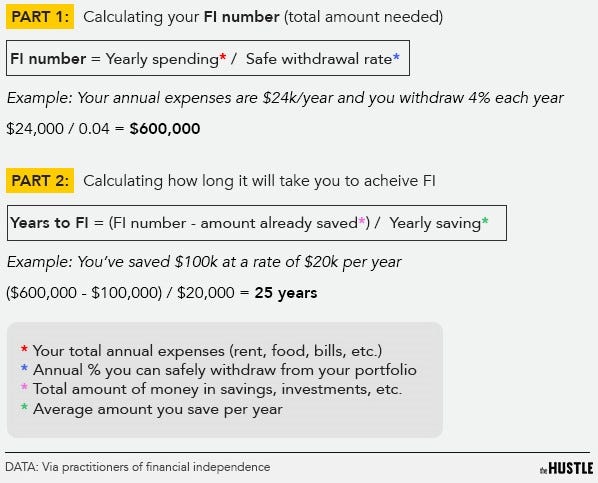
FIRE enthusiasts believe that anyone can follow the movement’s financial guidelines, but experts are divided on whether the 4% rule is safe.
In any case, what’s truly astonishing is that a growing number of people prefer to make sacrifices and live in conditions of extreme frugality just to be able to quit their 9-to-5 job by their early 30s. More and more millennials want to escape the traditional system and the traditional workplace: they find no satisfaction in their job.

Surprisingly, early retirees are mostly young tech workers who earn a lot of money. We are used to thinking that making money brings job satisfaction, but this belief is apparently based on a misunderstanding.
Money Can’t Buy You Happiness
While salary rises contribute to increase job satisfaction, they only do in the short term.
“To be happy at work, you don’t have to hold a fascinating job that represents the pinnacle of your educational achievement or the most prestigious use of your ‘potential’, and you don’t have to make a lot of money.”, says Arthur C. Brooks, social scientist and contributing writer at The Atlantic. “Job satisfaction comes from people, values, and a sense of accomplishment.”
Among the factors that affect job satisfaction, there are the values held by your company and co-workers, sense of accomplishment, recognition and work-life balance.
It’s not a matter of “what”, it’s more a matter of “why”. The results of a survey published by CareerBliss show the happiest and unhappiest jobs to be quite diverse:


How to Find Satisfaction in Your Job
Because there is no clear relationship between job satisfaction and the type of job, Brooks’s advice is to remain flexible without focusing too much on the job itself, searching instead for the values and culture that fit with our own.
Because finding a sense of accomplishment is crucial for job satisfaction, it’s important to set goals in one’s work. “While pay increases push up satisfaction temporarily, money as a career goal does not. […] For real satisfaction, you should pursue intrinsic goals — two in particular”:
- Earned Success: “Defining your future as you see fit and achieving that success on the basis of merit and hard work”. Earned success is the idea that you are good at your job and are committed to succeed. Employers who provide feedback and encourage employees to grow are those who can give you that feeling of accomplishment and earned success.
- Service to Others: “The sense that your job is making the world a better place.” You can find service in almost any job, not just in non-profit work. It’s the pleasure that comes from treating people equally, the joy of being of service to others.
A Dollar is What I Need
Sometimes having any job is enough to make people happier: unemployment is one of the biggest sources of unhappiness. “In 2014, economists found that a one-percentage-point increase in unemployment lowers national well-being by more than five times as much as a one-point increase in the inflation rate.”
Although the 4% rule has its flaws and the FIRE movement has many controversial aspects, living frugally in pursuit of early retirement is always an option. After all, we don’t need to spend lots of money to live our best life.
Money is necessary, but it’s not everything. As long as cutting back non-essential expenditure doesn’t make one feel uncomfortable, everyone can live a decent life without buying expensive things. But there is no point in living miserably for 20 or more years just to retire early.
Besides, humans have an intrinsic need to work and feel like valued members of society. Retiring early shouldn’t mean that one is free to sit around all day and do nothing — it should mean that a person has the flexibility to choose what they want to do to feel accomplished, even to choose their work.
Whether we decide to join the FIRE movement or try to find happiness at work, we should always keep our purpose in mind. Can we find a sense of purpose at work? If not, can we try to find it somewhere else? The secret to happiness, after all, is to fulfil our potential and to live as we were inherently intended to live.


