Yes, I Run Like a Girl, And?
Men have had a headstart, but women are catching up and, in some cases, overtaking
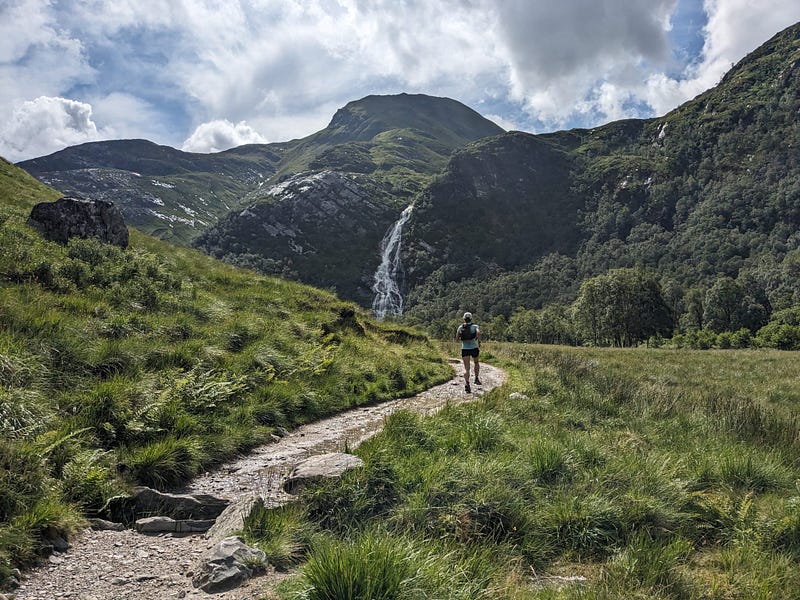
I stood bubbling with anticipation. Eyes transfixed on the race director.
The top three men walked off the stage, clutching their winnings, to a raucous applause.
An electrifying energy surged through me. A mix of pride in what I had achieved and excitement in having a small moment of glory bestowed upon me. Any moment now…
But it never happened.
They “forgot” to do the female prize-giving.
There I stood, having raced over rugged and mesmerising trails in the Scottish borders. Running through streams, up and down hills, navigating scree, bog, and tree roots, and kicking ass, but my gender rendered me invisible.
Instead of walking on stage and being celebrated en masse, the female podium winners were huddled into the corner of the marquee where our winnings were discarded onto us with barely an apology or a well-done.
Our achievements hidden from their deserving recognition.
A few years have passed since this race, but it still makes me feel dirty and humiliated.
And then… insult to injury
As if it wasn’t bad enough for a large race organisation to “forget” to do the female prize giving. The most popular running magazine in the UK did a two-page spread on the race.
Guess who they excluded? Yip you got it — women.
The first man was allocated a page, and the first male under 21 was given half a page, leaving space for an introduction and round-up. An obligatory results box was the only head tilt to my having even been there.
Why the preoccupation with those who have a dingle dangle?
I won by 10 minutes and came within the top 10 overall (meaning I was faster than 90 percent of the male racers). I don’t say this to brag; it’s irrespective, but I want to highlight that despite solid race results by myself and the other podium women, we were diminished.
Women were wiped out of this race in the prize-giving and the following media hype. Sure, I suspect it wasn’t a deliberate act of omission, but it was an omission nonetheless.
I’m not a “look at me” person. But I couldn’t help but feel icky. There was something so undermining about it all. So invalidating.
It makes me wonder what women must do to be treated with the same respect as men.
But the truth is, this isn’t on women. It’s on men.
It’s up to men to close their man-spreading legs so there’s space for us.
Access denied for women
We can’t draw comparisons between genders on an unfair playing field.
I’ve recently completed a course run by the Well HQ, an organisation that empowers women in health, work and life. And while it is recognised that we are closing the gap, we are still far from full equality in amateur and professional sports.
There was a public outcry when word got out that the National Collegiate Athletic Association (NCAA) supplied women with a rack of dumbbells while men had access to a well-supplied weights room.
We don’t give women adequate facilities to perform optimally, and then we have the gall to suggest they are inferior athletes to their male counterparts.
In her powerful essay titled Woman Can’t Do What Men Can Do, writer Katy Langston closes with a mic drop sentence.
“Sometimes, the only reason women can’t do what men can do is because we are denied access.”
And that’s exactly what our history is riddled with: large “access denied” signs.
Just look at the Boston Marathon.
This marathon has been running since 1897. It stands as the world's oldest and most prestigious annual marathon.
It wasn’t until 1967 that the Boston Marathon had its first woman racer: a staggering 70 years after the race's inception.
But when the first woman racer — Kathrine Virginia Switzer — was mid-race, the race manager tried to sabotage her run by pulling her number bib off, which would have rendered her out of the race.
What is wrong with some men?
Are they worried about the fragility of the male ego being beaten by a woman?
Conditional access — reveal skin and look “sexy ”
My hubby isn’t a football supporter but enjoys watching the Irish women’s team and has become quite a fan. When he tells people this, they give him a nod and a wry smile. Men think he watches them for sexual kicks.
The misogynistic assumptions are insidious.
My hubby watches the women’s football team for their skill, eloquence and minimal drama. I mean, have you seen the ridiculous tantrums displayed in men’s football? Anyway, I digress.
It pains me that I need to distinguish between women’s football and men’s football. I look forward to the day when football can be discussed without the automatic masculine assumption.
Some people meet my husband’s comments about women’s football with a “Oh, I prefer to watch beach volleyball.”
Boom, and there you have it. Because you just know they have no care for the sport and are solely interested in the scantily clad bodies.
Women in sports are objectified and leered at.
In 2021, the women’s Norwegian handball team were fined for refusing to wear bikini bottoms, instead replacing them with less revealing shorts.
The bikini bottoms were justified as being “for safety”. I guess no one was concerned about men’s “safety” then, since they wore baggy shorts and vests.
If you aren’t sure what I mean, check out this picture on Reddit, which shows the stark contrast between the men’s and women’s handball team kit.
Fortunately, the brave ladies changed the rule book by speaking out and taking a stand. The International Handball Federation updated its policy so women were no longer required to wear bikini bottoms.
But why are women excluded?
Pay inequality is rife in all work domains. And it’s no different in sport.
In the UK, the top men’s Premier League football players earn over three million pounds annually. Women in the equivalent tier come away with one-sixth of that amount, averaging 47 thousand pounds.
But it’s not just about money.
For too long, women have been treated like dancing monkeys — a tokenistic inclusion based on a different set of parameters than their male counterparts.
The truth is that access has been automatic for men. Whereas women have had to fight for participation in every. single. sport.
It’s fucking exhausting.
Did you know how pronatalist the history of women and sport is? According to this piece,
“Nineteenth century America idealized white woman’s modesty, frowning on sports as a threat to elite females’ fertility.”
So there we have it: women were denied access to sport as a form of reproductive control.
Why am I not surprised?
Women are climbing the ladder
The rhetoric has long been along the lines of “women can’t do what men can do.”
But actually — can men do what women can do?
We are centuries behind men when it comes to sport participation, and yet we are doing pretty damn well.
The results speak for themselves.
The English football team — affectionately known as the Lionesses — smashed the 2022 Euros to take the overall win. Something the men's team can only dream of.
In 2019, esteemed ultra runner Jasmin Paris took the overall win in The Spine, a 268-mile ultra race. She was a phenomenal 12 hours ahead of the first man. Oh, and she competed in this race while stopping several times to express milk for her young baby.
It may have taken us longer to get here due to obstacles beyond our control (ahem, the patriarchy), but here we are, smashing glass ceilings.
Show up for women in sport
Lidl and the Ladies Gaelic Football Association are working on a pioneering project to support women’s sports in Ireland. Their mission is to increase attendance at women’s matches.
With greater attendance, maybe sponsors will pay attention and see the merit in supporting women in sports.
And if we want women’s sports to be given the same airtime as men’s, we can all do our bit by attending the games or fixtures, engaging with the media covering women’s sports and having our voices heard.
Women are not small men.
Our bodies are different to men’s, but that does not make them inferior, weaker, or less able.
So yes, I throw like a girl, I run like a girl, and I catch like a girl. Because, funnily enough — I am a girl.
Sure, some race organisations and running magazines have let women down in the past, but as we rise to claim the space that is rightfully ours, they will have no choice but to invite us onto the stage and celebrate us.