Writing for Medium
Writing Fiction as It Applies to Writing Great Medium Stories
Kurt Vonnegut’s Rules for Writing Fiction apply to writing Medium stories as well

Ten days ago I wrote a Medium story featuring Kurt Vonnegut’s 16 Rules for Writing Fiction. I casually noted at that time that these rules also apply to writing blog posts, anecdotes, and Medium stories.
Now I’d like to make those rules more explicit for those of us who take writing stories for Medium seriously. I’ll comment on each of Vonnegut’s rules as they apply to writing Medium stories.
1. Use the time of a total stranger in such a way that he or she will not feel the time was wasted.
For Medium stories, this means to always fill your stories with good content — especially content that your fellow writers and readers can use. Content they can act on to fulfil their goals.
2. Give the reader at least one character he or she can root for.
Most Medium stories focus on providing information based on the writer’s life experiences. In that regard, the writer becomes the main character in the story. As the writer, you should be the character your readers root for — unless, of course, you are telling someone else’s story. If that’s the case, make sure your readers root for your subject.
3. Every character should want something, even if it is only a glass of water.
If your story doesn’t create any impetus to act, it will not get shared often. It will not get comments. It will not get claps. It will simply disappear into the ether.
Your goal in writing a great Medium story is to inspire people to act. Get them to want something bad enough that they will get up from their seats and do something to create a better world for themselves and those they love.
4. Every sentence must do one of two things — reveal character or advance the action.
Have you noticed how many readers stop in the middle of reading a Medium story? Why does that happen? One reason is simple: You have not given them a reason to keep reading. You have not advanced the action. Or you have not revealed something important enough to keep them wanting to know more.
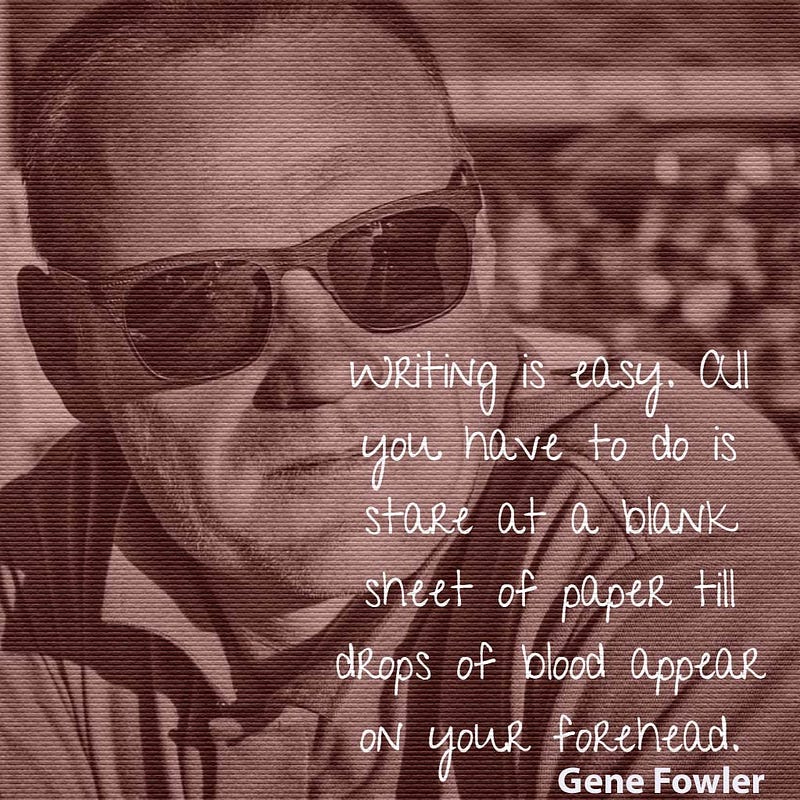
As Gene Fowler once wrote: Writing is easy. All you have to do is stare at a blank sheet of paper till drops of blood appear on your forehead.
A great Medium story reads like a novel. The action never stops. The reader keeps reading because they want to know everything the story promises to be. Make sure you live up to your promises.
5. Start as close to the end as possible.
Following this rule, I guess I should have started with Rule #14 or Rule #15. Of course, this rule isn’t all about numbered rules.
In writing a story, there is a basic rule many writing teachers try to teach their students. It is this: Shoot the sheriff in the first paragraph. Get the action going.
That’s what starting as close to the end as possible really means for a Medium story. It means getting to your main point as soon as possible.
6. Be a sadist. No matter how sweet and innocent your leading characters are, make awful things happen to them — in order that the reader may see what they are made of.
In writing any good story, you have to include both the bad and the good. Otherwise, what is there to learn? Character is revealed through our responses to the things that happen to us or the things that crush us.
In writing a Medium story, the best writers feature the pros and the cons. They offer the full story, from all sides, from all perspectives.
7. Write to please just one person. If you open a window and make love to the world, so to speak, your story will get pneumonia.
When you write a Medium story, aim to help just one person. Write the story for them. Help them to achieve their dreams, and you will automatically help many other people live their dreams as well.
8. Give your readers as much information as possible as soon as possible. To heck with suspense. Readers should have such complete understanding of what is going on, where and why, that they could finish the story themselves, should cockroaches eat the last few pages.
Your intro to any Medium story should clearly let readers know what to expect from your story. And during each step of your story, keep building up more and more knowledge for your reader.
Do that, and your readers will reward you with claps, comments, highlights, shares, and more.
9. Find a subject you care about and which you in your heart feel others should care about.
I feel like I should highlight this point. It’s really the essence of writing a great Medium story, one that will actually affect people’s lives in a real way.
Personally, I always write first and foremost to learn what I have to say. Writing, for me, is a tool for transformation. Medium stories should also be tools for transformation — for the readers!
10. Do not ramble.
Yes, as Medium writers, we get paid by how long people stay on our stories, but that is no excuse to be verbose, to pad a story with unnecessary words. Readers will stick with us if we write clearly and succinctly. Don’t waste their time fluff and fuss.
11. Keep it simple. Simplicity of language is not only reputable, but perhaps even sacred.
The best Medium stories are not works of fiction. They are not great pieces of literature. They will not — and should not — win you a Pulitzer.
Keep it simple. Write directly and clearly to the readers you want to reach.
12. Have guts to cut. Your rule might be this: If a sentence, no matter how excellent, does not illuminate your subject in some new and useful way, scratch it out.
I could write entire essays on each of these points, but I’m not. I believe you can learn all you need to learn by keeping everything short and sweet — and to the point. The best story writers on Medium do the same.
13. Sound like yourself. The writing style which is most natural for you is bound to echo the speech you heard when a child.
This rule applies not just to fiction writing, but to any writing. It especially applies to writing Medium stories. People on Medium really love reading stories from real people.
14. Say what you mean. You should avoid Picasso-style or jazz-style writing, if you have something worth saying and wish to be understood.
The best Medium writers have an invisible style — plain, simple, clear, and to the point. Just say what you mean, and you’ll be understood.
15. Pity the readers. Our stylistic options as writers are neither numerous nor glamorous, since our readers are bound to be such imperfect artists.
Vonnegut obviously had a low opinion of his readers. As a writer on Medium, I don’t have such a low opinion. I think Medium readers are among the most astute, most well-read, and most interested in almost anything readers to be found anywhere.
But still you should pity them. Keep your style clear and simple.
16. You choose. The most meaningful aspect of our styles, which is what we choose to write about, is utterly unlimited.
Style is one thing. What you choose to write about is something else. Here on Medium what you choose to write about is utterly unlimited. So choose to write about the things you love, the things you hold dearly, the things that hold you dearly.


